Showing posts with label Gender socialization. Show all posts

Thursday, March 28, 2013

Falconry and women

I don’t even know how I can possibly write this without sounding completely ignorant and sexist. Yesterday, I went on a falconry trip to witness how the hunting process takes place when you have a trained bird of prey. So we drove really faraway and reached out a deserted area in the north.

When I stepped out of that Land Cruiser I was shocked to see a woman holding this beautiful falcon and fixing its cap. The thing is, I’m quite the feminist and I do believe that women are capable of doing everything a man can and vise versa. Everything is possible. But to see a woman, in the middle of the desert (literarily), giving us lessons on falconry and looking so boss was just astonishing.

In a patriarchal society, it is really hard to find women doing things that men do to display their masculinity. Especially when it comes to a sport like falconry. In this culture, falcons are associated with strength, poise and total control and so are the men. The “Falcon Lady” (that’s what we called her because nobody had the guts to ask her again for her name) showed us the ropes and answered all our lame questions with scientific facts and personal experiences. We were very impressed by how much she knew and she wasn’t even old or anything. On the other hand, the men who came with us and tricked us (not intentionally) into thinking that they were going to do the hunting, just sat there and cuddled with their female Chihuahua dog. I guess that is what you would call hybrid masculinity. A combined toughness, decisiveness, and hardness with sensitivity, compassion, and vulnerability. Those same guys brought their younger daughters along to teach them about falconry.

I guess the reason why I was shocked is because of gender socialization. Gender socialization is the process where people learn the norms related to sex and gender. I know that women are biologically different than men, but I was socialized to believe that men are the ones who do the rough, tough kind of sports (like hunting with birds of prey) while women should pick more tender activities. Which is totally bull because she was doing something really amazing and enjoying it.

I am really glad that there are people out here who are willing to break the “rules” society made to pursue what they most enjoy.

Wednesday, March 27, 2013

Gender Socialization Conflicts in Doha


Food culture in Doha is one of the most important traditions that people uphold in Qatar. For example: if someone is visiting Doha for the first time, one of the things the citizens of Doha insist on offering the visitor is the food. Although the food recipes doesn’t necessarily originate in Doha, but people in Qatar perceive food as great social icebreakers.  
 Interestingly enough, when I observed the food culture in Doha I realized that the gender socialization notions and its applications in the Arab culture is conflicted. First, let me explain what I mean by the gender socialization. Gender socialization is the female and male genders’ learning process to the socially acceptable behaviors and attitudes to each gender’s role. 
In Doha’s culture, the culinary experience is one of the factors that gender is stratified by. Knowing how to cook in the Arab world is strongly affiliated with being a woman. Men are encouraged to know how to cook, however women are supposed and should know how to cook. They should also know how to serve the food for their fathers, husbands, and guests. From observation, I realized that this ideology conflicts with what’s taking place in the Arab restaurants of Doha. 

When I went to Bait El-sham, a Syrian restaurant,
 most of the waiters were males. I checked with the manager and he mentioned that the chef was a male too. Another Arabic restaurant that I went to is the Orient Pearl, which had very few female waitresses, much like Al Saha restaurant, Tajin, Damasca, and Morjan, which had mostly male waiters. Thus, the gender socialization that both genders were exposed to in their upbringing is conflicted with what’s applied in these Arabic restaurants. 
To further understand the conflict that’s taking place, I analyzed more Arab ideologies and gender socialization patterns that can be connected with this conflict. In Doha and the Arab world, there’s a huge distinction between the private, in the house, and public, outside of the house, sphere. The public sphere is more restrictive towards females. In Doha, part of the gender socialization that both genders are brought up with is that women can’t go out late, and can’t go out all the time, where as men are allowed to. 

 In trying to balance between the two deeply rooted beliefs that Arab men and women are brought up with, what became socially acceptable is that men should cook in these Arabic restaurants because it’s a male dominant society. Never mind the strong belief that cooking is associated with females, if the issue is one that has to do with gender, females are almost always contained in the private sphere of the home, something that we, females, are starting to break free from nowadays.


Monday, March 25, 2013

Gender Differences!


In our last sociology class we learned about how does gender affect people’s behaviors, and does genes or environment influence those behaviors. First let me start by demonstrating the difference between “gender” and “sex.” Sex is the biological characteristic of being a male and female, whereas gender it refers to the social roles that men and women play. So, the society and the environment have a great influence on how does male and female act.

When men or a women act the way they does it is not due to genes, in fact it is mostly due to the expectation of the society. When first a child is born and it’s a boy people will start treating him differently that if it was a baby-girl. Though he is just an infant yet his parents will keep saying, “you’re a man you should be strong.” They will start getting him balls, cars, painting his bedroom walls with blue and many other thing that the society have decided that those this are only for boys. If it was a girl on the other hand, they will start treating her more tenderly and getting her Barbie dolls, and pink stuff. But the question is why does the color blue and the color pink are associated with boys and girls respectively?

It is the Gender Socialization effect!
Gender socialization is the process of learning the social expectations and attitudes associated with one's sex. And because people tend to link blue with boys and pink with girls, it is unexpected for a baby-boy to wear pink cloths. Gender socialization gets people to know their roles according to their genders.
Women at the house are expected to do the housework and the men are breadwinners, thus due to gender socialization people tend to do the job that is expected from them.

Driving cars in Qatar
In Qatar Driving cars is associated with men, most Qatari families do not allow their daughters to drive because it is a men task. They’d rather have a driver than allowing their daughters to drive! However, many Qatari girls are breaking those rules that the societies setup. However, it is unusual to see a man breaking the gender rules. Men do not get involve in activities that are seen “girli activities” by the society! It is their masculinity that is affecting their actions. Masculinity is set of qualities that are considered to be characteristic of a male. This explains that it is easier for a female to gross-gender boundaries than for a male!  

Tuesday, March 20, 2012

What Makes Her Masculine.

We all grow up one of two sexes, with biological characteristics that identify us as being male or female. From the minute we are born we’re automatically part of a culture that differentiates our gender into social and cultural aspects of being one of either sexes. Gender socialization, which is the process where people learn the norms related to their sex and gender, happens to every single baby. Even as really young groups, gender socialization automatically splits girls and boys as two separate groups. According to any sociologist, all these differences that we see between men and women aren’t natural, but are all socialized or socially constructed.

As a female who grew up in a Palestinian, Arabic culture, I most definitely was socialized into a specific category, femininity. All my physical, behavioral, mental and emotional traits characterize me as a female. I wear dresses, skirts, and jewelry. I cross my legs when I sit. I cry quite often and I’m not embarrassed to say that I do. I try not to use foul language, because that is “not how a lady acts.” That is one of the things I hear my parents and family say every once in a while, that a lady isn’t supposed to use foul language, talk and laugh loudly in public and talk in a very rough manner. At least in my culture, a girl is supposed to be and act like a lady because in my religion many different lines from the Quran and sayings by the Prophet, PBUH, exemplifies a lady as a pearl or diamond, that is so delicate. For me to be that pearl or diamond, I can’t do many things in public, especially in front of men.

It’s considered deviance in my culture for a woman to smoke. Women get negatively sanctioned if they have a cigarette in their hand or if they smoke a hookah.


Smoking is considered to be a masculine habit, which automatically gives off a manly image. Many women smoke in public regardless of these cultural sanctions. This gives women power in such a culture, where women are said to be powerless. This could be considered to be a very masculine form of power based on domination and control, by simply holding a cigarette and going against all these negative sanctions. According to Sutherland, this form of power, which in a sociological perspective is called “power-over,” could be problematic because it’s abusive. So, smoking among women could influence other women to do it only to receive that kind of power as well, regardless off all the obvious health risks.

Gender Based Power In A Company

Thinking about our society and gender, gender polarization is evident in nearly every aspect of our lives! Power is also polarized by gender. From a very young age, we are socially constructed based on our sex and gender, which is also known as gender socialization.

Keeping this in mind, I decided to take a different twist to this matter and visit CENTCOM Projects to analyze the power within the employees based on their gender. CENTCOM Projects is a construction company based on steel, aluminum, joinery and interior fit outs. Therefore, majority of the staff in the labor section were men and barely had females in the office. This may be because women consider sex-appropriate positions such as the secretary and choose occupations that will not require them to relocate and work in unpleasant environments such as the factory.


From a sociological perspective, I examined the concepts of power-over, power-to and power-with while visiting the company’s office and factory in the industrial area. The notion of power-over was greatly evident as the foreman’s, manager and the director had the ability to get the workers do jobs when they didn’t want to. According to Weber, he defined power, as the ability of one actor to carry out his will against another. Clearly, this is was evident. While I was there, the foreman was achieving his goals by making one of the labor workers do his work. In this case of master/subject relation: the foreman is powered (master) and the worker is not (subject). At most times, this could possibly be a problem, as power is seen as an abusive force, unequal and the ability to force your physical strength and ideas over other employees in a workforce.


Luckily enough, I got to observe a power-to situation. One of the experienced workers came in and asked if he could either higher his position in the company or leave. From a sociological perspective, he recognized the control he has over his life, saw results of his actions and utilized his power. In other words, this could be described as self-control and self-efficacy.


In addition, the notion of power-with was not evident. However, it may be applied to labor workers if they come together as a group to challenge the system and ask for a change. In this case, if the workers struggle against the oppressive system, they would collectively work together to change it. This could happen if the workers need a rise in salary, new housing or even higher positions.


All in all, we could possibly say that the social construction of gender socialization goes back to social stratification and ethnic backgrounds.

Sunday, March 18, 2012

Where do we go now

After watching Nadine Labaki’s first film, Caramel, I was excited to watch her new film, Where Do We Go Now. In this film, Nadine plays the role of the main character, Amal. Once again Nadine successfully brings up a sensitive issue that is happening in Lebanon and in a few Arab countries, religious war. The film features a group of women trying to keep their unprivileged village and its people safe from getting killed in the war. In the sequence of events, we see the conflict between people from different religious backgrounds, and as Nadine herself says, “it shows how men can be friends in one day and become enemies the next.” Just because their religious group is having a fight in another village.


Gender role was clear in the film, as we can see how women sacrificed everything to help their husbands and kids to coexist with the other habitants under the religious pressures that everyone went under from time to time.

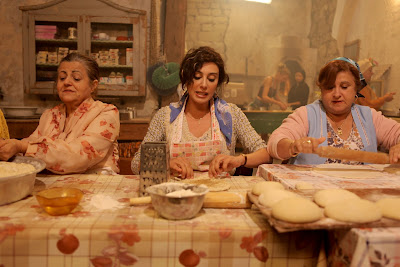
As known and as it is always the case in almost all movies, women are stereotyped to cook. We see that in one of the scenes were all women are gathered in the kitchen preparing pies. We also see that one of the women prepares gel, and her son takes it to the city to sell it, they cook to live. In all the scenes women were shown doing activities that don’t require physical labour, yet necessitate to have moral and spiritual power. We see that when “” hid the death of her youngest son from everyone around her just so she doesn’t become the subject of religious conflict among different legions citizens. Femininity in the film was clearly stated through the physical appearance of women where the only clothing they put on were skirts and dresses. Through the behavior where they keep coming up with tricks in order to keep men out of the religious war happening in other villages, by burning the newspapers and breaking the television.


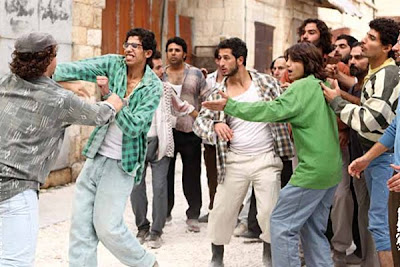
On the other hand men were associated with power in different scenes in the movie. For instance, men did all the work that required physical power such as moving the furniture, carrying sheep on their backs and carrying coffins on their shoulders. Men also have certain jobs to do, for instance, we see Rabee, painting the walls of Amal’s cafeteria. In some scenes men were chilling in the cafeteria drinking tea, smoking and playing cards, which represents men’s behavior during their past time. Men were impatient and easy to lost their temper. Moreover men show power on each other in fights. Showing physical power, having certain behavior and being emotionless sometimes represented masculinity.


Gender socialization was presented in the film in scenes that show the two teenagers, Nassim and Rokas, taking long travels on their bikes to sell products that are made by the village’s women in the city and brining grocery to their family and leaving the house in the early morning to be on time for the opening of the souk. They socialize to behave in a specific way that forces them to grow beyond their young age.


The way each character looked, behaved and expressed their feelings meant to give women femininity, and men masculinity.