Tuesday, March 6, 2012

The Witch is on her Broom: A sociological analysis of the first 5 minutes of a movie

"It's here!"


A dramatic change sweeps across the entire office as the words pop up on the computer screens of each cubicle. In a blink, the dormancy of a relaxed office atmosphere shifts to a tensed frenzy as the weightage of the words dawn on the employees of Margaret’s Book Publishing company.

Enter the boss.


Her glossy chestnut-brown hair is tied in a neat ponytail that bobs up and down as she tic-tocs (surprisingly gracefully) on killer heels. The dress is classy, albeit the tad-too-deep V-shaped neck of the blouse. Her most striking feature though is definitely the shapely supermodel like figure. Add to that alert eyes and a hard mouth and voila, you have Margaret Tate-- “the cold, chillingly mean, emotionless boss, incapable of maintaining any relationships.”

The employees, meanwhile, are hurriedly cleaning up their act.

They have all been alerted by the instantly messaged code word for when the boss is on her way to the building: “The witch is on her broom.”


Someone dumps the doughnut with a gasp and hastily picks up the telephone receiver. Someone else cries, “Shhhoot!” and scurries to the cubicle. Magazines are hurriedly put aside and suddenly water-cooler-breaks are up.

The movie being discussed is the 2009 romantic comedy, The Proposal, starring Sandra Bullock and Ryan Reynolds. With a total earning of over $317.5 million, The Proposal was the highest grossing romantic comedy of the year.


Following is the movie’s one-line description on ibmd.com: A pushy boss forces her young assistant to marry her in order to keep her Visa status in the U.S. and avoid deportation to Canada.


And this is where cinematic sociology can be used as an effective tool to explain the portrayal of empowered women in Hollywood movies.

The kind of power symbolized by Margaret (Sandra Bullock) in The Proposal may well be explained by the Weberian “power-over” definition of power. Simply put, it explains power in terms of the ability of individuals to further their will and attain their goals. This form of power “with perhaps the longest history in sociology, philosophy and psychology” was described by Weber as “the chance of a man or a number of men to realize their own will in a communal action, even against the resistance of others...” (Cinematic Sociology, Jean-Anne Sutherland, What is Power? p 115)



According to Amy Allen, author of The Power of Feminist Theory, this conceptualization takes the form of "a dyadic, master/ subject relation… a kind of masculinized power” (Cinematic Sociology, Jean-Anne Sutherland, What is Power? p 115).

The typical “pushy” boss, who embodies a certain masculine- feminity, wrongly exploits her co-worker by coercing him into marriage, just so she is spared deportation. Also, alongside being depicted as a headstrong young woman who has the world on her fingertips, Margaret Tate has also been considerably physically sexualized (remember the dress, the figure and the heels?).
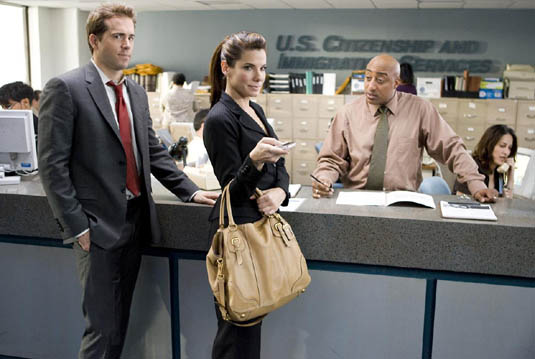


Cold, callous yet stunning: these are the defining characteristics of womanly roles that demonstrate a “power-over,“ one of the three types of the most prominent literary definition of power.

And in case of The Proposal, it takes barely the first 5 minutes to conclude the category of power that the movie is based on.

Although Margaret is “a woman with power, it looks like the masculine version of a power-over that we have grown accustomed to, perhaps the only kind of power we recognize as power” (Cinematic Sociology, Jean-Anne Sutherland, What is Power? p 120).


Consecutively, the “masculine woman” dominates, oppresses and exploits. All this to the extent that her assistant Andrew drinks "the same coffee as you do, just incase yours spilled.” (She had cast aside the comment as “pathetic,” with a role of her eyes.)


This kind of power portrayal, however, is the exact opposite of the way feminists would like it portrayed-- their goal is certainly “not to transfer domination and oppression (and masculinity) into the hands of women” (Cinematic Sociology, Jean-Anne Sutherland, What is Power? p 116).

Nonetheless, what with movies like The Devil Wears Prada, No Reservations and Lara Croft: Tomb Raider to name a few, the power-over conceptualization continues to remain a popular theme for popcorn flicks.

Bollywood


Bollywood is the largest film producer in India, producing about 800 films each year. One of the most popular aspects of Bollywood cinema is the music included in the films. Unlike Hollywood, Bollywood films use singing and dancing to show their viewers the story. Most Bollywood films tackle the issue of tradition vs. modernity. My mother and I are both huge fans of Bollywood films. My mother has one film in particular that she loves: Bride and Prejudice. She loves the film so much that she even has three copies of it at home – all from different regions so that no matter where in the world she’s living, she has access to one. I hadn’t really noticed the theme of tradition/modernity and the effect of the songs on film up until our last sociology class.


Bride and Prejudice is, as IMBd says, “Jane Austen’s Pride and Prejudice [that got] a Bollywood treatment.”  Gurinder Chadha, who directed other popular Bollywood films, such as Bend It Like Beckham, that also deal with the issue of tradition/modernity, directed the film. It is important to note a few risk-reduction strategies that can be seen with this film. Jane Austen’s novel is a popular one, therefore, remaking it with a “Bollywood” twist is making a film for a built-in audience. Also, the film was made my a prominent director who already directed a successful movie, and stars Aishwarya Rai, who is a huge star in Bollywood. The director’s name is on top of the purple DVD covers, while the actors’ names are on top of the blue ones.


My family has seen this film about a hundred times and now that I think about it, I notice that for the next few days following the screening, the songs are stuck in our heads. Not only that, but we (my little sister especially) loves to sing and dance the songs out. The more I think about it, sometimes we pop the DVD in because we feel like listening to the songs. They are extremely catchy and show you the story of the film. For example, Lalita, one of the main characters, is being pursued by her “father’s sister’s husband’s sister’s son” (Kohli). However, she is in love with Johnny Wickham at the same time that Will Darcy is falling for her. To show her struggle between juggling all three men, her sisters tease her by singing the song “No Life Without Wife.” In this song, her sisters mock her by showing her what marrying Kohli entails – the traditional life of a wife and her husband. At the end of this song, Lalita sings about her desire to marry Wickham and to be an “overseas bride dressed in white.”


This song not only shows you an important part of the story, but it also tackles the issue of tradition vs. modernity. Lalita’s mother is pushing her to marry Kohli, as he is from the family as well as the same country. With this, her mother is also pushing her into a traditional marriage. Lalita, however, is attracted to Wickham – a British man who is also poor, unlike Kohli. Wickham (and Darcy, who she ends up with at the end) both represent the idea of modernity – marrying outside of the family, which represents tradition. Her relationship with Darcy also shows this struggle, as Darcy himself, who represents modernization, comes to India to buy a resort in Goa. Lalita criticizes him for it, as she tells him that five-star comfort isn’t India. At the end of the movie, Darcy changes his ways and becomes a bit more traditional, meeting Lalita half-way. 


The love story of the modern world

As I sat in sociology class last week viewing random clips of Bollywood movies and dances, I realized that dancing and singing were extremely vital for a Bollywood film. In about every few minutes of a scene, the stars burst out into song and flash mob dances.

My focus is on a musical number preformed in the Bollywood movie ‘Love Aaj Kal’ titled “Aahun Aahun.” The title of the song has no specific meaning, however the song lyrics themselves hold more meanings to love than you could think of.

The movie’s plot is of finding your soul mate. Where the two lead characters were a couple and then decided upon a mutual separation and then to remain friends. As Meera, the female lead goes to India and Jai, her boyfriend remains in England they seem like they have both moved on.

At the same time, in parallel to Meera and Jai’s love story, Veer, a traditional love believer was narrating his story and how in the olden days they loved with respect.

The song Aahun Aahun is played in the theme of Aam Janta (meaning "common man') and Pratigya, in which Veer Singh represents Pratigya, while Jai represents Aam Janta. Each shows his different way of love, but both conclude that love has never changed. It shows that, even though, people these days try to make themselves believe that love is just an infatuation that goes away with time and that there is no such thing as "true love" or "soul mate", in their hearts they still love each other with that passion.

I guess what I’m trying to convey here is that there is a mix in culture and tradition. The old versus the new in Bollywood is what we’re studying nowadays in Sociology class.

Bollywood is being westernized and that’s what you can see in the clip.

Monday, March 5, 2012

Tradition vs. Modernity – Bollywood

About six or seven years ago, when I lived in Canada, if I spoke about Indian movies to my Canadian friends, they would automatically assume that all Indians wore traditional clothing all the time, or that the people would ride on elephants or run through fields or even live in villages. Although these are stereotypes, Bollywood classics did portray these kinds of images in their movies, that is, before the age of modernization.


Sociology has taught me a lot about the functions of societies, and has also made me more analytical of why and how societies function the way they do.

When I used to watch Indian movies before, I would appreciate the themes of tradition and family values. Although Indian movies have always been “Masala” movies – containing a variety of genres in order to appeal to a broader audience – they would address domestic problems such as arranged marriages, the role of women in their households and issues of status and caste.


At the present though, Bollywood has been pumping out movies with lots of special effects, hyperbolic plots, modernized views of Indian women, and has lost some of its traditional taste. I understand that the Indian movie industry has to keep up its pace with Hollywood and the ever-increasing rate of improvements in technology, but in terms of audiences these industries differ significantly.


While people of all ethnicities, religions, and ages watch Hollywood movies; it’s largely Indians who make up the audience of Bollywood movies. Another thing that differs vastly between Hollywood and Bollywood is the average length of movies. Hollywood’s movies are about an hour and a half, or two at the most, but Bollywood’s movies can last for three hours or more.

Why? The number of songs and dance sequences that are incorporated into Indian movies take up a large amount of time. This creates a distinction between Hollywood and Bollywood.


Modern day Indian movies still do incorporate songs and dances, but they are meant to help narrate the plot of the movie. Nowadays the plot of Indian movies seems to involve a lot of foreign back-up dancers and settings in cities like New York or London. The Indian actresses who are cast in these movies are light-skinned, super-skinny and really don’t represent the majority of Indian women. The same can be said about Indian actors – buff, light-skinned and usually portray men of the upper class.


Along with an evolution to plot, types of songs – which have now started to include lyrics in English – and physical appearance of actors, even the type of clothes that are worn in Indian movies today differ significantly than the traditional garb worn before. Before, saris – a type of traditional Indian garb for women – would be worn fairly modestly; today saris are being designed in a very “modern” way. But to maintain some dignity to the Indian culture, the elders of a household, mothers and grandmothers, are generally wearing saris in a respectable fashion. This also highlights the differences between generations.


An example of a fairly recent Indian movie that I’ve watched with a totally modernized and untraditional plot is Dostana, which means friendship. The storyline focuses on how two Indian men attempt to rent an apartment, but have to share it with an Indian woman, and in order to move in with her they have to pretend to be gay. Eventually both the men fall in love with this woman. The entire movie is shot in Miami, Florida and has the running time of 146 minutes. One of the songs in the movie is called “Desi Girl”; the word “Desi” means the dispersion of Indians in different countries, or away from their homeland. Although this song shows preference to the fact that the woman is Indian, it highlights that she is Desi. She is quite westernized in the way she dresses and thinks. This might be a subtle message encouraging Indian women to move abroad.


Is Bollywood becoming too westernized and degenerating the moral values of the Indian culture? Well, I’ve stopped watching Indian movies mainly because I see a lot of Hollywood mirrored in Bollywood. I used to watch Indian movies because of the unique plots and because of the originality of the stories.

However this is my personal opinion.

Bollywood does seem to be doing well for itself in India, with millions of viewers watching movies everyday. Then again, it could just be people wanting some air conditioning for three hours.

Don’t Wash Your Dirty Laundry In Public

Once again, Sociology has encouraged me to look at things differently. Even at movies! Since my previous reading was on family and gender, I decided to analyze my elder sister who is living by the traditional role and the Mona Lisa Smile movie that represent the notion.


The “ideal family" consists of the breadwinner husband, homemaker wife, and their children. This ideology may not represent how we are now, but it definitely has influenced economic policies, social roles, movies, expectations about family life and even our own individual choices we make today.

Sociologist Denzin once said, “Movies ‘screen’ and frame social reality, and they reflect ideological images of interaction relationship, and the community.”


I watched the movie Mona Lisa Smile with my elder sister, in addition to the sociological readings I had about the movie. Ironically enough, she related to the movie the same way the girl’s ultimate goal was to get married and fulfill the traditional role. She is now a housewife and mother, while being a pharmacists.

The movie is about a freethinking, feminist, independent liberal art professor who teaches conservative 50’s Wellesley girls to question their traditional societal roles they have been spoon-fed.


At one point of the movie, one of the staff members get mad at Giselle, one of the free-spirited students, and yells, “This is not a joke. A few years from now, your sole responsibility will be to taking care of your husband and children.” This quote becomes symbolic and becomes further evident as the theme of the movie evolves around the notion and on how the pupils see their education as a way to pass their time until they are married.

The traditional-societal norm at Wellesley provokes Katherine to encourage her students to reject the social norm by continuing their education. For instance, Joan is torn between attending law school and marriage; Katherine literally fills out her applications ford Yale, Joan’s dream school. However, Katherine gets disappointed when she finds out that Joan chose to get married and move to Philadelphia.

At one point of the movie, Betty’s mom says, “Good wife lets her husband think that everything’s his idea, even when its not.” This clearly shows the 1950’s conservative expected female role as a wife, and how the husband has the final say in everything.


One of the outstanding moments of the movie was when Betty returns to class and gets into an argument with Katherine. This part of the movie stood out the most to me, as it showed the struggle to break social norms of women in the society, while facing the elite.

Betty: Don’t disregard our traditions, just because you’re subversive.
Katherine: Don’t disrespect this class just because you’re married.
Betty: Don’t disrespect me just because your not
Katherine: Come to class. Do your work. Or ill fail you.
Betty: If you fail me, there will be consequences

“Don’t wash your dirty laundry in public,” Betty’s mom said. This emphasizes on the importance of appearance, and not what happens within the family itself. This tends to be symbolic as not all married women had a happy marriage and family, but had to put up an appearance.

Saturday, March 3, 2012

Household Chores in My Family

Two weeks ago, our housemaid had to go back to her country, the Philippines, to look after her sick mother for a while. Since then, all family members had to share the burden of the household-chores. However, the work was not divided equally among all members in the family.

Everyone had to wash their own dish after every meal, and do their beds every morning, even my 11 years old brother. My dad likes to cook sometimes. so, whenever he feels like cooking, he would go and make something for lunch. However, my mom is usually the one responsible of cooking.

Since I am the big sister and my mom is working and doing her masters, most of the household work is assigned to me. Even though, my 16 years old sister is responsible enough to do the same work I do, I still have to do more than she does. This is because, as my mom claims, because I’m the eldest sister, and so I must hold most of the responsibilities among my siblings. My sister cleans two rooms and one bathroom, whereas I clean four rooms, three bathrooms and the Kitchen. When it comes to laundry and ironing, my sister and I take turns. My little brother is only responsible of washing his dishes, doing his bed, and taking the trash out.


It is interesting to see how gender roles and power play out in the family. Women do more house-hold work, and the parents try to give as much work to their children as they can because they hold more power in the family.

It also seems that my little brother have socialized to think that males are not supposed to do house-hold work, whether it is from watching my dad, watching TV show and movie, or from his friends. One day he was complaining to my mom saying that he doesn’t want to clean his plate because boys are not supposed to do this work, women are supposed to do that. however, my mom hold more power in the family than he does, so she forced him to clean his plate after all.

Thursday, March 1, 2012

The Big Commune Family

The 1950’s were defined as the era of the nuclear family. Picturesque images of “Leave it to Beaver” and “Father Knows Best” became engrained into the American psyche. But family is not just defined through blood ties, extended lineages, and marriage; our socially constructed families are also culturally significant.


We have our university family, our friends who are like family and other such groupings of family. The deadheads, loyal fans/followers to the band, the Grateful Dead would be an example of a family united by a deep love for a specific type of music.


Communes are also, more or less, socially constructed families. Communes, NOT to be confused with communism, are defined as ideologically similar groups of people who craft a community based on their communal beliefs, typically outside the confines of traditional society. Often times, the ideas of utopianism, and the creation of a perfect society, come into play.

Early 19th century America saw quite an upswing in the number of these communes, which grew to be utopian societies. The Shakers, a religious and spiritual commune, gained traction shortly after the Revolutionary War. Because the shakers did not practice procreation, their membership was solely reliant on adoption and conversion to the Shaker ideology.


In the 1840’s, an entirely different community, parallel in practice to the Shakers, formed in Oneida, New York. Founded by John Humphrey Noyes, this group practiced what was known as a “complex marriage” where group members were encouraged to have multiple partners; Noyes essentially wanted one big family where monogamous commitments are unnecessary. Although the society disintegrated, their source of income, which was the production of silverware, lived far longer than the original society. Today, Oneida is a reputable brand of silverware in the U.S.


It is fascinating to think that the same generation brought up with the mindset of the nuclear family and traditional values created such a contrasting counterculture, years later in the 1960’s, 1970’s and 1980’s.

One of the most fascinating communes/utopian societies is the Rajneeshees, who followed Indian guru Bhagwan Shree Rajneesh, and established a society of over 2000 followers in Eastern Oregon. From habits of dress to the collective work ethic, and its eventual downfall due to corruption and feuds with locals, the society was and still is an enigma.


Communes haven’t died. Considering the current global economic climate, it is no wonder that the Fellowship for Intentional Community has an extensive list of communes currently forming. The website says that “these communal groups below range from small to large, urban to rural, and Christian monastery to secular anarchist collective.” The idea of living collectively with other individuals and forming a constructed family is part of the human need to belong. It is also a form of escape from the pressures of external society.