Showing posts with label Palestine. Show all posts

Monday, November 12, 2012

From Art to Politics!


Politics or art? This art work was sprayed by Banksy on the apartheid wall in Palestine. Banksy is a street artist. Street artists use different mediums to show their art in the streets. Banksy’s real identity is anonymous. Yesterday, I watched “Exit Through the Gift Shop,” which is a documentary about street art and Banksy. What does the whole movement of street art mean? And why is significant?


The narrator stated, “Street art was poised to become the biggest counter cultural movement since punk.” While the film is supposed to be about Banksy, it ended up being about the person who was planning to make the film. He calls himself Space Invader. He started by taking videos of the street artists. Later, he becomes part of the street art subculture. A subculture is a group of people who share a style, language, type of music, activities and beliefs. He becomes involved in their activities and later performs street art himself. But, what do Space Invader and the street artists have in common?

Space Invader makes his living through selling used clothes. He would buy them cheap and see people paying lots of money to buy a piece from him because it would have a designer name. The street artists are opposed to consumerism and the hegemonic ideology of the people, which prevent them from seeing the things going on around them. The concept of hegemony refers to the way people perceive some things as common sense. Hegemonic ideas are ideas that most of the people believe and see as being the common sense ways to think or behave. The hegemonic ideology of most of people is to consume products and to understand the world in the way it is shown through media. As a shopkeeper, Space Invader has understood how consumerism is stupid. People were paying a lot of money just because of the brand’s name. Street artists and Space Invader share the same belief about consumerism.

Through street art they perform a type of cultural resistance. Stephen Duncombe perceives cultural resistance as “culture that is used, consciously or unconsciously, effectively or not, to resist and/or change the dominant political, economic and/or social structure.” The definition can be seen visually through street art.


(Screenshot from the film)

The sculpture above was made by Banksy. It is a resistance against the social hegemonic idea of respecting a national symbol that does not mean anything. Banksy uses the street art culture to change the way people perceive symbols. Whether Banksy was conscious about the message he is sending or not, and whether his art would be affective or not, doesn’t matter. Either ways, it is considered cultural resistance.

There are four means of cultural resistance, content, form, interpretation and activity. The content of the message is to attract people’s attention to what they are not seeing or noticing about the worlds around them. For example, by drawing on the apartheid wall in Palestine, Banksy attracted the world’s attention to the wall. The form is concerned with the medium of the message. Street art was always in streets and many people did not understand its purpose. The form is a typical street wall, but it took a step forward by appearing in the film. The different mean allowed the street message to be clearer. The interpretation part is related to the society and how they interpret the art. Before I watched the documentary, I interpreted street art as something beautiful, which is ruining public property. Activity is not only the performance of street art, but also the meaning behind it. When they are drawing on public property they are attracting attention to what people are not seeing. An example of this is the street art on street ads. It reflects the street artists’ belief about being opposed to consumerism.


(Screenshot from the film)

Banksy had an art exhibition in Los Angeles. He brought an elephant that was colored with the same colors of the wallpaper. In the documentary the narrator says that the purpose of the camouflage elephant was to show “how easy it is to ignore the things right in front of us.” Then he continues talking about how the people in media saw “what’s right in front of them.” The reporter in the next shot was talking about animals’ rights.
In the Youth Culture in The Middle East class, we discussed how today’s culture could be tomorrow’s commercial object. This is what is happening with the street art culture. The street art found its way to art auctions, where people were doing what the art itself was opposed to; consuming art in the form of a “commodity.” Spending lots of money just because this artist made this piece of art. Banksy himself comments on this issue saying, “It is not about the money.”

I’m a fan of art that appreciates beauty. I understand and relate to Banksy and the street artist’s resistance. I was an art student, and I didn’t like the way people try to tell others how to see art. It is like a project under construction to spread a hegemonic idea of what art should be. It aim is to teach people to ignore the beautiful art in front of them because it doesn’t follow certain rules. It also encourages consumerism and seeing art as a commodity and doing it to please people. Street artists do art because they like it and they have a message behind it. This is why they never reveal their real identities. For them it’s about the art and the message, and not the fame or the money.

Sunday, September 16, 2012

Keffiyeh

This week, there was a discussion about the "abaya-as-fashion" movement in the Gulf and whether deviating from the norm of how the garment is worn could be considered a form of passive resistance to cultural mores. Our discussion got me thinking about another cultural item of clothing that experienced a similar development from national symbol to fashion trend:


The keffiyeh started out as a headdress worn by men in the Gulf region, Palestine, Syria and Jordan, before becoming a symbol of Palestinian nationalism in the 1960s with the start of the resistance movement within the country. It is an extremely vital aspect of material culture in an environment where two ideologies are constantly at battle with one another. 

In recent years, the message behind the scarf has been worn away through the process of globalization, a dissemination that has rendered the keffiyeh as a major trend in the West. Highbrow brands like Urban Outfitters have added it to (and removed it from) their collections. Although the craze has died down a bit, it is not uncommon now to see images like this:


In class, three questions were posed that were very relevant to this topic, the first being: is a single homogenous culture good? There probably wouldn’t be an Israeli-Palestinian conflict if the newer generations of youth all shared the same material and non-material culture. Would this turn the keffiyeh’s role in consumer culture into an act of union?

The second question was: does globalization increase ethnic and racial inequalities? In this case, the dissemination of the keffiyeh only serves to highlight the Palestinian struggle to retain their culture. It almost seems that because Palestine is no longer considered a geographical state, that their symbol of nationalism is no longer relevant as anything more than a capitalist fashion statement for hipsters.

The third question was: what happens when you try to resist globalization? In terms of identity, the Palestinian people are quite busy resisting many other things, but it seems that other people have been handling the keffiyeh situation for them. Some are casting the trend aside because of its exploitation of Palestinian culture, while others are calling it “hate-couture” and resisting it for its connotations of “terrorism” and “violence” – a rather ethnocentric interpretation of the scarf.

Much like the abaya in the “Immodest Modesty” reading, the keffiyeh has changed and continues to do so. But unlike the abaya, which started out as a traditional garment and became a form of passive resistance through fashion (or so it seems), the keffiyeh developed from a symbol of resistance into a fashionable way to be passive.


Monday, October 17, 2011

McDonaldization in Your Homes!

As soon as you walk into someone’s house you could automatically get a sense of the culture. Some houses even have a particular smell that could identify where the residents are from. Walking into my friend’s house I mindlessly recognized the scent I smell in all Sudanese houses I enter. This is actually the scent of some products they use in the house that are shipped in to Qatar from Sudan. The next thing I notice is the color and brightness of the house. It’s usually white and more blunt than my house for example, which gives their space a more temporary feel. A lot of the Sudanese houses I’ve been to use white lights, in contrast to mine, where we have warmer lighting.


You get a sense that the Sudanese residents don’t really consider this house in Qatar their home. Whereas for Palestinians, who constantly struggle to live in a subculture, try to make these houses their homes. When I say subculture, I mean a smaller culture within another culture that Palestinian usually live in. Palestinians use warmer colors, a lot of carpets and really design their houses in a way to make it feel like a home to them. In my home, and a lot of Palestinian homes I’ve visited, we try to add a lot of Palestinian elements to the house as a reminder of that place we “belong to,” even if we didn’t buy these objects from Palestine.


Sudanese usually have a lot of African and tribal objects around their “temporary” house that are bought back from home, to remind them of that place that they will eventually go back to, their real home.


However, the households did have some things in common. To begin with, there was a feel of alienation, which could be defined as a state-of-being where human life is dominated by the forces of its own inventions. The houses were machine-dominated. The families weren’t connecting in conversation, but most of the family members were watching TV. While the teenagers or working children were on their laptops, connected to the Internet. Some of the younger children were playing video games.


When the mother or housemaid cooked or even made tea, they would use a kettle, microwave, gas-run oven and so on. Everyone in the house was using a machine. Some of the siblings even communicated through the use of their cell phones, instead of verbal communication. So, even if the culture is different or the dialect they use is different, whether you’re Sudanese or Palestinian you are influenced by this idea of “McDonaldization.” In sociology, McDonaldization is a process where society is increasingly run like a fast-food restaurant. This means that we’re all being influenced by the idea of rationalization and even households could be modernized some way or another. This definitely can’t sound very literal, where a household could never really be a McDonald’s. However, all homes try to be as efficient, predictable and controlled as possible. They have a set of rules to be followed, try to be as efficient as possible with time, money etc. and predictable with honesty and the open relationship everyone has with one another. With time, the children in the house and the parents start demanding more. Here, control and calculation come in, where they need to monitor the amount of things they buy and consume.

Tuesday, September 20, 2011

Will They Ever Belong?

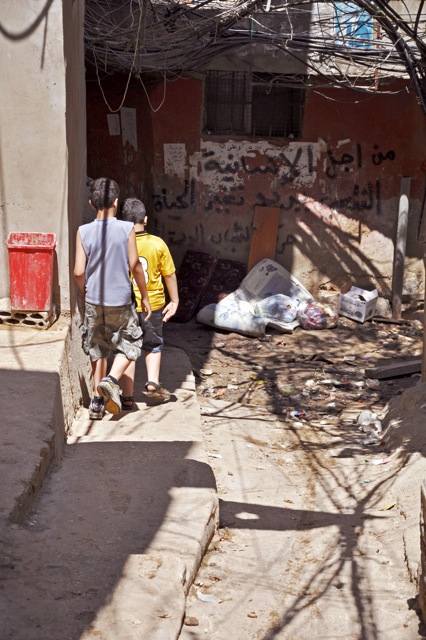
At seven years old Abu Afif was told he was going on a little vacation and that he would return to Palestine after 10 days, while things settled between Israel and Palestine. Almost sixty years later, Abu Afif, like millions of other Palestinians, still hasn’t returned and lives in Burj Barajneh, one of several Palestinian refugee camps in Lebanon. Three of the main countries the Palestinian Diaspora spread to were Syria, Jordan and Lebanon. In Lebanon, there are 12 refugee camps that house thousands of Palestinians each, building their own societies within a larger Lebanese society.


Burj Barajneh was the camp I stayed in for two weeks this summer. We drove
into the only road in the camp. As I got out, walked to my temporary “home,” I had to zigzag my way through numerous alleys that flowed with sewage and waste. Trying to look up to the sky, there was nothing to see. All I saw were countless electric wires.


Like Mexicans in the US, Palestinians in Lebanon suffer from minimum wage. Palestinians cannot usually find jobs outside the refugee camps. However, if they do, it’s probably a low-wage job like a painter, carpenter and so on. Many refugees graduate from medicine, engineering and other majors. But later, they unfortunately find it very difficult to work in their field. If they can’t find a way out of the country to somewhere where they could actually do their job, they end up opening a small business in the camp itself for very low incomes, or they divert into another direction in life.


Due to their economic, social and political background, Palestinians have created a new culture that will allow them to adjust their way of life to this subculture that they have created. The term subculture in sociology basically means a smaller group contained within a larger culture, so a world within a world. Palestinians have established and try to maintain their identity and culture within a complete different culture, the Lebanese culture.


Palestinians in Lebanon also suffer from an identity crisis. Like many other Palestinians around the world, they don’t really have a culture and try to adapt to what they hear about the Palestinian culture. The only home they really had was taken away and the “home” they currently live in can’t really be considered a home because it could be taken away from them at any time.