Wednesday, September 21, 2011

The link between food and culture

Every country has its traditional food. Like any other country, Qatar has certain types of food that represent the culture of the country. However, some of these types of food originated from other countries and then brought up in Doha. There are a several main dishes shared in Doha and amongst the Gulf countries as well which shows the cultural levelling amongst these countries. The main dish that is cooked in Doha is The Thibeeha, which is known to be a symbol for celebrations or occasions. This dish is composed of rice and herbs with meat. The Thibeeha is a very important aspect of our culture and beliefs, since it is to show respect for the guests. Welcoming a guest in the Qatari society is very important.

As a tradition, Arabic coffee must be served with dates. Dates are also part of the Muslim culture, and the production season of dates usually increases during Ramadan, which is the holy month in Islam. This is due to the reason that when its time to break our fast, we have to have at least one date before starting to eat.

There’s a cultural diffusion in Qatar when it comes to food. Food companies have been brought from all over the world to Doha, providing all types of food available. There is a wider selection where one can choose from. For example: Chinese, Lebanese, Moroccan, Indian, American, French and many other types of food. These range of different types of food allows Qatar to have selections and options for tourists to choose when they visit Qatar for the first time.

There are a few norms


when it comes to eating in Qatar. For example in gatherings, the youngsters should always allow the elders to sit first on the dining table and serve them anything they would request. This shows respect for the eldest. There are certain types of food in Doha that are preferably eaten using the hands. Fish and crabs for example are eaten using the hands. However, not everyone follows this rule but this is how most Qatari citizens eat fish and crabs.

Arabian Horses - A Symbol


Growing up in high school I’ve always pictured culture as the unique traditional dresses and meals every country has. It was an idea that we constructed through the ceremonies we use to do in school such as “International Day”, where each class chooses a country to represent, and dress up in their customs in the next morning. From that sense, culture as a subject of study did not interest me, because at the end of the day, you will always prefer your own culture to others. Yet, from what we learn so far in our sociology class, culture is not just about the beautiful ceremonies and traditions, its about how each society construct a way of life that they then make sense of. If I had to explain it to my little sister, I’ll tell her that culture is the glasses we wear, to see the world around us. I decided to look at my own environment first and analyze my own senses.


There are many objects and animals that as a young Qatari I refer to. Some of these may have a pan-social references, such as the Qatari flag, or the Arabic language, while others are more related to my family and friends. For example, one symbol of pride is the Arabian horse. It is a symbol that is popular in the Islamic and Arabian history, and for many people today still has a great value. Even though for the majority of horse breeders, keeping those animals is a bad business financially, it is still a hobby that I personally attach to, and so do many in the Qatari society. Even at the national level, the government invest hugly in equestrian sports. Al Shaqab for example is an equestrian club located in Education City. It bought and bred in the previous years top Arabian horses such as Udaid Al Shaqab (picture above), and has its own Academy the is open to public to help promote the sport.


Looking closely at the equestrian sport globally, there are many values and norms that surround it. One would be that it is a sport of the elite in society, such as royals and successful businessmen. Due to that, there are expectations to the way you dress and behave. This is especially true in Europe where I noticed emphasize on royalty sense in horse races in England and France. However, the social class attributes to the sport are less noticeable in Qatar, especially in terms of dresses people ware. This can be explained when you look at the dress code of the society. Traditional Qatari Thoub and Qutra are wore by royals and citizens alike, flattening any social hierarchy there is, at least in physical appearance.

Abaya - A Fashion Statement


Butterfly, fold, and jumpsuit are three of the many names given to the designs of the modern Abaya. Originally, it was a cultural garment worn by women in the Middle East to cover up the shape of their body. In fact, women in the past did not have to wear it since most of them covered themselves up modestly. Today, in the Gulf countries in particular, the designs are constantly in change, depending on the trending world of fashion. Rather than having a loose black cloth, it now comes in various shapes and with multiple embroidery designs.


Since the clothing under will not show, girls tend to portray their fashion sense by the Abaya they are wearing. Not only is it a type of material culture that women use to cover up, but it also shapes the social relationships. I remember having a Syrian lady visiting us in Doha. She was shocked by how the Qatari girls wore the Abaya. It was a culture shock to her, as she was used to the plain loose black cloth, and not the multiple designs. However, since the material component is shaped in some way by the non-material culture, she has adapted to this trend as everyone else was following it, and is seen as a sign of modernization.

New designs are out everyday, ranging from very loose to very fit. Those designs come from other countries and act as a cultural diffusion. The neighboring countries influence us. Therefore, when there is an Abaya exhibition such as Heya or a fashion show, young designers from all over the Gulf countries would display their unique designs, and the Qatari girls would buy them. Here are a few abayas I bought from the Saudi section


The young girls here are attracted by each other’s unique Abaya designs. I was ordering popcorn before entering the movie at Villaggio, and I saw this girl wearing an Abaya that attracted my attention. So I went up to her and asked her where she got it tailored. She replied by saying that she had it made in one of the Abaya exhibitions held at Doha Exhibition Centre. I kindly asked her if I could take a picture of the Abaya in order to make the same. Here is how it looked like.

Not only is the influence regional, but is also Western in some way. For example, in one of the exhibitions, I saw a design that had studs on the shoulders, along with others that were “funky”. I kept thinking inside my head that I saw those designs on a dress a star was wearing, and now it is implemented on the Abaya. Lady Gaga acts as a major influence to all those girls that want their Abaya to be extra original. Also, recently young girls have their Abayas tailored in a way that it would look like a jumpsuit from the bottom, which is also influenced by the West. I have also seen girls that deliberately shortened their Abaya, and when I first saw it and asked them why, they would say that they wanted to show their heels off. I completely understand that it is a cultural norm, and those designs just keep getting updated by the day.

Tuesday, September 20, 2011

Will They Ever Belong?

At seven years old Abu Afif was told he was going on a little vacation and that he would return to Palestine after 10 days, while things settled between Israel and Palestine. Almost sixty years later, Abu Afif, like millions of other Palestinians, still hasn’t returned and lives in Burj Barajneh, one of several Palestinian refugee camps in Lebanon. Three of the main countries the Palestinian Diaspora spread to were Syria, Jordan and Lebanon. In Lebanon, there are 12 refugee camps that house thousands of Palestinians each, building their own societies within a larger Lebanese society.


Burj Barajneh was the camp I stayed in for two weeks this summer. We drove
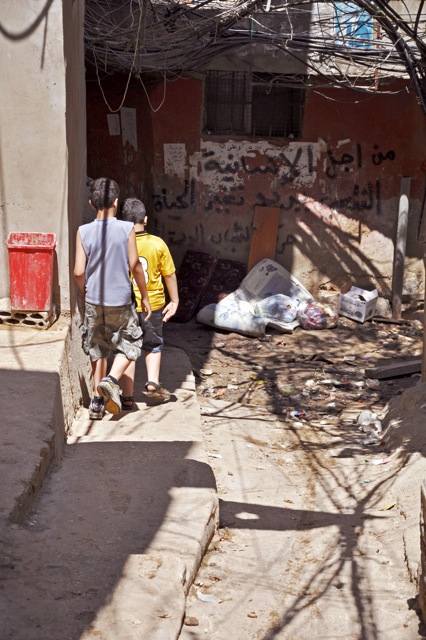
into the only road in the camp. As I got out, walked to my temporary “home,” I had to zigzag my way through numerous alleys that flowed with sewage and waste. Trying to look up to the sky, there was nothing to see. All I saw were countless electric wires.


Like Mexicans in the US, Palestinians in Lebanon suffer from minimum wage. Palestinians cannot usually find jobs outside the refugee camps. However, if they do, it’s probably a low-wage job like a painter, carpenter and so on. Many refugees graduate from medicine, engineering and other majors. But later, they unfortunately find it very difficult to work in their field. If they can’t find a way out of the country to somewhere where they could actually do their job, they end up opening a small business in the camp itself for very low incomes, or they divert into another direction in life.


Due to their economic, social and political background, Palestinians have created a new culture that will allow them to adjust their way of life to this subculture that they have created. The term subculture in sociology basically means a smaller group contained within a larger culture, so a world within a world. Palestinians have established and try to maintain their identity and culture within a complete different culture, the Lebanese culture.


Palestinians in Lebanon also suffer from an identity crisis. Like many other Palestinians around the world, they don’t really have a culture and try to adapt to what they hear about the Palestinian culture. The only home they really had was taken away and the “home” they currently live in can’t really be considered a home because it could be taken away from them at any time.

Culture shock?

If someone would ask you, what makes you different from Person A or Person B, you would probably be able to come up with a list from the top of your head, without even having to think, like nationality, language, religion or even food habits or education.

In other words, the way you have been brought up is what differentiates you from the others. A sociologist defines this as culture. The way of life of people or more specifically, the human created strategies for adjusting to the environment.

For some of us, seeing different culture is the best part about traveling, where as for few other, they have a culture shock coming from place X to Y. Culture shock is the strain that people experience while traveling from one region to the other, and must reorient themselves to the ways of the new culture. And this was exactly what happened in the movie Outsourced, where an American products salesman (Todd) heads to India to because of his replacement, after his entire department is outsourced. Being unaware of the beliefs and values of India, he found himself in a very inconvenient situation. For example, in India, Cows are considered sacred and play an important role in the Hindu religion. Whereas when Todd goes to India, being ignorant, he talks about cows as a food product without realizing how sensitive a topic it was and he goes on doing the same sort of mistake, until he finally finds someone who could teach him about the Indian culture.

People’s behavior and values change from culture to culture, and that is rooted to the shortage and abundance of resources in different regions. For example, the video shows how common begging is in India. However, in Qatar it is hardly seen in public. The economic structure of the country breaks the conservation-oriented behaviors of its people.


According to Sociology, some of the most important types of non-material cultures are beliefs, values, norms, symbols and language. And some of these aspects were clearly noticeable in Culture Shock, an Al Jazeera documentary, on how African migrants find ways to deal with the European culture. These African migrants face instances of racist violence in Germany, where because of their skin color, people assign symbols. People assign offensive names.

Despite being immigrants, some of their habits perfectly match local customs, which is a case of cultural universals, which refers to things found in every culture. But sometimes people hold on to the viewpoint of ethnocentrism, because of which these African migrants are not being accepted by the social norms.

Click here to check out the documentary on Al Jazeera

Culture Shock: What is it like to live in Europe with an African identity?

Monday, September 19, 2011

Getting Sociological on the VMAs


There are so many theories in every subject and sociology is not an exception. There are three big sociological theories: the functionalist theory, the conflict theory and the symbolic interactionism theory. One of the three big sociological theories is the Functionalist Theory, which can be applied to almost anything. The functionalist theory is basically looking at society as if it is a car and knowing that each part in the car has a particular function, and that if there was a part missing then the whole car, society, will fall apart. The functionalist theory believes that people actively work making stability and order happen.

The Functionalist Theory can be applied to almost any event. Recently there were the Video Music Awards that aired this summer. If we look closely the Video Music awards you can apply many different functions of the functionalist theory.


This year the event was held in Los Angeles but there was no host for the VMAs, as they were unable to find anyone that matched the requirements. Different celebrities presented the awards and there were several performances done by different people. Every year the VMAs try to go over the top and give a completely unexpected performances but there is a certain degree as to which you can out do something, so this year the VMAs were much simpler than the extravagant events they used to be. Even Lady Gaga didn’t change into a million costumes throughout the event , instead she dressed as a man, which is still not the most normal thing to do but people always expect something different from her and she always delivers.


The manifest functions could be that the VMAs brings people/family together whether they are watching it on Television or Live in Los Angeles. Everyone is interested in what the celebrities are going to wear and who's going to be there. The marketing and Public Relations sectors benefit from this event. Companies can place advertisements throughout the show, every time it was time for Jessie J to perform during the break several advertisements for fast-food restaurants or products played., particularly Taco-Bell.

Latent functions that are associated with the VMAs is the focus on public transportation as people would more likely use the bus or train to avoid traffic jams. The VMAs could bring complete strangers together if they have similar tastes in music or videos.


Anticipated disruptions of the VMAs are the same as the disruptions that happen with any large celebration, traffic, littering and shortage of clean toilets because of the large amount of people.

Everything can be looked at in a sociological way even the most unexpected cases.

Sunday, September 18, 2011

A Sociological Perspective on Infrastructure Works in Doha


Sociology’s big question focuses on how existing larger social forces around us impact human activity and shape virtually every aspect of our lives. They affect the simplest mundane behavior and actions such as the way we address our mentors, the way we walk, talk, move, act and interact in public and with the public. In other words, sociology allows us to see and understand the world and the way it works in a whole new perspective. As sociologist Peter L. Berger explains: “the first wisdom of sociology is this – things are not what they seem.”


From using credit cards to the way we dress, to construction here in Doha, the influences of social factors become easier to interpret, detect, and understand, when we adopt a quality of mind that allows us to do so, called the social imagination.


First, when visiting a construction site, the most obvious social force to consider is the everlasting effect of the Industrial Revolution which according to the book by Joan Ferrante, is partly the reason for the emergence of sociology. Apart from the changes in transportation, tunneling and manufacturing which are all applicable to the construction industry in Qatar, Berger highlights the process of mechanization as the central feature of the Industrial Revolution. The process of mechanization is significant in infrastructure work sites. Skilled workers have shifted into the roles of machine operators and automated labor force, where the pile-driving machines do the excavations, and the cranes do the heavy lifting and moving of heavy materials such as pipelines.


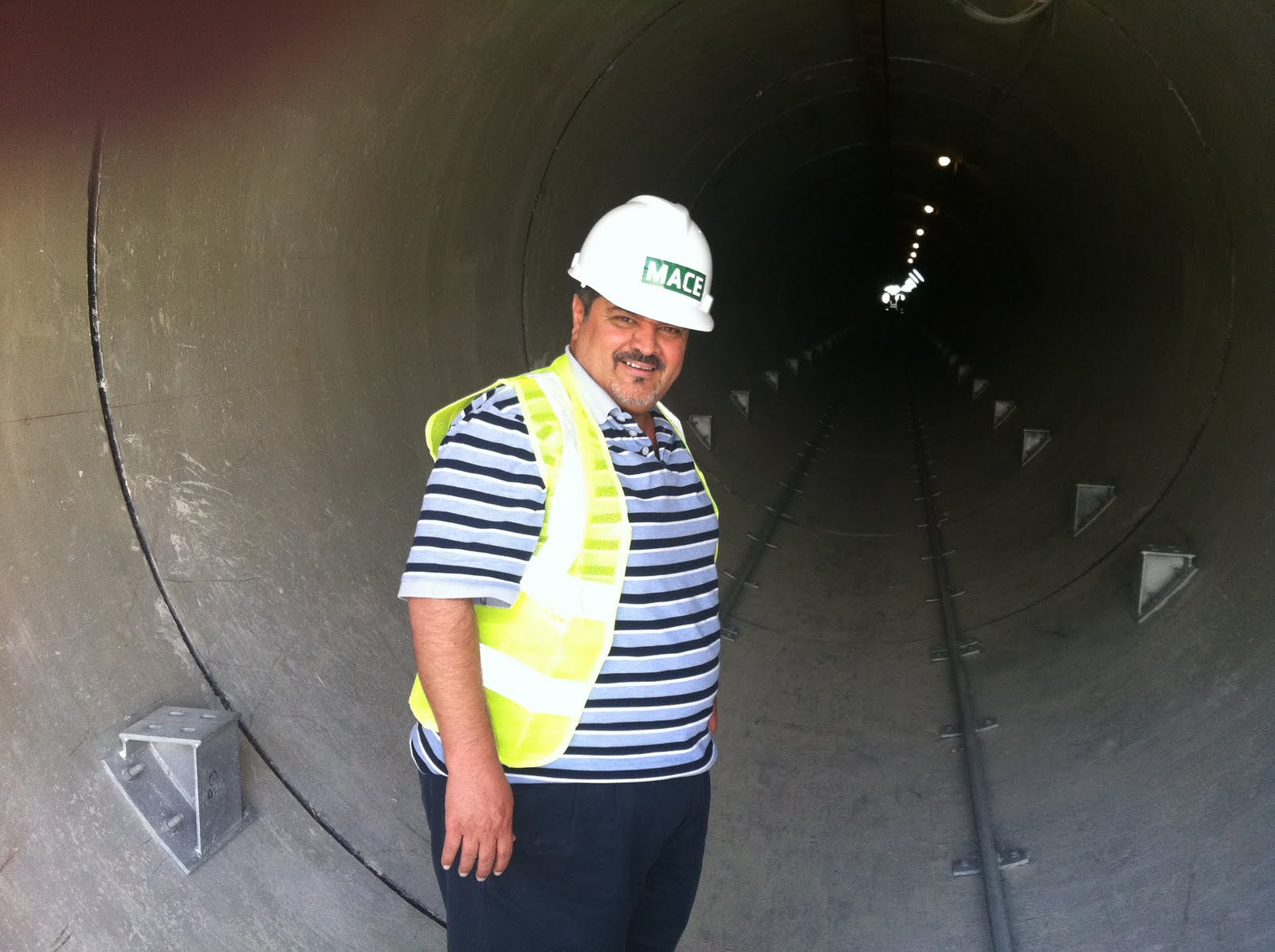
The workers perform non-skill demanding tasks such as fixing pipe supports in place in the concrete tunnel, preparing to place the pipes on the side anchors inside the tunnel and placing the belt around the pipes for crane lifting.


Use of railroads is also applicable in infrastructure. The video below shows a battery-operated engine as it drives the tires that move the pipes along a railway into the tunnel. In addition to the rails on the bottom that are built for the pipes, there are rails on the top to transport workers into the tunnel as well.


At times where leveling and balancing the pipes in place required skill and timing-perfection of the laborers, the total station surveying instrument is a technology that enables the surveyor to accurately place the pipes to accurate level and alignment.


However, a process such as GRP pipe lamination still requires skill combined with the use of technology and machinery. Apart from technology, globalization is another force that influenced infrastructure in Doha by allowing western innovations such as GRP pipe lamination and other tactics and procedures to be integrated here in this region. By doing so, older methods are eradicated and newer ones are introduced. Adopted methods from other places around the world can also altered and improved to create more appropriate solutions.


Symbolic meaning is another social force that can be noted while observing a construction site. Symbols such as the workmen’s protection equipment, helmets, gloves, and protective clothing and the company’s logo have a shared assigned meaning or value. A particular dress code could signify a person’s station or job rank. The company’s name or logo on the workers’ vests can mean the company itself, the field of construction, site work, infrastructure or a even a shared feeling of affinity and belonging to a certain group, where all members of the company or workers feel a sense of solidarity.


The social status or ranks in a construction organization is the social force that determines how different employees interact with each other. The general hierarchy of positions in a construction company usually includes: the managing director, site engineers, superintendants, general foremen, foremen, crew leaders and workers. The social status of say, a foreman, and the associated roles and attributes of this role influences the way in which the workers respond to the foreman’s orders by obeying him, as well as the way they address him and speak to him. The foreman for example is most likely to be assertive and authoritative and the workers are likely to comply. Each status affects the way these people interact with each other. This sharing of meaning and interpretation of symbols relates to the sociological theory called the Symbolic Interactionist Theory, which in this case would be used to examine the role of symbols in shaping social interaction among individuals including their daily communication and response to each other.


Ultimately, industrialization changed more than just the way things operate. It changed how people lived their own lives and the lives of everyone around them. According to Ferrante, developments such as the railroads, electricity, and the steamship changed our perception of time and space. The time needed to complete a project such as the ones shown in the pictures, or for building a skyscraper, and the way engineers and project managers negotiate this time has changed dramatically and will continue to change. In turn these changes affect the entire execution of a project and its completion date. Moreover, the changes in the process of shipping of equipment and materials, introduction of new machinery and technology and moving them across sites contribute to the emergence of a fast-paced, mechanized, bottom-line thinking, consumption-oriented economy and wealth-pursuing culture.