Showing posts with label material culture. Show all posts
Monday, October 22, 2012
Souq Waqif - The Kebabization Experience
As a CDA for the dorms on campus I am required to program events each month that engage the residents with the local culture. Last weekend I took the residents on my floor to Souq Waqif for a program titled “Kebabization”. Initially, I intended this program title to be a pun on the various terms in academia that are created with the “ization” standard. However, visiting Souq Waqif was a different experience this time around because I actually had those terms (that I used to come up with “kebabization”) at the back of my head. This allowed me to look at this experience from a relatively new lens.
Souq Waqif, with its fascinating streets filled with budging tourists and locals was as lively as ever. The bus dropped us off in front of a falcon shop. The falcons in the shop were pretty expensive but the falcon shop and other similar “performances” of the local culture reminded me of Cole’s notion of performance in “Bedouiness”. I regard this as a performance, as this is similar to the attempts for the “revival of tradition” in Petra and part of the quest for “authentic” presentation of the local culture. These performances are visible all over Souq Waqif in forms of the many Arab restaurants whose hosts are dressed up in elegant traditional dresses, allowing the visitor to “buy hospitality” as suggested by Cole in the same article.
I have always noticed a particular group of elderly men with carts around Souq Waqif. This time around I found out that they are called the “Hamali”. In sociological terms I would regard this group as a subculture. This is because this group shares unique instruments (their carts), uniforms and space. This aspect helps them stand out in the crowd at Souq Waqif. I have not seen them anywhere else in Doha so far.
Walking around Souq Waqif and noticing global brands like Baskin & Robins present along with the Shujja Iranian Kebab place that we visited hints towards glocalization to an extent. Souq Waqif, as previously mentioned is an attempt to revive Qatari tradition. Cole also describes this as the change from “the Bedouin into wealthy entrepreneurs of international tourism”. This is a confluence of various sociological and modern communications phenomenon presenting a very interesting situation.
The architecture of Souq Waqif has always fascinated me. It reminds me of the Prince of Persia games that I played during my childhood. This time, however, with the set of academic inventory with me I observed a certain bricolage in Souq Waqif’s architecture. This is a consequence of the fusion of the modern with the traditional. The traditional, however, in this case is the general Arab tradition because many critics regard the Qatari culture as still in the process of development. The modern, for one, in Souq Waqif’s architecture can be seen in the form of beautiful lighting across the traditional alleyways.
Souq Waqif at first may seem chaotic as any marketplace because there is a lot happening at a point in time. A closer look enabled me to apply the concept of homology, which helped me consider the myriad of micro organisations in the large marketplace. One such organisation is the act of trade. Almost every entity at Souq Waqif engages in some kind of trade; whether you are the buyer or the seller or just a simple visitor, you are definitely taking or giving something either in terms of material and non-material culture.
In conclusion, it can be said that a place like Souq Waqif helps us experience the modern and the traditional in one place. It is a highly recommended place for first time visitors and a definite recommendation for locals who want to relive what Arab culture is all about.
Labels:
architecture,
bedouiness,
bricolage,
Communications,
Doha,
glocalization,
hamali,
homology,
material culture,
Modern,
non-material culture,
performance,
Qatar,
sociology,
souq waqif,
subculture,
traditional
Tuesday, September 25, 2012
Glocalization: Muslim Women and Sports
Once again, here I am writing another blog post relating to what we recently discussed in Sociology class about globalization and glocalization. Globalization can be defined as the flow of goods, services, money, people, information and culture across political borders, while, glocalization is a combination of globalization and localization. In other words, glocalization is established and disseminated globally, but also recognized to remain the local customs and traditions of a particular setting.
The beauty of sociology is that whatever theory or concept we learn, we could apply it to nearly every aspect of our society. I will be applying the concept of glocalization and globalization to the Qatar Women’s Sport Committee and specifically, Qatar’s National Team of Table Tennis for women, as I am a former player.
When it gets to glocalization and globalization, we should consider the multi-national corporations involved, governments, resistance and the consequences. Multi-national sports corporations such as Nike, Stiga and Adidas will benefit by increasing their markets and increase their profits from supplying the players and the teams with shoes, equipment’s and clothing. Also, governments and the Olympic committees will get involved in this matter when deciding on whether which countries should play against each other. For instance, when the Third Muslim Women’s Games was taking place in Iran in 2001, the Table tennis team had to get the approval from the Olympic Committee on whether they could participate in the games. In addition, I always had the sense of resistance while playing table tennis. The more conservative women and the more traditional locals were against playing. For example, one my friends had to stop playing because her family did not allow her to due to the societal norms and culture. On the other hand, some girls were conservative and played with their hijab on. Another form of resistance I noticed was segregation. Most of the time we were playing tournaments with only females, as most players and officials were uncomfortable in an environment with men. Lastly, consequences were evident when most parents and elder people were complaining about the loss of traditions and culture. The players spent more time in school and then playing table tennis, while barely making enough time with the family. The way the girls used to dress was westernized; the language we communicated in was English rather than Arabic. At one instance, one of the officials questioned me on why I don’t speak Arabic when I’m a Muslim and live in Qatar. All of these cases could be a representation of material and non-material cultural loss. At the end of the day, it depends on the individual and how they allow globalization influence their life and what they do.
At most times, I felt like I’m playing table tennis, but the Arabic version in respect to the Qatari and Islamic traditions and customs.
The beauty of sociology is that whatever theory or concept we learn, we could apply it to nearly every aspect of our society. I will be applying the concept of glocalization and globalization to the Qatar Women’s Sport Committee and specifically, Qatar’s National Team of Table Tennis for women, as I am a former player.
When it gets to glocalization and globalization, we should consider the multi-national corporations involved, governments, resistance and the consequences. Multi-national sports corporations such as Nike, Stiga and Adidas will benefit by increasing their markets and increase their profits from supplying the players and the teams with shoes, equipment’s and clothing. Also, governments and the Olympic committees will get involved in this matter when deciding on whether which countries should play against each other. For instance, when the Third Muslim Women’s Games was taking place in Iran in 2001, the Table tennis team had to get the approval from the Olympic Committee on whether they could participate in the games. In addition, I always had the sense of resistance while playing table tennis. The more conservative women and the more traditional locals were against playing. For example, one my friends had to stop playing because her family did not allow her to due to the societal norms and culture. On the other hand, some girls were conservative and played with their hijab on. Another form of resistance I noticed was segregation. Most of the time we were playing tournaments with only females, as most players and officials were uncomfortable in an environment with men. Lastly, consequences were evident when most parents and elder people were complaining about the loss of traditions and culture. The players spent more time in school and then playing table tennis, while barely making enough time with the family. The way the girls used to dress was westernized; the language we communicated in was English rather than Arabic. At one instance, one of the officials questioned me on why I don’t speak Arabic when I’m a Muslim and live in Qatar. All of these cases could be a representation of material and non-material cultural loss. At the end of the day, it depends on the individual and how they allow globalization influence their life and what they do.
At most times, I felt like I’m playing table tennis, but the Arabic version in respect to the Qatari and Islamic traditions and customs.
Labels:
Communications,
culture,
customs,
globalization,
glocalization,
Hijab,
material culture,
Muslim,
non-material culture,
Olympic Committee,
Qatar,
sociology,
Sports,
sports in Qatar,
tradition
Sunday, September 16, 2012
Keffiyeh
This week, there was a discussion about the "abaya-as-fashion" movement in the Gulf and whether deviating from the norm of how the garment is worn could be considered a form of passive resistance to cultural mores. Our discussion got me thinking about another cultural item of clothing that experienced a similar development from national symbol to fashion trend:
The keffiyeh started out as a headdress worn by men
in the Gulf region, Palestine, Syria and Jordan, before becoming a symbol of
Palestinian nationalism in the 1960s with the start of the resistance movement
within the country. It is an extremely vital aspect of material culture in an
environment where two ideologies are constantly at battle with one
another.
In recent years, the message behind the scarf has
been worn away through the process of globalization, a dissemination that has
rendered the keffiyeh as a major trend in the West. Highbrow brands like Urban
Outfitters have added it to (and removed it from) their collections. Although the craze has died down
a bit, it is not uncommon now to see images like this:
In class, three questions were posed that were very
relevant to this topic, the first being: is a single homogenous culture good? There
probably wouldn’t be an Israeli-Palestinian conflict if the newer generations
of youth all shared the same material and non-material culture. Would this turn
the keffiyeh’s role in consumer culture into an act of union?
The second question was: does globalization
increase ethnic and racial inequalities? In this case, the dissemination of the
keffiyeh only serves to highlight the Palestinian struggle to retain their
culture. It almost seems that because Palestine is no longer considered a
geographical state, that their symbol of nationalism is no longer relevant as
anything more than a capitalist fashion statement for hipsters.
The third question was: what happens when you try
to resist globalization? In terms of identity, the Palestinian people are quite
busy resisting many other things, but it seems that other people have been
handling the keffiyeh situation for them. Some are casting the trend aside
because of its exploitation of Palestinian culture, while others are calling it
“hate-couture” and resisting it for its connotations of “terrorism” and
“violence” – a rather ethnocentric interpretation of the scarf.
Much like the abaya in the “Immodest Modesty” reading,
the keffiyeh has changed and continues to do so. But unlike the abaya, which
started out as a traditional garment and became a form of passive resistance
through fashion (or so it seems), the keffiyeh developed from a symbol of
resistance into a fashionable way to be passive.
Thursday, September 13, 2012
Sociology and GoRemy?
It became a norm for this generation of youth to look up topics they are interested on the Internet, more specifically on Google and YouTube. Why you ask? Well because everybody is on the Internet. I say “on” instead of “in” because all the social websites provided to us as Internet users, help people voice their opinions online, a big number of who do it through posting videos on YouTube.
Indeed, there has been a growing phenomenon of people posting their own creative videos on YouTube, Vimeo and many others, which range from music they’ve composed to comments on other videos/movies/songs/campaigns etc …
What’s interesting about those videos is that a big majority of the YouTube users are young. As a fellow Arab social media user, I notice that a lot more young Arabs from all around the world are posting videos and voicing their opinions about various topics.
The YouTube videos that came to my mind when thinking about Youth Cultures in the Middle East are the videos of Young Arab youtubers that live in America, who make silly songs about Middle Eastern food, wealth and cars. GoRemy is a YouTube channel that belongs to Remy Munasifi, he is an Arab-American stand-up comedian that makes music parodies and videos, which made his channel very famous for incorporating Arabic traditions and culture into his videos, which have over 77 millions hits now.
One of his most popular songs is “Saudis in Audis”, where he covers the fact that Saudis are very rich and well ... drive Audis.
I notice a lot of reference to material and non-material culture in this video, such as the car, the traditional white clothing, the dancing hand gestures, and many more…
He also brushes on Arab stereotypes, such as “ Saudis just put hose in the ground,” which refers to the abundance of oil and gas Saudi Arabia has. There are so much more stereotypical points he covers in this specific video about the highbrow Saudi culture, which you’ll all have to see for yourself.
He also has songs that talk about famous traditional Arabic dishes, such as, Tabouleh, Falafel and Hummus. His versions of these famous comedy parodies appeal to a lot of youth, especially Arab youth. He gets video responses from Arabs all around the world, but mainly from the U.S and Canada, which showcases the spread of the Arab community all around the world.
What’s also interesting about YouTube and GoRemy, is that it increased channels led and owned by Arab Youth also making funny videos about other Arab cultures, it has increased to a point where I see hegemony of Arab transmitting their cultures through comedic videos.
Watch them all they are hilarious!
Monday, September 10, 2012
Abayas In Qatar
The recent readings we had this time were so broad that it made it difficult to decide what to write about. However, words such hegemony, material culture and cultural relativism stood out to me when I started to apply those terms to real life situations here in Qatar.
We are not passive when it comes to the media. We, humans, tend to critically analyze and interpret what we see, read and hear. In this case, abaya trends and fashion in Qatar emphasize this theory because most women here are using abayas as a way to resist and protest against the old traditional culture. At the same time, they’re conforming the culture by resisting western influence. In order to observe and have a better understanding, I decided to take a walk in Landmark Mall and observe abaya stores and women wearing abaya.
First of all, we should keep in mind that wearing an abaya is symbolic of the Qatari material culture. By material culture, I mean everything that is part of our construct within our physical environment, basically, anything that we can touch. While walking through an abaya store, I noticed how most women bought what was either advertised through the media outlets such as posters and magazines, or custom made abayas that had some touches of western fashion. This goes back to my point, women here are resisting the western influence, but simultaneously protesting against traditional and simple culture of wearing a black abaya. In other words, abayas have become a form of expression and cultural relativism.
Another factor I noticed was the ideology behind wearing an abaya. By ideology, I mean the system of concepts and relationships by accepting its causes and effects. In other words, wearing an abaya is embedded within the Qatari culture and society if you don’t wear it, you will be looked at as either foreign or just different. It seems to be part of the social norm to wear an abaya. From what I observed tonight, most young women in their teenage years were wearing fancy abayas, whereas older women were wearing more simple and elegant abayas.
Before walking out of Landmark Mall, I noticed a group of young women wearing fancy abayas with westernized designs that looked almost like dresses. In sociological terms, that could be a possible hegemony. Yes, women here are resisting western influence, but the West has already used its power to cause voluntary consent, as it seems the natural order of things. Some abaya wearers tend to wear the abaya just because of the societal norms and for the respect of the elderly. One of the girls i talked to said, "I only wear it cause of my father. I take off my abaya when i leave the country. I design most of my abayas from most fashion trends in Europe, i guess that is a way for me to express my taste in fashion." All in all, we should keep in mind that “Culture” is socially constructed.
First of all, we should keep in mind that wearing an abaya is symbolic of the Qatari material culture. By material culture, I mean everything that is part of our construct within our physical environment, basically, anything that we can touch. While walking through an abaya store, I noticed how most women bought what was either advertised through the media outlets such as posters and magazines, or custom made abayas that had some touches of western fashion. This goes back to my point, women here are resisting the western influence, but simultaneously protesting against traditional and simple culture of wearing a black abaya. In other words, abayas have become a form of expression and cultural relativism.
Another factor I noticed was the ideology behind wearing an abaya. By ideology, I mean the system of concepts and relationships by accepting its causes and effects. In other words, wearing an abaya is embedded within the Qatari culture and society if you don’t wear it, you will be looked at as either foreign or just different. It seems to be part of the social norm to wear an abaya. From what I observed tonight, most young women in their teenage years were wearing fancy abayas, whereas older women were wearing more simple and elegant abayas.
Before walking out of Landmark Mall, I noticed a group of young women wearing fancy abayas with westernized designs that looked almost like dresses. In sociological terms, that could be a possible hegemony. Yes, women here are resisting western influence, but the West has already used its power to cause voluntary consent, as it seems the natural order of things. Some abaya wearers tend to wear the abaya just because of the societal norms and for the respect of the elderly. One of the girls i talked to said, "I only wear it cause of my father. I take off my abaya when i leave the country. I design most of my abayas from most fashion trends in Europe, i guess that is a way for me to express my taste in fashion." All in all, we should keep in mind that “Culture” is socially constructed.
Wednesday, October 26, 2011
Material Culture in Sudan
Culture is everything made, learned, or shared by the members of a society, including values, beliefs, behaviors, and material objects. Culture is learned, and it varies tremendously from society to society. We begin learning our culture from the moment we’re born, as the people who raise us encourage certain behaviors and teach their version of right and wrong. One important aspect of culture is Material culture. (SparkNotes)
Material culture consists of the concrete, visible parts of a culture, such as food, clothing, cars, weapons, and buildings. Aspects of material culture differ from society to society. (SparkNotes) Here are a few features of material culture in Sudan:

This is the traditional bride, where she must be covered with gold on her wedding. Also Henna is a necessity for married women, so they are known in the society that they are married. Also the Hena is a material object because is its a part of the Sudanese culture.

Also another part of the Sudanese material culture is tribal beauty marks its done by many tribes in Sudan. Which is when young girls, becomes a woman and eligible for marriage, her face will scarred in tribal patterns to represent that she is ready.

Another important material in the Sudanese culture is the “Toub” the national dress for women. Married women wore the “Toub”, which is a representation that they are married. Young girls are not allowed to wear. The “Toub” is also the identity that differentiates the Sudanese women from other women around the world.
Material culture is important in every culture and country, it defines the identity of each nation. In Sudan we have many significant material culture that presents Sudan, and known all around the world.
Here is a Video on Youtube that elobrates more on the Sudanese Culture
http://www.youtube.com/watch?v=OZtlwD2miUE
Source:
SparkNotes Editors. “SparkNote on Society and Culture.” SparkNotes.com. SparkNotes LLC. 2006. Web. 18 Oct. 2011.
Material culture consists of the concrete, visible parts of a culture, such as food, clothing, cars, weapons, and buildings. Aspects of material culture differ from society to society. (SparkNotes) Here are a few features of material culture in Sudan:

This is the traditional bride, where she must be covered with gold on her wedding. Also Henna is a necessity for married women, so they are known in the society that they are married. Also the Hena is a material object because is its a part of the Sudanese culture.

Also another part of the Sudanese material culture is tribal beauty marks its done by many tribes in Sudan. Which is when young girls, becomes a woman and eligible for marriage, her face will scarred in tribal patterns to represent that she is ready.

Another important material in the Sudanese culture is the “Toub” the national dress for women. Married women wore the “Toub”, which is a representation that they are married. Young girls are not allowed to wear. The “Toub” is also the identity that differentiates the Sudanese women from other women around the world.
Material culture is important in every culture and country, it defines the identity of each nation. In Sudan we have many significant material culture that presents Sudan, and known all around the world.
Here is a Video on Youtube that elobrates more on the Sudanese Culture
http://www.youtube.com/watch?v=OZtlwD2miUE
Source:
SparkNotes Editors. “SparkNote on Society and Culture.” SparkNotes.com. SparkNotes LLC. 2006. Web. 18 Oct. 2011.
Labels:
behaviors,
beliefs,
material culture,
society,
sudan,
traditional,
Values
Tuesday, October 18, 2011
Sociology on the road
Instead of learning from the typical power points presentations in class, our Sociology Professor, Geoff Harkness, decided to take us to the Al-Mathaf museum last Thursday during our 80 minute long class. We all showed up on time, which illustrates how disciplined we are to our role obligations. While we were all in the bus heading to the museum, we were all quiet and uncertain about how the trip will integrate the contents of our sociology syllabus. One of the students was brave enough to tell to Professor Harkness that museums are boring. Professor Harkness played his role wisely by responding “When I was younger, I didn’t appreciate museums, but as I grew older I started to gain this appreciation.”


Once we arrived, we were welcomed by the Head of Education Michelle Dezember who has a sociology degree. We spent the first 15 minutes discussing the formal organization of the museum. First to define formal organization; it is the coordinating mechanisms that bring together people, resources, and technology and then channel human activity toward achieving a specific outcome. So at the entrance, there were desks with computers that store the data about the visitors. An example of a formal dimension of the museum is asking the visitors about their nationality, gender, age and their visiting status to the museum. About the organizational values, the museum is quite flexible to the type of exhibitions it hosts. It’s not limited to a specific type of culture. It accepts exhibitions from various cultures, which highlight the involvement of significant cultural diffusion.


The museum had some norms like not entering to the Gallery hall with food and beverages and also not taking photos of the art work inside. The exhibition that we saw was called the Swalif project which means short stories. There were a plethora of traditional Arabic paintings but we only had time to analyze two paintings. The first painting was by Jassim Zaini and it was called oil on panel. The painting showed how the Middle East has gradually progressed towards urbanization. On the right of the painting, there were women on a rowing boat just simply sitting, and a young boy fishing with a stick. But moving onto the middle and left side of the painting, there was a man holding a book and switching on an industrialized oil panel. There were also two men lifting some heavy objects and a man fishing with a huge fishing net. The painting explained an aspect of the gender roles in Arab countries which was that men are the ones expected to work hard and engage in some physical labor and technology, while women are expected to just take care of the family and support them. The background of the painting had some buildings which is a symbol modernism. There were also palm trees and a sun, which are quite common in the material culture of the Middle East.
The next collection of paintings was done by Sultan and they elaborated again the role of women in the Arabic society. The paintings showed women in their homes, sitting on the ground and grinding bread or cooking. The women were wearing their long traditional dress and burqa,which explains how conservative the Middle Eastern culture is. Also, the women in the picture had many serving plates beside them, which reflect the symbol of generosity and hospitality of the Arabian culture.

Head of Education Michelle Dezember
The trip was immensely enjoyable and educational at the same time. Many thanks to our Sociology Professor ,Geoff Harkness, for his creativity in planning for our class and making us more interested in the study of sociology.
Once we arrived, we were welcomed by the Head of Education Michelle Dezember who has a sociology degree. We spent the first 15 minutes discussing the formal organization of the museum. First to define formal organization; it is the coordinating mechanisms that bring together people, resources, and technology and then channel human activity toward achieving a specific outcome. So at the entrance, there were desks with computers that store the data about the visitors. An example of a formal dimension of the museum is asking the visitors about their nationality, gender, age and their visiting status to the museum. About the organizational values, the museum is quite flexible to the type of exhibitions it hosts. It’s not limited to a specific type of culture. It accepts exhibitions from various cultures, which highlight the involvement of significant cultural diffusion.
The museum had some norms like not entering to the Gallery hall with food and beverages and also not taking photos of the art work inside. The exhibition that we saw was called the Swalif project which means short stories. There were a plethora of traditional Arabic paintings but we only had time to analyze two paintings. The first painting was by Jassim Zaini and it was called oil on panel. The painting showed how the Middle East has gradually progressed towards urbanization. On the right of the painting, there were women on a rowing boat just simply sitting, and a young boy fishing with a stick. But moving onto the middle and left side of the painting, there was a man holding a book and switching on an industrialized oil panel. There were also two men lifting some heavy objects and a man fishing with a huge fishing net. The painting explained an aspect of the gender roles in Arab countries which was that men are the ones expected to work hard and engage in some physical labor and technology, while women are expected to just take care of the family and support them. The background of the painting had some buildings which is a symbol modernism. There were also palm trees and a sun, which are quite common in the material culture of the Middle East.
The next collection of paintings was done by Sultan and they elaborated again the role of women in the Arabic society. The paintings showed women in their homes, sitting on the ground and grinding bread or cooking. The women were wearing their long traditional dress and burqa,which explains how conservative the Middle Eastern culture is. Also, the women in the picture had many serving plates beside them, which reflect the symbol of generosity and hospitality of the Arabian culture.
Head of Education Michelle Dezember
The trip was immensely enjoyable and educational at the same time. Many thanks to our Sociology Professor ,Geoff Harkness, for his creativity in planning for our class and making us more interested in the study of sociology.
Tuesday, October 4, 2011
Unleashing the Qatari Culture in the Residence Halls
On September, 27th, 2011, one of the female residence halls in Education City in Qatar hosted an event to educate the International students about the Qatari Culture.The CDA’s and the residence hall director arrived before the event to set up all the items which represent the material culture of Qatar. These items included the traditional sofas, Arabic music, local pastries, regional dresses and henna cones.

A total of 16 students made it to the event. Most of the students came from Middle Eastern and Asian countries. However major western influence reflected the way these students dressed and talked. The fact is that Education City, which consist of six American universities, sways the subculture of the students to behave in a more western-oriented manner. They all communicated in English since not everyone from the attendants could speak the Arabic language.


Throughout this social gathering, I noticed many aspects of the non-material culture of the country. For instance, folkways like greeting everyone in the event by kissing on both cheeks were firmly applied. Also, the attendants showed open-mindedness and respect towards each other, which is a value embraced within the Qatari Culture. There were norms like maintaining the cleanliness of the place by disposing all tissues, paper plates, plastic cups after using them. Everyone made sure that they kept the pillows of the traditional sofas in the correct order after sitting on the sofas. The music was played at a modest volume. These examples illustrate how keen the Qataris are about living in a hygienic and organized place.


Back to the material culture, the students indulged in the two large dishes of the freshly baked chicken, meat, spinach and vegetable pastries known as fatayer. The portions were huge and this explains the concept of hospitality and generosity when it comes to dining in the Arabic culture. The students had fun trying out the Women’s traditional dress which corresponds to the beliefs of Islam in the culture as the dress was very conservative. Also throughout the event, the students were excited to get their hands decorated with the complex henna designs as henna in the Qatari culture symbolizes beauty.

Adding to all the energy of the occasion, one of the students turned 19 on the very same day. Matea Malikanovic a freshman at Georgetown University celebrated her birthday among the many students in the event. No one knew that her birthday was on that day so there weren’t any preparation to celebrate the occasion to its full potential. However they did sing her the popular birthday song and exchanged birthday wishes, which showed an example of cultural diffusion. Originally from Bosnia, Malikanovic shares a glimpse of her past, “I was born during the war,” she states. However, the situation has improved immensely since then. Still, she decided to study in Qatar to gain a better understanding of the culture and religions of the Middle East.

Birthday girl
A role is the behavior, obligations, and rights expected of a social status. The role of an Education City student involves committing to your schedule, submitting your assignments on time, participating in class and of course passing exams. Despite the busy academic schedule of most the students at the event, they were all looking forward to relaxing and enjoying their time. In fact, 9 students had exams the next day. Elizabeth Boctor, a Weill Cornell student said “I have no idea what I’m doing here but I know I’m happy.” Similarly, Sarah Omar, from Georgetown University expressed her excitement on attending the event, “We are enjoying free food and seeing people we normally wouldn’t see because of our busy schedules.” This casual get-together permitted the students to step out of their rigorous role and engage in leisure and social activities.
While the event only lasted for two hours, it gave students the chance to renew their motivation for studying and refresh their energy. It also helped inform them about the various aspects of the Qatari culture.
A total of 16 students made it to the event. Most of the students came from Middle Eastern and Asian countries. However major western influence reflected the way these students dressed and talked. The fact is that Education City, which consist of six American universities, sways the subculture of the students to behave in a more western-oriented manner. They all communicated in English since not everyone from the attendants could speak the Arabic language.
Throughout this social gathering, I noticed many aspects of the non-material culture of the country. For instance, folkways like greeting everyone in the event by kissing on both cheeks were firmly applied. Also, the attendants showed open-mindedness and respect towards each other, which is a value embraced within the Qatari Culture. There were norms like maintaining the cleanliness of the place by disposing all tissues, paper plates, plastic cups after using them. Everyone made sure that they kept the pillows of the traditional sofas in the correct order after sitting on the sofas. The music was played at a modest volume. These examples illustrate how keen the Qataris are about living in a hygienic and organized place.
Back to the material culture, the students indulged in the two large dishes of the freshly baked chicken, meat, spinach and vegetable pastries known as fatayer. The portions were huge and this explains the concept of hospitality and generosity when it comes to dining in the Arabic culture. The students had fun trying out the Women’s traditional dress which corresponds to the beliefs of Islam in the culture as the dress was very conservative. Also throughout the event, the students were excited to get their hands decorated with the complex henna designs as henna in the Qatari culture symbolizes beauty.
Adding to all the energy of the occasion, one of the students turned 19 on the very same day. Matea Malikanovic a freshman at Georgetown University celebrated her birthday among the many students in the event. No one knew that her birthday was on that day so there weren’t any preparation to celebrate the occasion to its full potential. However they did sing her the popular birthday song and exchanged birthday wishes, which showed an example of cultural diffusion. Originally from Bosnia, Malikanovic shares a glimpse of her past, “I was born during the war,” she states. However, the situation has improved immensely since then. Still, she decided to study in Qatar to gain a better understanding of the culture and religions of the Middle East.
Birthday girl
A role is the behavior, obligations, and rights expected of a social status. The role of an Education City student involves committing to your schedule, submitting your assignments on time, participating in class and of course passing exams. Despite the busy academic schedule of most the students at the event, they were all looking forward to relaxing and enjoying their time. In fact, 9 students had exams the next day. Elizabeth Boctor, a Weill Cornell student said “I have no idea what I’m doing here but I know I’m happy.” Similarly, Sarah Omar, from Georgetown University expressed her excitement on attending the event, “We are enjoying free food and seeing people we normally wouldn’t see because of our busy schedules.” This casual get-together permitted the students to step out of their rigorous role and engage in leisure and social activities.
While the event only lasted for two hours, it gave students the chance to renew their motivation for studying and refresh their energy. It also helped inform them about the various aspects of the Qatari culture.
Labels:
american culture,
beliefs,
cultural diffusion,
Education City,
Folkways,
material culture,
non-material culture,
Norms,
Qatar,
Values
Saturday, October 1, 2011
A Bangladeshi Engagement Party: Observing Culture and the Process of Socialization
Qatar Foundation is a perfect representation of the multicultural society that exists here in Doha. According to the QF website, the QF community is made-up of 90 different nationalities. Being exposed to so many different people allows you to interact with, and learn about these cultures that can be found in one oasis. Whether you are a student, staff or faculty member in Education City, your chances of experiencing a taste of culture from all around the world prove to be unique and worthwhile. Here’s an example…

A few weeks ago, I was invited to Rezwan and Samira’s engagement party, friends of mine who were both students in Education City. Rezwan and Samira are both Bangladeshi. They share the same culture, languages, and understanding of the material and non-material culture that they grew up to become accustomed to. Culture has a social context. And my friends to be married, have both undergone a process of socialization in which they have learned and acquired a certain way of life, and a sense of self in the society they live in, in Doha as well as in the social environment of their homeland in Bangladesh. The process through which the Bengali way of life or identity that both Rezwan and Samira have learned, accepted, and taken as his or her own is called internalization. According to the book by Ferrante, through this process of internalization, the norms, values, beliefs and languages are passed on to them by their socializers.
The Bangladeshi people all belong to a group in which they share a distinct identity, interact with each other, and feel a sense of nationality, pride, belonging, and membership. There are different types of groups that act as agents of socialization. And the people who are probably the most influential in terms of passing on the Bangladeshi cultural identity to Rezwan and Samira are family members, especially parents, and elders – people who belong to the primary group, a social group in which members have strong emotional ties.
A Bengali wedding ceremony or any other party prior to a wedding such as an engagement celebration differs greatly from one that my family would host. It was a very interesting and enjoyable experience sitting there amongst his family, and friends (who were not entirely Bengali) watching what went on in this beautiful gathering. A wealth of sociological terms and concepts can be applied to all the elements I observed in the three-hour period I spent at the party. Everywhere I turned, I wanted to shout out one of the theories from class. But I saved it all for the blog, and stuck to “congratulations”.
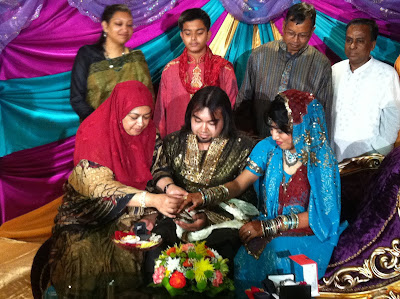
As soon as I stepped into the party hall upstairs in the Indian restaurant called "Aalishaan", I was surrounded by symbols, material culture and non-material culture. The material culture consists of all the natural or man-made objects with attached meanings, for example the food, the traditional clothing, the festive decorations and gifts. The non-material culture includes the Bengali language, the values (the respect for the elderly, and the behavior towards them), beliefs (pertaining to the Muslim faith) and gestures (greetings, and ways of interaction among the guests and hosts, and celebration activities).

According to Ferrante, socialization involves both nature and nurture. Rezwan and Samira’s genetic make-up, “physical appearance” or biological inheritance, are related to nature. They “look” Bangladeshi, and similarly their Bengali friends, and family, look Bengali too. On the other hand, the social environment I witnessed including their primary group of relatives, close friends and family, and the interactions between them, are all considered the nurture part of socialization, through which Rezwan and Samira live their lives, have social experiences and human interactions. Although their appearances might suggest they are Bangladeshi, there is a reason why some of their relatives for example, do not speak English. Their relatives have not acquired the same education, experiences, and social contact as Samira and Rezwan did. Hence, nature and nurture are both critical to analyzing the process of socialization and either one cannot be ignored.


The ceremony started off with a Qur’an recitation, when all guests remained seated and quiet, followed by a short speech. A significant symbol was used to signify to people that they are expected to be still and quite for the recitation of the Holy Qur’an. That symbol, also used frequently prior to proceeding with a significant act or movement, is the phrase of two words in Arabic “bismullah” meaning, “in the name of God”. As soon as the speaker said those words, everyone sat down, and stopped their conversations, waiting attentively, knowing what to expect afterwards. Another example when this symbol was spoken is before the slicing of the cake.

The cake segment, was one of the one most intriguing and amusing of all the events in the party to me. In Bangladeshi culture, feeding sweets to the bride by all elders, relatives and those involved, is a key part of the ceremony. The glowing bride Samira, had to watch the big mouthfuls being fed to her, piece by piece…and I could see how the poor thing tried so hard to nibble off smaller manageable bits. Everyone wanted to take part in the feeding process, even the bride’s younger brother. Cake was flying at her at a constant speed. Luckily her husband-to-be finally took over, and he and Samira both started feeding their closest relatives in return.

This may be seen as a symbolic gesture between people of group in which the act of feeding cake to each other conveys a meaning of love, blessing, gratitude, respect, good will, and value from one person to another. Other examples of symbols and gestures include the gestures for expression between the mother-in laws to their son and daughter-in-law and the gesture in which Rezwan and Samira’s mothers placed their hands on the bride and grooms heads and hands as to bless them, also saying at times, short versus from the Qur’aan.
Another important part of non-material culture, that is also symbolic in nature, includes presenting the gifts to both the bride and groom from the mother-in-laws. Rezwan’s mother presents Samira with a gold bracelet and ring placing them on her arm and finger. And Samira’s mother presents Rezwan with a new watch, and also places it on his arm. This exchange of gifts is considered part of the engagement process, where both sides present gifts as meaningful tributes. The act of giving the gifts is the non-material culture, and the gifts themselves, can be considered tangible material culture.
Other tangible material culture includes all the different aspects of the bride and groom’s wardrobe: clothing, accessories, veils, bracelets, necklace, rings, jewellery, and henna.


The food that was served, was Indian cuisine not Bengali. And although there are a lot of similarities between the two in terms of spices and key foods, serving Indian food at a Bengali ceremony could be considered a form of cultural diffusion, in which other cultural items are borrowed from a source outside the Bengali culture.
Finally, all of these shared experiences, gestures, symbols, that are recalled, reproduced, and repeated in this ritual (engagement ceremony) or event are passed on from generation to the next in order to be sustained and preserved. Socialization is impossible without memory. Therefore, the only way through which this preservation and passing on of experiences is possible is through collective memory. Without collective memory, Rezwan and Samira’s families wouldn’t have passed on experiences that shaped the “Bangladeshi” engagement party I attended, groups with particular identities would seize to exist and I wouldn’t have been able to remember any of the things I just wrote about in this blog post!
Subscribe to:
Posts (Atom)