Showing posts with label american culture. Show all posts

Wednesday, April 25, 2012

Externally vs. Internally


In today’s blog post, I will be discussing how the portrayal of reel Arabs in movies affects the image of Arabs and Muslims in Westerner’s minds. Also I will discuss how these portrayals create fear and false expectations in Westerners who visit the Middle East.
Reel Arabs in movies are portrayed in four ways:

  1. 1.     Villains and terrorists
  2. 2.     Maidens
  3. 3.     Sheikhs
  4. 4.     Cameos

For example, in Sex and the City we saw Maidens and Sheikhs. In most post 9/11 movies we usually witness the  “villains and terrorists” of reel Arabs. For people who have never been to the Middle East or have no constant interactions with Arabs or Muslims will get the wrong picture painted in their heads of Middle Easterners.


In the final game of the football league, Carnegie Mellon Qatar was playing against the Community College of Qatar. After the game, the players and the fans socialized over a small reception following the awards ceremony. As I was socializing with the fans, I happened to meet 1196 Carnegie Mellon University graduate who was visiting Qatar on business. He graduated from the main campus in Pittsburgh, and this was his first trip to the Middle East. I decided to engage in the conversation he was having with some of the other students. They asked him what he thought of Doha and if it met his expectations. He responded by saying that he was quite astonished with how developed Qatar was and how back home in the states, people planning on visiting the Middle East had completely different expectations, in the negative sense. He said that back home, people expect the Middle East to be dangerous, filed with bombers. Also, they expect that women do not, under any circumstances socialize with a male Westerner. We all laughed as he said, “man was I surprised.” I looked around to see if people were genuinely laughing, and to my surprise they were –because I wasn’t. I was in fact slightly offended.  However, it was nice to see that no one takes such matters too personally because if they did then there would be so much resentment towards Westerners.

After my encounter with this man, I couldn’t help but wonder, are the Arabs and Westerners that different? We speak different languages, we dress differently, our traditions are different, our cultures are different, and our appearances are different. On a different note, we are also the same. We want to be happy, we want to be safe, we want to obtain a good education, and we want good health for our loved ones and ourselves. Just because externally we are different, it doesn’t mean on the inside we can’t be the same ordinary people, living our day-to-day ordinary lives.

Tuesday, February 7, 2012

Deaf And Rich


Sociologists look at class and culture when they analyze society. Last week I began watching the show ‘Switched at Birth’. In my blog post, I will be discussing the overall plot of the show to give you a better understanding of what is going on. I will talk about how living and growing up in very different class cultures, created and shaped the two main characters’ (Bay and Daphne) personalities and even effected the two everyone around them. The show is set to portray the American culture and therefore contrasts the lifestyles between the highbrow, white, American family and the lowbrow, working-class, Mexican single mother who is trying to make enough money to give her daughter a normal life. The main idea is that the two girls were accidentally switched at the hospital and therefore lived lives that were not pre-destined for them.

The Mexican hairdresser raises Daphne, who is deaf. Daphne becomes accustomed to living a simple life of a poor girl in a beat down, not very safe neighborhood. She attends Carlton (a school for the deaf and is used to an environment very different from that of the hearing schools). Meanwhile, Bay is raised in the Kennish household. Her father is an ex baseball player and she attends Buckner Hall – one of the most prestigious schools in her area. Bay always feels like an outsider in her own home because she does not look like any of her family members, her interests are ones that her mother does not encourage, and her temper and sarcasm come from within her as opposed to something she picked up from her parents.


One day she decides to ask her parents for a DNA test to see if they are in fact related. The results come in negative and they all find out about the switch. From there, everything changes and Bay and Daphne and everyone involved needs to start adapting to their new lifestyle and complicated situation. For example, Daphne is now part of a hearing family and needs to keep up with reading lips because her parents have no clue about signing. Moreover, Daphne’s biological family and Bay start learning how to sign in order to make it easier to communicate with Daphne. You can see how the two cultures of the hearing and the hearing impaired come together and work towards better and easier communication through the use of language.


Born and raised in Qatar, I was socialized in an Egyptian/Palestinian home but outside, it was a whole different culture. My brothers and I attended private schools, which meant that we socialized with people of many different cultures – including locals. Because of my social experiences with my Qatari friends and classmates, I learned to speak Qatari fluently and began communicating with my friends in their language, which made it much easier for us to have better flowing conversations. We never really faced language barriers. However, you can see how I was the one who had to change and teach myself their language since I was the outsider living in their society, learning their language and traditions and cultures. Moreover, living in Qatar had influenced me to the extent that I actually got myself a Abaya made since it 'grew on me' and I grew a certain appreciation for it.

Sunday, January 29, 2012

Culture?


We always hear the word culture, but what does culture really mean? Culture is a term that has many different inter-related meanings. However, the word "culture" is most commonly used in three basic senses:

▪ Excellence of taste in the Fine Arts and humanities, also known as High Culture.
▪ An integrated pattern of human knowledge, belief, and behavior that depends upon the capacity for symbolic thought and social learning.
▪ The set of shared attitudes, values, goals, and practices that characterizes an institution, organization, or group.

Sitting in the last sociology class, I have realized that culture can simply be explained, just like sociology, to be a mixture of fun and interesting things. Simply put, culture is determined by many aspects including history, tradition and behaviors.

An example, the “Simpsons.”

The Simpsons has been on television for quite a while, created and broadcasted through Fox Broadcasting Company. The Animated sitcom was created to resemble the American middle class life style and brought with it all the domestic problems.

Due to its popularity, The Simpsons gained many viewers and still remains a favorite among societies consisting of all ages. From the dysfunctional family outlook, to the composed inner harmony of the characters, the Simpsons was seen to have brought with it many aspects of family and societal behaviors demonstrated in real life America.

How does the Simpsons relate to culture? Well, America was founded on the basis of a new world; there was no specific culture that was obtained by the so-called- Americans. However, American culture, or western culture as parts of the world call it, was developed through popular behaviors. From the Simpsons we reveal that even with such a simple television show, people’s ideas shift to the direction intended.

There is no way to say that culture was brought upon by mediums such as films and television shows such as the Simpsons. However, you can be sure that it has enhanced the ideas of culture to compass around it.

Sunday, November 20, 2011

Graffiti an Art or Deviant Act?


Graffiti as art is one of those "in the eye of the beholder" type questions.


Graffiti art is an art form. The reasons, including aesthetic criteria, as to why it is an art form far outweigh the criticism of illegality, incoherence, and nonstandard presentation. However graffiti art overcomes these concerns and thereby can be considered as an art form.Graffiti art originated in the late 1960's, and it has been developing ever since. However, it is not readily accepted as being art like those works that are found in a gallery or a museum. Most of the opposition to graffiti art is due to its location and bold, unexpected, and unconventional presentation, but its presentation and often-illegal location does not necessarily disqualify it as art.In sociology Graffiti is still an argumentative topic, wither it is a form of Art or a deviant behavior. Societies throughout history and to the twenty-first century continue to hold mixed feelings toward graffiti. According to Grove’s Dictionary of Art, the term “graffiti” derives from the Greek word “graphein” meaning, “to write.” However the term has also been defined as any inscriptions (drawings or words) scratched or scrawled on public surfaces.The Canadian Oxford English Dictionary defines deviance as “the behaviour or characteristics of a deviant,” a person who “departs from the expected rules of conduct” and strays from normal, social standards.


Graffiti as a Form of Deviance
The hip-hop subculture holds a strong place in reality. In effect, the situation has grown to cause much concern to everyday citizens. Graffiti can be seen as a threat to the quality of life in a community because millions of taxpayers ’dollars are spent on its removal;in fact public funds can be entirely swept up by graffiti eradication.
The act has become an illegal offense because it implies the act of damaging property
without authorized permission. The public sees graffiti as an act of deviance because it decreases the value property, detracts from the beauty of neighbourhoods and hurts tourism. Unattended pieces of graffiti give off the visual impression of an “uncaring and indifferent society.

Graffiti as an Art Form


Since the start of modern graffiti in New York in the late 1960s, there has been much debate over its legitimacy as an art form. Many see graffiti as a gang related and merit-less, while others hail graffiti as a legitimate art form of the utmost importance. In this argument of graffiti as an art form, one must make the clear distinction between tags or scrawling and spray-paint murals.Aspects of the art world have even accepted graffiti as art, having had many gallery showings (Powers, 1996). In 2004, the Cultural Olympiad held a festival of graffiti art,Chromopolis, in Greece. Chromopolis invited sixteen graffiti artists from seven different countries to “paint” on public walls in ten Greek cities. In addition to the art galleries featuring graffiti, auctions have occurred specifically for the purposes of selling the works of graffiti artists.The fact that society views graffiti as subversive has to do, in large part, with its appeal and the identity of the graffiti subculture. Graffiti can be seen as an art form for the lower class to rise up and have a voice; it is about the reclamation of public space and the denouncing of ownership.


Sources:

http://docs.google.com/viewer?a=v&q=cache:3sCNcl4XsqIJ:www.sustain.ubc.ca/pdfs/seeds_05/winter/graffitti/A%2520Sociological%2520Analysis%2520of%2520Graffiti.pdf+graffiti+as+deviant&hl=en&gl=qa&pid=bl srcid=ADGEEShOUcGIoK892qLDginHXg4htueEpFgl_JgJ1_Ip8GojYgZBTh9DeUH26CHCV40rJplz9EnxPYsP9r_lEtnHvpQWCmUMt15CQoCSLzm-_bmn-ZboT02179mJ20LN1bj911yMqeUH&sig=AHIEtbTHwvFAR6t7wzPZYxG-L_8dEdKmpA

http://www.graffiti.org/faq/stowers.html

Sunday, October 30, 2011

Culturally Religious

For some reason, Islam is automatically linked to Arab identity. It’s like foreigners don’t realize that Arabs can actually be of a different religion. What’s funny about this is that Arabs might forget that too sometimes.

Many of us Muslims grew up in a culture that is based on our religion’s pillars and rules. So, in Islam we follow a lot of the things that our Prophet, PBUH, did, such as saying “Bism Allah” (In God’s name) before starting a meal. I remember sitting at the dining table with my parents when I was younger; after they plated my food, they reminded me to say “Bism Allah.” Being my-not-thinking-before-I-act self, I chose to act out and break the norm and said, “mish Bism Allah” (not in God’s name). I obviously had no idea what I was saying. After that, I automatically got a negative sanction from both my parents, which is a negative reaction in sociology. Looking back at that memory now I understand exactly why my parents did that. Now, I actually understand what I said and why my parents asked me to say “Bism Allah.” It’s not something we just said for social reasons; it had religious meaning as well.


Here’s the thing, there is “haram” and there is “a’ib.” “Haram” basically means forbidden upon in Islam. “A’ib” means shameful in our culture. Sometimes it’s hard to distinguish between the two. An example of something that could be considered “a’ib” and not “haram” is being deviant by getting a crazy hair cut and dying your hair bright pink. If you go out to visit family friends or even just family it could be “a’ib” to walk in with a crazy hair-do and you will probably get a lot of negative sanctions. But in Islam, it is not “haram” to look like that. However, many culturally restrictive things are also forbidden in Islam, like one’s choice of wear. A woman is supposed to be dressed appropriately in public in Islam and in this culture.


The same goes to girls and guys mingling; it could be considered “a’ib” and “haram” at times. Girls and guys hanging out isn’t something that we see in public all the time, aside from in universities in Education City and at parties. It wouldn’t be so hard to find someone, at least one person, staring at you from the corner of his or her eye when you’re alone with the opposite gender, especially if you’re younger in age.

Wednesday, October 12, 2011

“Our trip to Chile a few years back is what really helped me identify much more as a Chilean than a Palestinian.”


If you look at Fatima Abdulla,you’d never guess where she’s
from. She was born in the United States, grew up in the United Arab Emirates, but is half Chileanand half Palestinian. Socialization is the process by which people develop a sense of self-being and learn different norms of the society they’re living in. Precisely, the process involves the individual gaining a sense of self-identity, learning about social groups, developing their human capacities and conveying the social and physical environment they have inherited. For the most part, Fatima has identified her hybrid identity with the help of her agents of socialization: her parents and family. In this case, the primary group supports her socialization, as the group is a social one in which has ‘face-to-face’ contact and a strong emotional tie. Her family plays an important role as it gave her deepest and earliest experiences to the “rules of life,” as they were first to introduce the culture and patterns of their society. Hybrid and biracial children tend to grow up in the same culture of either parent or at least their language, but Fatima Al- Zahra didn’t. Growing up in the States for the first seven years of her life, she spoke English fluently rather than Arabic or Spanish. Her parents always wanted her to have a strong grasp of the English Language in order to thrive in an English-speaking environment.

It wasn’t till she moved to Abu Dhabi that she was struck by the whole role strain and cultural identification. She was no longer an American citizen, but half Palestinian and half Chilean. As a result, Fatima’s role, as in her behavior, obligations, and right’s expected of her status in relations to others became more important and meaningful. She struggled not only with her new identity when she first moved to Adu Dhabi, and also experienced role strains. Role strain is when the individual is involved within conflicting expectations from others. She felt strained because of the expectations of the community she was living in. She gradually became more exposed to the Arabic language, however struggled to learn it correctly mainly because of the social expectations tied to that. She struggled with her impression management, as she was new to the whole location. According to Fatima, Palestinians were always quick to identify them as Palestinians and completely ignored their Chilean side. Due to the unfortunate loss of her father, she became closer to her mother and identified to her culture much easier.

“When I would go visit my Palestinian relatives, I tended to ‘control’ myself a little more. I dressed differently, and paid more attention to things such as correct forms of addressing members of the family,” Fatima said. From a sociological perspective her situation may best be described as impression management, where she manages the image she’s trying to project. This may be the way she controls herself when she’s around Palestinians and Arabs, which is different than when she is when with Chileans. She may physically be identifiable as an Arab, Russian, Persian, Turkish or even Lebanese, but she’s Chilean at heart.

Now at the age of nineteen, Fatima speaks both Arabic and Spanish, along with English, but still prefers English as her vocabulary and grammar usage is much more developed than in either of two languages languages. “I’m not as fluent in the two other languages, but it doesn’t matter because language for me isn’t my only form of identity. The things I grew up with and love doing are my identity markers,” Fatima giggled. According to her, she loves learning the languages for the sake of the language itself, and not just for cultural identity.


Tuesday, October 4, 2011

Unleashing the Qatari Culture in the Residence Halls

On September, 27th, 2011, one of the female residence halls in Education City in Qatar hosted an event to educate the International students about the Qatari Culture.The CDA’s and the residence hall director arrived before the event to set up all the items which represent the material culture of Qatar. These items included the traditional sofas, Arabic music, local pastries, regional dresses and henna cones.
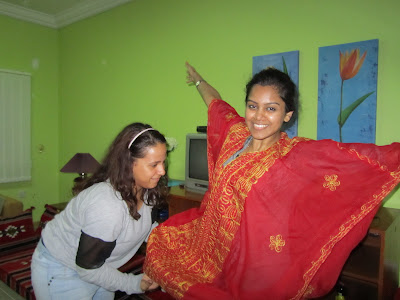


A total of 16 students made it to the event. Most of the students came from Middle Eastern and Asian countries. However major western influence reflected the way these students dressed and talked. The fact is that Education City, which consist of six American universities, sways the subculture of the students to behave in a more western-oriented manner. They all communicated in English since not everyone from the attendants could speak the Arabic language.


Throughout this social gathering, I noticed many aspects of the non-material culture of the country. For instance, folkways like greeting everyone in the event by kissing on both cheeks were firmly applied. Also, the attendants showed open-mindedness and respect towards each other, which is a value embraced within the Qatari Culture. There were norms like maintaining the cleanliness of the place by disposing all tissues, paper plates, plastic cups after using them. Everyone made sure that they kept the pillows of the traditional sofas in the correct order after sitting on the sofas. The music was played at a modest volume. These examples illustrate how keen the Qataris are about living in a hygienic and organized place.


Back to the material culture, the students indulged in the two large dishes of the freshly baked chicken, meat, spinach and vegetable pastries known as fatayer. The portions were huge and this explains the concept of hospitality and generosity when it comes to dining in the Arabic culture. The students had fun trying out the Women’s traditional dress which corresponds to the beliefs of Islam in the culture as the dress was very conservative. Also throughout the event, the students were excited to get their hands decorated with the complex henna designs as henna in the Qatari culture symbolizes beauty.


Adding to all the energy of the occasion, one of the students turned 19 on the very same day. Matea Malikanovic a freshman at Georgetown University celebrated her birthday among the many students in the event. No one knew that her birthday was on that day so there weren’t any preparation to celebrate the occasion to its full potential. However they did sing her the popular birthday song and exchanged birthday wishes, which showed an example of cultural diffusion. Originally from Bosnia, Malikanovic shares a glimpse of her past, “I was born during the war,” she states. However, the situation has improved immensely since then. Still, she decided to study in Qatar to gain a better understanding of the culture and religions of the Middle East.


Birthday girl


A role is the behavior, obligations, and rights expected of a social status. The role of an Education City student involves committing to your schedule, submitting your assignments on time, participating in class and of course passing exams. Despite the busy academic schedule of most the students at the event, they were all looking forward to relaxing and enjoying their time. In fact, 9 students had exams the next day. Elizabeth Boctor, a Weill Cornell student said “I have no idea what I’m doing here but I know I’m happy.” Similarly, Sarah Omar, from Georgetown University expressed her excitement on attending the event, “We are enjoying free food and seeing people we normally wouldn’t see because of our busy schedules.” This casual get-together permitted the students to step out of their rigorous role and engage in leisure and social activities.

While the event only lasted for two hours, it gave students the chance to renew their motivation for studying and refresh their energy. It also helped inform them about the various aspects of the Qatari culture.

Wednesday, September 28, 2011

Cultural Diffusion


The diffusion of culture often brings paradoxes into the society. The borrowed diffusion of Mcdonalds tends to be one of the outstanding contradictions in Qatar and the Islamic region. Therefore, the question is, will the Qatari society be able to absorb both dining norms and hold its heritage?


McDonalds within Qatar seems to be one of the major paradoxes in our society. McDonalds has affected the society and its norms of dining that we don’t even realise. In this case, Islamic culture is rooted in the Qatari society, which tends to pinpoint unity, ritual habits of dining and family-orientated occasions. Muslims have numerous outstanding rituals when dining. In refrence to Ahadiths, Muslims should avoid sitting at the table when possible, eat with the right hand as Satan uses the left, then lick fingers and plate after dinning. Then ask for forgiveness and drink within three gulps. Therefore, dinning within an Islamic society does not seem to be as simple as eating at the dinning table. On the other hand, none of these ritauls take place while eating at McDonalds. By eating in Mcdonalds, we do not practice the Islamic rituals, but adapt to the Americanized fastfood ways of eating. Additionally, the family orientation and unity may be lost when dining in Mcdonalds, as it is a shortcut to traditional ways of eating. As a result, McDonalds represents the western dominance over the MiddleEast and Islamic way of dinning.

To conclude, norms of Islamic dining within the society are eventually wearing away as the younger generation Americanizes the cultural dining norms. Therefore, the society may keep hold of the cultural familiarities, but they are going to change overtime.

Wednesday, March 9, 2011

Taboos and Popular Culture

Your heart is closed and in my hand I’ve got so many keys.
Which secret key will ever let me open your heart?
Once I open your heart, tell me, will you accept me?
I can’t stop this TABOO, that undeniable TABOO.


Those words were written by the Japanese lyricist and artist Koda Kumi that simply shows how some of our instincts are incontrollable or to vulgar that the society can’t accept. TABOO, reaching number one in the Japanese Oricon Charts, is also the strictest and most highly regulated norm of all the norms. In this case, Koda Kumi lyrics clearly states that even though there are a lot of unaccepted sub-cultures in one’s society, there mighty still be some part that will open the society’s “heart by a key.” That is not true to all cultures because it’s affected by the history, the religious beliefs and other factors. With popular music, movies and culture, other cultures around the world start to accept these forms of taboo and might have an influence on the today’s and future generations.

Photo on the right: CD single of the #1 song TABOO by Koda Kumi.

Some of these cultures include people who believe they’re vampires; groups of homosexuals; groups of drug dealers; or groups that enjoy an unusual form of pleasure, like Rihanna likes to say it “but chains and whips excite me.” There’s a strong message in that song. It became popular and Rihanna has a huge fan base ranging from adults to teenagers to kids. The reason this is shown to the society now without having a lot of conflict or controversy is because it’s already accepted. How? By the over exposure of music videos and movies that contain such themes.
Picture on the left: Rihanna on the Cover of a 2010 G.O. Magazine issue promoting sexual images and themes.


The Simpsons, Ugly Betty, Family Guy, Six Feet Under; these are just a list of popular TV shows and top rated that shows either hidden or exposed themes of sexual jokes and humor, drugs, drinking and homosexuality. People become more addicted to this and keep watching while their subliminal mind starts to slowly accept taboos.

So, back to Koda Kumi’s song, TABOO, the media holds a lot of keys that slowly unlocks the “closed-minded” society’s heart. Not all societies are accepting yet, and some are still strict and reject but not as 3o years ago. More promotion happens and generations are affected. So the question is, how far will this acceptance go? Until when will this norm breaking habit continue? We don’t know but we can observe and witness the spread of acceptance and tolerance thanks to popular culture and popular media.

PS. TABOO is capitalized because that’s the official way of writing the song through its official profile on the website.

The video below is the music video of TABOO, where the general story shows Koda Kumi's interest in a man who later on disappears and she finds him with, not much of an interest to the opposite sex. But, unexpectedly, she smiles and accepts it. This message makes her fans accept this along with her as well.

Tuesday, March 1, 2011

Cultural Colonialism


Colonialism may have ended, but it is fair to say that cultural colonialism still lives on.
It is a new, more powerful type of colonialism, in terms of control and domination. Probably one of the main reasons behind this emergence is because of the highly developed technological tools and means that the dominating countries use nowadays. In other words,in sociology, this new type of colonialism can be described as the desire of the first- world countries to mentally and emotionally invade the third-world countries’ values and perceptions through soft and concealed weapons, mainly for economic purposes. In this case, these weapons are the cultural means, such as media, language, education, and religion; that is what the term ‘cultural colonialism’ is all about.


Cultural colonialism has emerged in the 1960s and it has become a threat for the receiving culture, but an enrichment of the colonizers’ cultural identity. The public mass media are the foremost example of this phenomenon. Trough global commercialization of broadcasting, countries can control other counties’ cultural values. The media uses its hegemonic power to increase its country’s economic power. For example, American culture is the most successful at this; by allowing its companies to advertise, it’s like hitting two birds with one stone. The media company is getting money and as an added bonus, the country’s economy is increasing in wealth because people are subconsciously told to purchase new products that they may not even need.


Cultural colonialism also creates cultural dependency on the receiving cultures. For example, the current foreign aid is mainly not targeted towards human development, but rather increases aid dependency in poor countries. Africans in particular, receive rice as food aid from American farmers, therefore Africans farmers become more dependent on food aid and unable to use their own natural resources to compete with other countries or contribute to local food production. The Pakistani population has also been dependent on the U.S. for its economic and military aid. Thus, Pakistan will always need this foreign assistance for its survival and security.


Language can be used to control cultures as well. For example, French is the dominating language in Morocco and this make them completely depended on French, rather than their native language to communicate with each other.

Monday, February 14, 2011

Emotions Are Made of This

One event, mixed emotions, permanent memories. That’s what two high students left before they killed 17 students and a teacher. In April 1999, Eric Harris and Dylan Klebold did this tremendous event in order to be heard. They stated in their diaries that they had trouble being heard when a jock bullied them, a girl played with their emotions, and couldn’t find someone who would simply just listen to them (except for their diaries). However, this isn’t about what motivated them, but what effect they left for the town, Columbine. The shared feelings, created by these two murderers, brought those people to a sense of unity and togetherness is called Collective Effervescence. (Picture on the right: Eric Harris and Dylan Kelbold)

It varied differently from one emotion to another, from one phase of the event to another, from one person to another. The emotions were definitely mixed and it caused sadness, anger, confusion and so on. The first phase I would probably say it was confusion as to what’s going on from all the students who first heard in the cafeteria on that day. Then it led to a basic human instinct, which is the need for survival; that instinct is also associated with fear.
In the video below, you will see what emotions you get during the event when the students start shooting in the cafeteria. Later on it will view what happened right after where all the people are confused, in fear, and weeping for their losses. (Possible emotions will be mentioned supporting the cultural effervescence theory.)

Not only that they’ve committed such hideous act, but these two murderers support sociologist Émile Durkheim’s theory from his book Suicide. The book states that there are three patterns of suicide most commonly referred to as egoistic suicide, altruistic suicide and anomic suicide in men only, as it also mentions that men have the highest rate of suicide than women, which is the important part.


Even by just viewing a film (such as Michael Moore's Bowling for Columbine), the unity of shared emotions still lives on today. Not only to the ones that saw the event, but the ones who simply reliving the scene on the screen. It never seems to die because now it’s part of our history and a cultural aspect in the small town of Columbine.(Picture below: Michael Moore's comic for the documentary's promotion.)