Showing posts with label cultural object. Show all posts

Saturday, March 12, 2011

Progress In Souq Waqif


Two types of progress are seen in souq waqif and sociology allows us to track these diverging behaviors in cultural behavior. One is cultural progress. Specifically, I am talking about the art exhibitions that are held in the galleries and some of the restaurants found there. The second kind of progress is that of westernization and globalization.


I have been to souq waqif many times and each time I go there, I am amazed at both of these types of progresses.


I remember the first time I ever went to souq waqif was with my school, and I remember telling one of my friends “Why is there a Baskin Robbins in the middle of souq waqif? Isn’t this supposed to be a cultural place?” What I had failed to realize then was that even though Baskin Robbins was not part of my culture, it is still part of culture- just not mine. Baskin Robbins’ motto is “Your Neighborhood Ice Cream Store” which shows how dominant it is in American society, or how dominant it wants to be. I can’t be the judge of that because I’ve never actually been to California- which is where Baskin Robbins first started out. The same goes to the restaurants in souq waqif, for example the Iranian, the Indian and the Italian restaurants.


Also, another form of cultural progress is the art exhibitions that can be seen in the galleries of souq waqif. One of the exhibitions that I went to focused on Qatari artists and I could actually see the artist painting his work onto the canvas. Not only was it interesting to see an artist at work, creating a cultural object, but it was interesting to see a Qatari one because it was the first time that I’ve seen this type of thing. I’ve also seen an exhibition where more than one person has worked on a piece of art, so it was a collective activity and there was a division of labor amongst the people. I also heard many people talking about their thoughts of the many artworks and each person had a different opinion, which proves that cultural objects are multivocal.


The other kind of progress is the westernization and globalization. The Baskin Robbins example could be put in this category as well. As I previously mentioned, Baskin Robbins started out in the United States of America, specifically the state of California. So the fact that it is located in Qatar means that Qatar is becoming westernized, even if it is through a simple thing like ice cream. Another example of westernization in souq waqif is the fact that many of the cafés have multiple television screens in them that usually play some sort of western sport, usually football. Once when I was walking around the souq, I heard a loud cheering noise coming from the cafés, I assumed a team had won and the people were cheering because of that and that they were experiencing collective effervescence. Another example is the parking lot surrounding the souq. This is part of westernization because the need for parking lots came from the west, which is where cars were invented. Traditionally parking lots were not needed because all people needed were posts to tie their camels to.


Monday, February 14, 2011

Emotions Are Made of This

One event, mixed emotions, permanent memories. That’s what two high students left before they killed 17 students and a teacher. In April 1999, Eric Harris and Dylan Klebold did this tremendous event in order to be heard. They stated in their diaries that they had trouble being heard when a jock bullied them, a girl played with their emotions, and couldn’t find someone who would simply just listen to them (except for their diaries). However, this isn’t about what motivated them, but what effect they left for the town, Columbine. The shared feelings, created by these two murderers, brought those people to a sense of unity and togetherness is called Collective Effervescence. (Picture on the right: Eric Harris and Dylan Kelbold)

It varied differently from one emotion to another, from one phase of the event to another, from one person to another. The emotions were definitely mixed and it caused sadness, anger, confusion and so on. The first phase I would probably say it was confusion as to what’s going on from all the students who first heard in the cafeteria on that day. Then it led to a basic human instinct, which is the need for survival; that instinct is also associated with fear.
In the video below, you will see what emotions you get during the event when the students start shooting in the cafeteria. Later on it will view what happened right after where all the people are confused, in fear, and weeping for their losses. (Possible emotions will be mentioned supporting the cultural effervescence theory.)

Not only that they’ve committed such hideous act, but these two murderers support sociologist Émile Durkheim’s theory from his book Suicide. The book states that there are three patterns of suicide most commonly referred to as egoistic suicide, altruistic suicide and anomic suicide in men only, as it also mentions that men have the highest rate of suicide than women, which is the important part.


Even by just viewing a film (such as Michael Moore's Bowling for Columbine), the unity of shared emotions still lives on today. Not only to the ones that saw the event, but the ones who simply reliving the scene on the screen. It never seems to die because now it’s part of our history and a cultural aspect in the small town of Columbine.(Picture below: Michael Moore's comic for the documentary's promotion.)

Thursday, February 3, 2011

It Has to be Real

Cheryl Lynn was the first to sing the infamous disco number-one hit “Got to Be Real.” I heard it first the song, which I thought was an Mary J. Blige original, in the 2004 Dream Works animated film Shark Tale. However, in 2010, heard it again by a Japanese singer named Koda Kumi. I stopped and thought “Is she covering the song now?” I decided to Google it. Shockingly, I found out that it was a 70’s original . How can something 4 decades ago still live on to the 21st century? Who do we thank for this? The Art Worlds. Their collective activity made this one of the ultimate theme song for the Disco Culture.(Photo in the center: Cheryl Lyn in 2005 receiving an award for Dance Music Hall of Fame for the song Got to Be Real.)

How do we know that it’s popular? Well, other than its commercial success (that was conducted a Dance Music Hall of Fame), it is well liked and it’s iconic to the 70’s. Now every time I hear the instrumental I think of disco balls and lights and people “getting their groove on”. We can also agree that it’s authentic to the Dance and Disco culture, as that’s the group of people it belongs to; disco dancers. May believe that it is dead but “disco is still alive”.

So Cheryl Lyn sang the song, but there’s a whole team behind the song which makes the interlocking relationship for this cultural object. This interlocking relationship includes writers, producers, musicians, music video makers, dancers and every single person who contributed to create this cultural object. Written by Cheryl Lynn, David Paich and David Foster, they are still accredited today for the new covers because they made it happen. (Photo on right: shows the original writers on the booklet of the 2010 cover.)

We can’t deny that it is globally ubiquitous. As a matter fact many different cultures sampled the instrumental into their songs including Dominic Republic, South Korea, Japan, Australia, England and so on; they borrow the signature introduction of the song and the instrumental hook. There are also official covers where artists directly sing the song in their own way. The video below will show the different artist and their versions and you can find the list of the artists who sampled the song in this link.

Untitled from Juicyyification on Vimeo.

Saturday, January 29, 2011

"Tainted Love" as cultural object

In the opening chapter of his book Mix It Up: Popular Culture, Mass Media, and Society, sociologist David Grazian offers a brilliant deconstruction of a single cultural object, the storied history of the song “Tainted Love.”

Written by Ed Cobb, the original version of “Tainted Love” was recorded by soul singer Gloria Jones in 1964.

Seventeen years later, the U.K. duo Soft Cell would enjoy a smash hit with their cover of the same song. The Soft Cell cover of “Tainted Love” set a (then) Guinness World Record for the longest consecutive stay on the U.S. Billboard Hot 100 chart (43 weeks).

Soft Cell member Marc Almond wrote that "his only significant contribution to the song's instrumentation was the suggestion that the song begin with a characteristic ‘bink bink’ sound which would repeat periodically throughout.”

In 2001, shock rocker Marilyn Manson recorded a cover of the song for the soundtrack to the film Not Another Teen Movie. Note how Manson slows down the song to a crawl, underscoring the grotesque -- and tainted -- aspect of the song’s primary theme, uncovering untapped dimensions in his reinterpretation.

Finally, Brazilian pop singer Rihanna sampled the bassline and signature “bink bink” beat for her song “SOS,” which paid tribute to the original song with the inclusion of the line, “I toss and turn, I can’t sleep at night.” Note how the musical score to Rhianna’s own song is built around the hook contributed by Soft Cell’s Marc Almond.

In his deconstruction of this enduring cultural object, Grazian reminds us that, “Pop music, like Greek tragedy and Elizabethan drama, can transcend its historical moment to enjoy endless cycles of rediscovery and reinvention, just as ‘Tainted Love’ began as a 1960s northern soul song, and found new life as an 1980s synth-pop classic, which two decades later would be sampled for inclusion on a 2006 R&B dance hit.”

Wednesday, January 26, 2011

Qatar Unified Imaging Project (QUIP) Maps Qatar's Cultural Heritage

How is Commercialization and Urbanization Impacting the Culture of Doha?


Two days ago, I heard about the QUIP research project, which holds great relevance for the research culture of Qatar as well as the broader community of people that are interested in the history and cultural traditions of this country – including the awesome members of this cultural sociology class! The project is spearheaded by Virginia Commonwealth University in Qatar (VCUQatar) and is funded by the Qatar National Research Fund. I would like to think of it as a cross-cultural collaboration between an American design school VCU, Qatar University, and the British-based University Of Exeter, which boasts the highest collective expertise on gulf studies that includes anthropology, history, Islamic studies, sociolinguistics, material culture and many more. I met with Tammi Moe, lead Principle Investigator on this three-year project. Over a huge plate of French fries and three liters of soda, Mrs. Moe was able to provide me with a substantial wealth of information regarding this stimulating research project. I was particularly interested in the aspects of the research that include cultural diffusion, and the impact of commercialization and urbanization on Qatar’s cultural heritage.


Source: VCUQ Photo Gallary Archives

Heritage informs nearly all fields of research because it allows us to understand our humanity. We can look at material and non-material culture to identify what we value as humans. In the stories we pass on from generation to generation we communicate our essence.


Source: VCUQ Photo Gallary Archives

The objects of material culture and the practices of non-material culture show our values and are meaningful to understanding humanity. Games we played as children, our mother's recipes, what we captured in a photo, traditional dancing, music, objects of veneration are different expressions of our cultural heritage.


Source: VCUQ Photo Gallary Archives

It's how we participate in shaping the value of these objects and practices that informs other disciplines from sociology to design. That is why I found QUIP to be a vital and crucial project. It will help guide the interpretation of researchers around the world by creating access to what is important in Qatar's culture.


Source: VCUQ Photo Gallary Archives

These values and belief systems are easily over shadowed by what is currently being emphasized, the highly visible consumer and brand name culture that the world's attention is now focused on. We become distracted by the glitz and glamour and forget what the true values and beliefs of this society are and this has placed the material and non-material culture of Qatar at risk.


Source: VCUQ Photo Gallary Archives

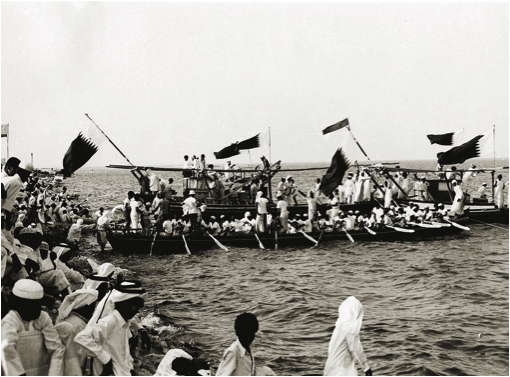
Pearl Diving ­­– A cultural object that belongs to Qatar’s heritage. As Griswold defines it, this cultural object is a “socially meaningful expression” of Qatari tradition, and “tells a story” of this people’s way of life and means of living.


Source: VCUQ Photo Gallary Archives

Commercialization and urbanization have shifted the cultural focus from traditional to modern consumption – from barely surviving to ultra luxury. The urban sprawl has introduced “the other” into the closely guarded fareej forcing the neighborhoods of Qatar to spread apart. So much so that there is a project underway to rebuild the “heart of Doha” displacing merchants that provided reasonably priced goods, to over-priced merchandise.


A lot of very interesting entries on Qatar traditional activities are found on this blog.

There are grassroots efforts to preserve traditional architecture but so much has already been destroyed in the push for rapid advancement.


source (up): VCUQ Photo Gallary Archives (Both pictures taken at Souq Wakif)


Check out this website that portrays the background and changes of Qatar.

Examples of the Transmission and Reinterpretation of Culture:

It used to be that shopping occurred in the living rooms of neighborhood women and Souq Waqif. Now we have brand stores in large shopping malls.


Source: VCUQ Photo Gallary Archives

In explaining how the cultural heritage of Qatar is fading and being neglected, Tammi Moe referred to an article in the Guardian newspaper, saying " Although this is an interesting article it completely neglects the true "cultural heritage" of Qatar and the surrounding Gulf. It focuses completely on modern events and forgets about the people of Qatar that have struggled to live here before the discovery oil. Qatar's heritage and culture is rich in many ways and we must maintain the cultural memory through modern vehicles."


Source: VCUQ Photo Gallary Archives

Overshadowing of culture:

For example the following pictures depict the literal overshadowing of modern architecture. The new designs overpower and diminish the essential historical and cultural monument:-

Source: VCUQ Photo Gallary Archives (Both images of Qatar National Museum)

Old mosque architecture/ Modern mosque architecture:

source(up): VCUQ Photo Gallary Archives


This change also includes "cultural diffusion"- a process where cultures adopt parts of other cultures. Qatar is adopting modern styles of architecture from other western cultures.

Fingers crossed, this project will build the research materials so that sociologists, anthropologists, and scholars can study and explore Qatar’s rich and very existent culture. Hopefully, QUIP will map cultural indicators and document them before they are lost forever.

Many thanks to the fabulous Tammi Moe for allowing me access to these super cool photo archives. Also, for her time, help, generosity with information, insightfulness, and of course - the irresistible fries.

Saturday, January 15, 2011

Bryan Adams rocks Doha (sort of)

Sociologists do their best to describe the differences between what they call high culture and popular culture. High culture typically refers to cultural objects found in the fine arts -- classical music, the writings of William Shakespeare, the ballet, and the opera -- and often confers high status upon the consumer. Popular culture is basically the culture consumed by the masses. You know, American Idol and that sort of thing.


Something that's not easy to come by in Doha is live music. Sure, you can catch the occasional oud player in the souq, but live bands are a true rarity. Even more rare is a concert by a well-known musician. You have to fly to Dubai or Beirut for that type of thing. But on December 16, my wife and I actually got to see a real concert by a genuinely famous musician, one Bryan Adams.


Now, I've never been what you might call a big Bryan Adams fan, despite the fact that he's the top-selling male Canadian artist of all time. But in Doha, you take what you can get, and if Bryan Adams was coming to town, we weren't going to miss it.

And you know what? It wasn't bad. Granted, seeing Adams play his many many hits live didn't transform me into a superfan or anything, but we had a really great time singing along with about 5000 other folks. "Cuts Like a Knife?" Check. "Summer of 69?" Check. "(Everything I Do) I Do it for You?" But of course. Adams aims to please, which means hit after feel-good hit. And, wow, the dude's got a lot of hits. It was one of those concerts where you pretty much knew every song, even if you didn't realize it was a Bryan Adams song. All in all, a fun night, very similar to the one had by the couple in this video.


Now, had I known that these guys were playing in Abu Dhabi the same night, Bryan would have had to do everything he does for someone else. But it was a nice night on the beach in Doha. Yeah, that's right, the beach. It's winter here, which means it gets down into the upper 60s at night on occasion. Brrrrr!