Showing posts with label Lebanon. Show all posts

Monday, November 5, 2012

Star Academy vs. Big Brother: Al-Rais

In the red corner we have Big Brother (Al-Rais). Never having reached its first round of evictions. In the blue corner we have Star Academy that has completed its eighth season. The winner is clearly the latter, having been a success across the Arab region. After reading the chapter by Kraidy I began to wonder why both reality programs, that are similar in more ways than they are different got different responses.


Having briefly watches some of the original Big Brother series from Europe and America I began to wonder why on Earth it actually got picked up in the Arab world. The concept itself was very Western, so much so that it went against the traditional values and norms of the largely Muslim audience. It isn’t the idea of having an Arabic version of a show that is problematic. It’s the actual premise and nature of the show.


Largely the audiences of the original shows tuned in to see what sexual relations were going on and to see the latest explicit argument. The contestants on the western show drink, casually have sex, and bear all (literally) to the world. Those are the three aspects of it that attract the viewers. Strip all that away and you’ll have a group of strangers living in a house. Why would anyone want to watch no drama?
Star Academy on the other hand, still had its fair share of criticism and resistance. However, it was still very similar to the actual format of the original French show Star Academy. It’s singing competition that has contestants living in a house and performing to a live audience for votes. It isn’t all based on personality, and there is a purpose for being in the same house. True, people do tend to tune in to see what the contestants are doing in the house, and to see what love triangles are forming. It's still a show that is able to use a bit of the Big Brother concept minus the excessive nudity.


Now, both shows came out at around the same time: late 2003, and early 2004. One based in Lebanon, and the other in Bahrain. Both shows received a lot of criticism and weren’t expected to succeed, and it was true for one of them. The kiss in Bahrain is probably what ended it for Big Brother. I’m sure there have been kisses on Star Academy, but I find it unlikely that they’d have the same protests as in Bahrain. It is only because they are two different cultures.


I personally see that Star Academy was produced in the right place at the right time with the right concept. Big Brother might have worked if it took place in present day Lebanon. It’s interesting to see how one show gains success and another doesn’t. There has to be more to the format of Big Brother than a group of people living in a house in order for it to be successful. Reality TV works when there’s drama, and in the case of Big Brother there was definitely drama, just not from the actual content of the show.

Monday, March 12, 2012

Class in Lebanese

Lebanon is one country I consider myself quite familiar with; I’ve been visiting Lebanon every summer since I was a kid. But, this year was the first time I actually visited Lebanon by myself, for the sole purpose of discovering it on my own, not just to visit family. I grew up in a culture that is very politically involved and knew quite a lot about the political situations in the Arab world, which means that I was quite aware of the different political and religious sects in Lebanon. But of course, it’s very different when you realized all these things for yourself.


Lebanon has been under a very shaky government for a while now, and has been through many, many different wars, all related to the different sects within the country. Even though there are numerous political parties in Lebanon, most of the parties play very small roles in the government itself. However, whether you were a Sunni Muslim, Shiaa Muslim, Christian, Palestinian or Syrian, all these parties play a big role in your involvement and interactions within the country.

Being a Palestinian refugee from Lebanon, I always realized how racist many Lebanese are against Palestinians. Like I mentioned in one of my previous post, "Will they ever belong?", Palestinians cannot work outside refugee camps and suffer from many unequal treatments in Lebanon.

Well, in this trip to Lebanon I realized that this society wasn’t only considered racist to Palestinians, but any person of color, African, Indian or Nepalese, was automatically listed under the lower working class minority. This makes them one of the minority groups in Lebanon, being singled out for unequal treatment and collective discrimination.


During my trip, I bumped into a Sudanese friend of mine who brought this subject to my attention. This was her third visit to Lebanon and she stated that most people automatically thought she was a maid or a worker. “I've been to so many countries and never in my life have I ever been subjected to so much ignorance and discrimination,” she said. She also said that everyone, including maids and workers, only spoke to her in English and were so shocked that she could speak Arabic.

I witnessed this myself when I walked into a mobile shop with the same friend. As we tried to enter the store, one guy stood at the door of the shop and gave my friend very cruel stares as if she wasn’t supposed to enter the store. It took him some time to finally move out of our way and let us in. When she asked the guy in the shop for a sim card, he didn’t seem to understand what she was saying, even though she spoke very clearly. However, when I asked, he seemed to understand exactly what I wanted and helped us right away.

This isn’t a topic that people really speak of, however many organizations and groups have been trying to make people more aware of this. IndyACT launched the “Anti Racism Movement” in Lebanon in 2010. They started this movement in 2010 and one of their reasons was that many people were being discriminated against and “prevented from entering [shops] because of skin color or prejudice and definitely because of the weakness and/or indifference of civil society actors in dealing with these phenomena and the absence of a criminalizing and binding law that affects these racist practices in Lebanon.”


In nearly every country in the world, there is always a connection between race/ethnicity and class. People in Lebanon are definitely stratified according to achieved characteristics, like their incomes. Class plays a huge role in a person’s social stratification and socialization into the society. In Lebanon, a person of lower class could be discriminated against and treated unfairly. If I was to talk about the Asian and black workers in Lebanon, I would say that they are stratified into both caste and class systems, where their race and their achieved characteristics definitely play a part in their lifestyle. Since the society in Lebanon has its ways of categorizing by race, and because of an Asian or black worker’s expected income and obvious race and ethnicity, it is pretty hard for one of those workers to move up the class system and be assimilated into the Lebanese culture.

Sunday, November 13, 2011

The City And The Mountain

I spent my Eid Break in Lebanon. During my visit to Lebanon, I was curious about the lifestyles of Lebanese people. I stayed in the city of Lebanon, Beirut. However, we went to the mountains several times to look at the different lifestyles. I realized that the people living in the mountains have a totally different lifestyle than the people living in Beirut.
The people living in Beirut are more modern and their treatment with others is civilized and what we are used to. However in the mountains the lifestyle completely changes. The lifestyle in the mountains is more traditional; they are attached to their culture and traditions more than the citizens of Beirut. Everything is done in the natural way. For example, when I went to visit the people from the mountains the fruits they served were freshly picked out from their garden. The food they served were all from natural products even the vegetables was from their farm.
In the mountains the gender roles highly differ than the city. The man’s job in the mountains is to go out and work during the day to get money whereas the wife would stay and work at home. The wife would cook and clean and take care of the children. The children would behave in certain ways and manners depending on their sex.
However in the city there is not much of a difference between males and females. Both of them work the same job. They would both work in coffee shops and stores whereas in the mountains you would not see much woman working outside their homes. In the mountains the men have to show their full masculinity to be able to work all day long to provide food and a healthy living for his family.
The men in the mountains do not bond much with women that are not related to them, whereas in Beirut it is completely normal. In the mountains the people do not work based on secondary sex characteristics but they work on primary sex characteristics


. A female’s job is very different than a male’s job. The path of work is already made for you as soon as you are born in the mountains. However in Beirut, it is completely different because the path is not necessarily dependent on gender.

Tuesday, September 20, 2011

Will They Ever Belong?

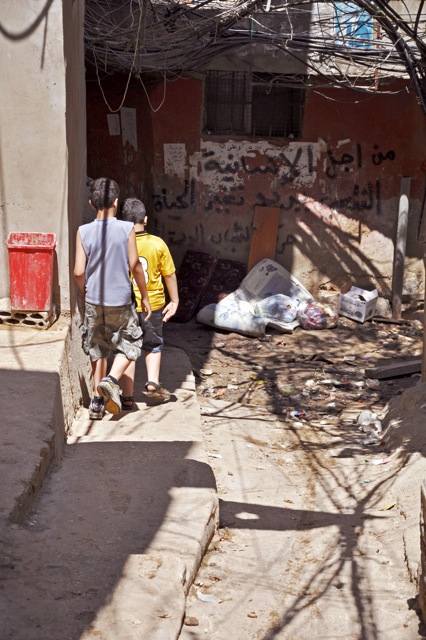
At seven years old Abu Afif was told he was going on a little vacation and that he would return to Palestine after 10 days, while things settled between Israel and Palestine. Almost sixty years later, Abu Afif, like millions of other Palestinians, still hasn’t returned and lives in Burj Barajneh, one of several Palestinian refugee camps in Lebanon. Three of the main countries the Palestinian Diaspora spread to were Syria, Jordan and Lebanon. In Lebanon, there are 12 refugee camps that house thousands of Palestinians each, building their own societies within a larger Lebanese society.


Burj Barajneh was the camp I stayed in for two weeks this summer. We drove
into the only road in the camp. As I got out, walked to my temporary “home,” I had to zigzag my way through numerous alleys that flowed with sewage and waste. Trying to look up to the sky, there was nothing to see. All I saw were countless electric wires.


Like Mexicans in the US, Palestinians in Lebanon suffer from minimum wage. Palestinians cannot usually find jobs outside the refugee camps. However, if they do, it’s probably a low-wage job like a painter, carpenter and so on. Many refugees graduate from medicine, engineering and other majors. But later, they unfortunately find it very difficult to work in their field. If they can’t find a way out of the country to somewhere where they could actually do their job, they end up opening a small business in the camp itself for very low incomes, or they divert into another direction in life.


Due to their economic, social and political background, Palestinians have created a new culture that will allow them to adjust their way of life to this subculture that they have created. The term subculture in sociology basically means a smaller group contained within a larger culture, so a world within a world. Palestinians have established and try to maintain their identity and culture within a complete different culture, the Lebanese culture.


Palestinians in Lebanon also suffer from an identity crisis. Like many other Palestinians around the world, they don’t really have a culture and try to adapt to what they hear about the Palestinian culture. The only home they really had was taken away and the “home” they currently live in can’t really be considered a home because it could be taken away from them at any time.