Monday, April 8, 2013
Fashion & feminism
Friday, March 29, 2013
Feminism phobia
Feminism has been portrayed in movies through the representation of powerful, smart women who are capable of defeating “evil” male figures. This representation made me assume for a long time that feminism truly stands for strong, independent women. The female characters in these movies could be described by two definitions: The Bond girl or the Single girl. According to Hilary Radner in her book Neo-Feminist Cinema, “The Bond Girl represents a change in the women’s position…the single girl, unlike the Bond girl, was not by nature exceptional. Rather, she was an ordinary girl who strove successfully to become exceptional.” Although problematic to some extent, those representations of women in movies reflect a side of feminism that does not seem to form a big problem considering that it is breaking gender stereotypes. So what is the problem with feminism?
In my opinion the problem stimulated from the fact that feminism now encourages the notion of gaining power through appearance and consumption. This is what Radner defined in her book as neo-feminism. According to Radner, “Neo-feminism refers to the tendency in feminine culture to evoke choice and the development of individual agency as the defining tenets of feminine identity.” An example of such form of feminism is presented in movies such as Sex and the City 2. The representation of women in such movies emphasize the importance of their appearance and the power they have through making the right decision in purchasing products (mostly fashion brands). If feminism was only concerned with empowering women and achieving equality, then why is popular culture using feminist movements to advocate for passivity through product consumption?
What we're left with are two forms of feminism: The tomboyish representation of women that is defined as the Bond girl or Single girl, and the autonomous female that has control over her appearance and is defined by the neo-feminism movement. The question is, does either of them represent what feminism really stands for?
Saturday, March 16, 2013
Representation of Gender in Egyptian Cinema
The film tells us the story of Laila, a smart and enthusiastic young woman who struggles with the patriarchal society she lives in where the traditions are imposed on women in order to please men. In the first scene of the film, Laila challenges the headmistress of her school. When the headmistress says that women’s job is motherhood, while war and struggle is for men only, Laila preaches to the students of her school and says that war doesn’t differentiate between men and women and asks the school to ‘open the doors’. After she leads a demonstration against occupation, Laila returns home and gets beaten up by her father who sees what she did as a scandalous act. Laila’s father has power over her. Throughout the film, Laila is forced to act within the gender roles imposed on her as she gets engaged through an arranged marriage. However, at the end, Laila finally decides to leave her fiancé, run away and jump on the train to Port Said with her lover to join the resistance of the people against the Triple Aggression instead of going to Fayoum with her family.
Finally we see Laila getting the power to control her life, however, this ending shows that Laila’s freedom was still dependent on her lover, Hussein, who’s a male figure and that she could not achieve it on her own. If we look at a more recent example, Taymour w Shafika (2007), we find a lot of the similar notions, empowering women throughout the film and dis-empowering them at the end. Taymour w Shafika is a typical romantic-comedy starring Ahmed El-Sakka and Mona Zaki.
Taymour and Shafika are lovers and best friends who have been neigbors since their childhood. Since the beginning of the film, we see that Taymour has power over Shafika due to his masculinity. His masculinity is enhanced by his buffed up muscles and his job as a security officer.
Shafika gains more and more power as she gets her PhD and becomes the Minister of Environment. Shafika’s power is seen as the problem throughout the film, as Taymour is a conservative, traditional man, who makes Shafika choose between him and her career. After choosing her career, Taymour breaks up with Shafika. By the end of the film, Shafika gets kidnapped after she goes on a business trip to Ukraine, but “luckily” Taymour was on her security team and he rescues her. Shafika realizes that her love for Taymour is worth sacrificing her career and they get married, giving up her power-to as she gives Taymour the power over her.
Thursday, March 7, 2013
Who Run The World (Girls)
In our last Sociology class, we have discussed how families are considered as element of socialization and how gender roles can affect the stability of families and relationships. We also looked closely into the breadwinner system and discussed the elements of changes and continuity regarding the system.
There are two main reasons why successful women remain single, they are either too busy working and achieving their goals or they are seen as "high maintenance" by men. Men are often intimidated by women who are better than them financially and career wise. This whole "Beauty fades, but personality and brains last forever" just doesn't seem to cut it anymore. Of course, many successful men look for women are equally successful and smart in order for them to support themselves in their social and professional circles. There has been many cases where marriages have been ruined due to the wife having a more successful career, and it usually happens when the in-laws or the public interfere and comment on their situation. Most of the middle-eastern men were brought up in a house where the mom was a stay-at-home mom and the father being the breadwinner. However, many of them are pro-feminism and demand equality for women.
![]() |
| What happened to "Behind every successful man is a woman"? |
![]() |
| One thing about Middle-Eastern men, they will never let you pay the bill just because they're men. |
Why are women still single then? Frankly, because some of them choose to be. What bothers in me in our society is how people contradict themselves when it's a stigma for girls to remain unmarried and for men to marry girls who are more successful (or the breadwinner) in the family. Successful, ambitious and more educated girls are then forced to stay single because they haven't found an equivalent companion.
Even though feminism is perceived as a western ideology, many westerners are highly against it simply because they're men.
![]() |
| Shame! |
![]() |
| BIGGER SHAME!! |
Thursday, February 28, 2013
Feminism in The Hunger Games
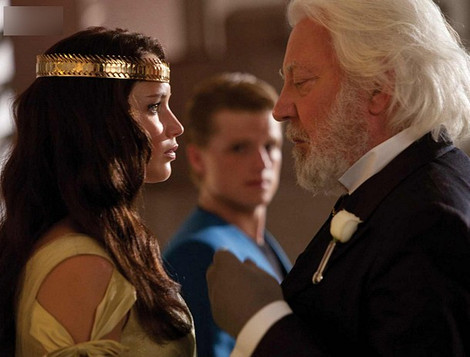
In 2011, Suzanne Collin’s The Hunger Games become quickly worldwide Young Adult literature best seller. The story revolves around Katniss Everdeen, a sixteen-year-old girl that takes her younger sister’s place to fight in a survival-of-the-fittest tournament in a post-apocalyptic world. She puts herself in danger in order to protect her family, sacrifices for her district and tricks the capitol (the game leaders) through the means of her wit and intelligence. Eventually, she survives the game that forces twenty-four children to fight to their death, along with Peeta, the romantic interest who is described as far weaker than her.
Saturday, April 14, 2012
Masculinity and cinema

In the 1980s, masculinity was defined and portrayed in movie as characters being physically strong – having muscles. Expressing feelings and being emotional was strictly unacceptable. It was almost a taboo for a man to express himself in public, especially with the presence of women. These values are represented in the tough, decisive, hard, competent person of Arnold Schwarzenegger, one of the most famous starts in the film, business and political industry. Schwarzenegger was the typical masculine man.

However, in the late 1980s, a new form of masculinity emerged in film¬ – a hybrid masculinity. It was referred to as hybrid because it comprised elements of both masculinity and feminism. This new form allowed men to display “sensitivity” and emotionality” in public, while at the same time not giving up on being tough and decisive. Nowadays, hybrid masculinity is no longer a new form. It became sort of the norm in many movies. The film Fireflies in the Garden is a good example. In this film, we see Michael Taylor (Ryan Reynolds), the lead actor, being able to express his feelings and show them without putting his masculinity into question. In one of the scenes we see him crying, which was considered a symbol of weakness that is usually associated with female feelings for so long.
A scene of a male crying over a woman or over an issue in his life no longer strikes the audience as culturally shocking or unacceptable.


Displaying emotions became acceptable not only in movies but in politics as well.
Thursday, March 22, 2012
Down With Love: Feminism or Neo-feminism
Down With Love (2003), a romantic comedy set in early 1960’s can be described as a perfect example to establish the feminist movement that emerged in the 60’s. All the components of the ‘second wave’ feminism are portrayed in this film. According to the story, Barbra Novak (Renée Zellweger), an feminist writer wants to publish her new work “Down with Love”, basically a book that is capable of freeing all women and empower themselves by teaching them how to be able to ‘enjoy sex without a commitment’. The entire purpose of the book is to create a feminist world in order to boost the morale of women in workspace and in community in general. This concept of the movie is similar to the idea of the second wave feminism being a sexual revolution for women.

However, according to the plot, the message of feminism tends to fluctuate back and forth between second-wave and post-feminism, which is more accurately named as neo-feminism. Because Barbra Novak exploits her sexuality in order to obtain her goal of empowering women as well as expose the real identity of her arch rival Catcher Block (Ewan McGregor). She turns out to be a very manipulative character, and besides that she also deviates form her own principles (from the one’s she mentions in her book) in order obtain her goal. Thus establishing the post-feminist notion of “sexuality is a source of power”.
Tuesday, March 6, 2012
The Witch is on her Broom: A sociological analysis of the first 5 minutes of a movie
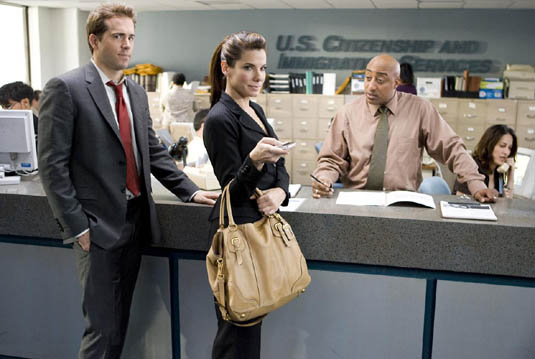
A dramatic change sweeps across the entire office as the words pop up on the computer screens of each cubicle. In a blink, the dormancy of a relaxed office atmosphere shifts to a tensed frenzy as the weightage of the words dawn on the employees of Margaret’s Book Publishing company.
Enter the boss.
Her glossy chestnut-brown hair is tied in a neat ponytail that bobs up and down as she tic-tocs (surprisingly gracefully) on killer heels. The dress is classy, albeit the tad-too-deep V-shaped neck of the blouse. Her most striking feature though is definitely the shapely supermodel like figure. Add to that alert eyes and a hard mouth and voila, you have Margaret Tate-- “the cold, chillingly mean, emotionless boss, incapable of maintaining any relationships.”
The employees, meanwhile, are hurriedly cleaning up their act.
They have all been alerted by the instantly messaged code word for when the boss is on her way to the building: “The witch is on her broom.”
Someone dumps the doughnut with a gasp and hastily picks up the telephone receiver. Someone else cries, “Shhhoot!” and scurries to the cubicle. Magazines are hurriedly put aside and suddenly water-cooler-breaks are up.
The movie being discussed is the 2009 romantic comedy, The Proposal, starring Sandra Bullock and Ryan Reynolds. With a total earning of over $317.5 million, The Proposal was the highest grossing romantic comedy of the year.
Following is the movie’s one-line description on ibmd.com: A pushy boss forces her young assistant to marry her in order to keep her Visa status in the U.S. and avoid deportation to Canada.

And this is where cinematic sociology can be used as an effective tool to explain the portrayal of empowered women in Hollywood movies.
The kind of power symbolized by Margaret (Sandra Bullock) in The Proposal may well be explained by the Weberian “power-over” definition of power. Simply put, it explains power in terms of the ability of individuals to further their will and attain their goals. This form of power “with perhaps the longest history in sociology, philosophy and psychology” was described by Weber as “the chance of a man or a number of men to realize their own will in a communal action, even against the resistance of others...” (Cinematic Sociology, Jean-Anne Sutherland, What is Power? p 115)
According to Amy Allen, author of The Power of Feminist Theory, this conceptualization takes the form of "a dyadic, master/ subject relation… a kind of masculinized power” (Cinematic Sociology, Jean-Anne Sutherland, What is Power? p 115).
The typical “pushy” boss, who embodies a certain masculine- feminity, wrongly exploits her co-worker by coercing him into marriage, just so she is spared deportation. Also, alongside being depicted as a headstrong young woman who has the world on her fingertips, Margaret Tate has also been considerably physically sexualized (remember the dress, the figure and the heels?).
Cold, callous yet stunning: these are the defining characteristics of womanly roles that demonstrate a “power-over,“ one of the three types of the most prominent literary definition of power.
And in case of The Proposal, it takes barely the first 5 minutes to conclude the category of power that the movie is based on.
Although Margaret is “a woman with power, it looks like the masculine version of a power-over that we have grown accustomed to, perhaps the only kind of power we recognize as power” (Cinematic Sociology, Jean-Anne Sutherland, What is Power? p 120).
Consecutively, the “masculine woman” dominates, oppresses and exploits. All this to the extent that her assistant Andrew drinks "the same coffee as you do, just incase yours spilled.” (She had cast aside the comment as “pathetic,” with a role of her eyes.)
This kind of power portrayal, however, is the exact opposite of the way feminists would like it portrayed-- their goal is certainly “not to transfer domination and oppression (and masculinity) into the hands of women” (Cinematic Sociology, Jean-Anne Sutherland, What is Power? p 116).
Nonetheless, what with movies like The Devil Wears Prada, No Reservations and Lara Croft: Tomb Raider to name a few, the power-over conceptualization continues to remain a popular theme for popcorn flicks.
Monday, December 12, 2011
Inequality between genders

In our society, there has always been a physical difference between both sexes. Therefor it has been a common subject where there are some big inequalities between genders. Just the idea of creating two groups of gender: men and women show the origin of this inequality. Moreover, due to the idea of a physical difference between genders it has created in our society a form of sexism. Where it is believed that man is superior to women, but it’s only a cliché just because it is based on “the physical capacity” of that gender. Somehow this idea has evolved and created many differences and inequalities in our society. There are a lot of discrimination concerning the rights of the women, the salary differences and so on….
Due to the sexism a new movement has been created to that may be considered as a deviance, but it‘s only created to give back the right that the women need. This movement is called feminism where women want to be looked in the same way as the men. They do not want any more discrimination and need to have the same status and work equally with men. Also by threaten the woman the same way as the men it will help the society and economy to grow further and be healthier. The following video is a good explanation of the inequality that is happening in our society.
Saturday, December 10, 2011
Women Rights
In our Sociology class we learned about feminism.Feminism is a collection of movements aimed at defining, establishing, and defending equal political, economic, and social rights and equal opportunities for women.Feminist theory, emerging from these feminist movements, aims to understand the nature of gender inequality by examining women's social roles and lived experience, developing theories in a variety of disciplines in order to respond to issues such as the social construction of sex and gender.
What I am writing today will be from my own point of view. I will be including religions “Islam” point of view as well. I will be talking about women rights in Islam.
We all agree that women and men are both human, but does society think that they should be given equal rights? That sounds reasonable since they are all humans.
In another sense women are very different from men in their physical, mental, and emotional nature.
If equality between people of the same gender is impossible because of the differences of skills and abilities, so how can we request equality for very different genders?
Women and men are equal in religious obligations. Both are required to testimony of faith, prayer, fasting, obligatory charity, and pilgrimage. In certain conditions it is easier for women since they go through physical changes during the monthly period they are excused from prayers and fasting.
Men and women are both equal in the financial and property ownership. In Islam women can go in to business selling, buying, owning, with no need of guard ship and with no restrictions or limitations.Sometimes the society itself creates some rules, which put women whom go in to certain types of businesses in a category that are considered deviant.
In Islam Men and women are equal in the rights of getting education. The Prophet of Allah (Peace be Upon Him) said: Seeking knowledge is compulsory for each and every Muslim (i.e. both male and female).
[Ibn Majah #224 al-Baihaqi and verified]
The Prophet of Allah (Peace be Upon Him) said: The most complete believer is the best in character, and the best of you is the best to his womenfolk.
[Tirmidhi #1162 and verified]
In Islam they have equal punishments and rewards as Allah said in the Quran: (Whoever does righteous acts, whether male or female, while he is a believer, verily, to him we will give a good life, and We shall pay them certainly a reward in proportion to the best of what they used to do.)
[16:97]
There are much more rights that I didn’t mention that really shows how Islam honors women. To know more about women rights in Islam visit http://www.womeninislam.ws/en/women-right-islam.aspx