Showing posts with label Film. Show all posts

Saturday, March 16, 2013

Representation of Gender in Egyptian Cinema


If we look at films as the reflection of society, then one of the main themes that should be looked at in a nation’s cinema is the representation of gender roles. In the book Cinematic Sociology, Jean-Anne Sutherland tries to define power in regards to women’s empowerment. She divides the notion of power into different types of power. The first type is ‘Power-Over’, which is the classic Weber-ian definition of power. Power-over simply divides power between the powered (master) and the non-powered (subject). The master controls the subject, and in the case of Gender, the man controls the woman as masculinity and manhood are equated to power. There’s also ‘Power-To’ which is the case when one has control over the circumstances of their own life. These power-over and power-to notions that we experience in reality is both portrayed and challenged in films. If we look at Egyptian films specifically, we find that the representation of gender roles has not really changed since the 1960s. Starring Fatin Hamama, Al Bab Al Maftuh (1963) is a melodrama based on a novel with the same title written by Latifa El Zayyat.


The film tells us the story of Laila, a smart and enthusiastic young woman who struggles with the patriarchal society she lives in where the traditions are imposed on women in order to please men. In the first scene of the film, Laila challenges the headmistress of her school. When the headmistress says that women’s job is motherhood, while war and struggle is for men only, Laila preaches to the students of her school and says that war doesn’t differentiate between men and women and asks the school to ‘open the doors’. After she leads a demonstration against occupation, Laila returns home and gets beaten up by her father who sees what she did as a scandalous act. Laila’s father has power over her. Throughout the film, Laila is forced to act within the gender roles imposed on her as she gets engaged through an arranged marriage. However, at the end, Laila finally decides to leave her fiancé, run away and jump on the train to Port Said with her lover to join the resistance of the people against the Triple Aggression instead of going to Fayoum with her family.


Finally we see Laila getting the power to control her life, however, this ending shows that Laila’s freedom was still dependent on her lover, Hussein, who’s a male figure and that she could not achieve it on her own. If we look at a more recent example, Taymour w Shafika (2007), we find a lot of the similar notions, empowering women throughout the film and dis-empowering them at the end. Taymour w Shafika is a typical romantic-comedy starring Ahmed El-Sakka and Mona Zaki.


Taymour and Shafika are lovers and best friends who have been neigbors since their childhood. Since the beginning of the film, we see that Taymour has power over Shafika due to his masculinity. His masculinity is enhanced by his buffed up muscles and his job as a security officer.


Shafika gains more and more power as she gets her PhD and becomes the Minister of Environment. Shafika’s power is seen as the problem throughout the film, as Taymour is a conservative, traditional man, who makes Shafika choose between him and her career. After choosing her career, Taymour breaks up with Shafika. By the end of the film, Shafika gets kidnapped after she goes on a business trip to Ukraine, but “luckily” Taymour was on her security team and he rescues her. Shafika realizes that her love for Taymour is worth sacrificing her career and they get married, giving up her power-to as she gives Taymour the power over her.

Thursday, February 28, 2013

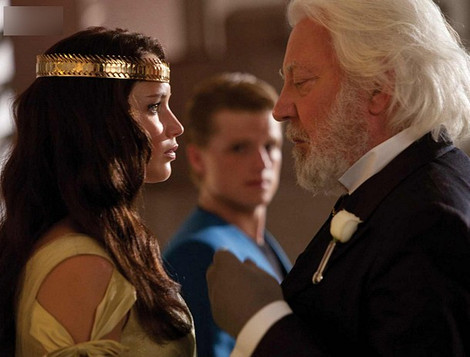
Feminism in The Hunger Games

                     
                       In 2011, Suzanne Collin’s The Hunger Games become quickly worldwide Young Adult literature best seller. The story revolves around Katniss Everdeen, a sixteen-year-old girl that takes her younger sister’s place to fight in a survival-of-the-fittest tournament in a post-apocalyptic world. She puts herself in danger in order to protect her family, sacrifices for her district and tricks the capitol (the game leaders) through the means of her wit and intelligence. Eventually, she survives the game that forces twenty-four children to fight to their death, along with Peeta, the romantic interest who is described as far weaker than her.


                       Someone I immediately thought of when reading the book was Hermione Granger’s character in the Harry Potter series. What is refreshing from Collin’s is that the series main protagonist is female, and stands on her own. Though both characters share similar characteristics of intelligence and loyalty, Katniss’ character defers significantly by the fact that she is strong physically and smarter than even the strongest male characters in the books, in the arena.

   
                        Furthermore, Katniss is a strong contrast of many other female literatary characters, namely Bella Swan from the Twilight Saga. Swan is the epitome of the modern-day damsel in distress, whereas Katniss doesn’t rely on a strong male character to save the day. The trilogy has now turned into a major motion picture, and little has been changed, least of all Katniss’ strong characteristic and her portrayal of the feminine ideal. In a sociological perspective, Katniss can be seen as the feminist character that is fighting Hollywood’s age-old idea of the hegemonic masculine character and ideals constructed of gender roles that have always been in place. Throughout the book, Katniss saves Peeta on more than one occasion and challenges what it means to be a strong female character, or what it means to be a strong main character, that isn’t defined by her gender. Sociologically, the “powered” woman has now transitioned in books and film from the masculine patterns of patriarchy and into individual women coming to terms with their lives. With Katniss, this means a stronger ideal role model for girls and an icon for feminist readers for both the book and the silver screen. “For women, the need and desire to nurture each other is not pathological but redemptive, and it is within that knowledge that our real power is rediscovered,” said Audre Lorde, writer and activist, in an essay.


Photographs courtesy of Lionsgate Entertainment.

Monday, November 12, 2012

From Art to Politics!


Politics or art? This art work was sprayed by Banksy on the apartheid wall in Palestine. Banksy is a street artist. Street artists use different mediums to show their art in the streets. Banksy’s real identity is anonymous. Yesterday, I watched “Exit Through the Gift Shop,” which is a documentary about street art and Banksy. What does the whole movement of street art mean? And why is significant?


The narrator stated, “Street art was poised to become the biggest counter cultural movement since punk.” While the film is supposed to be about Banksy, it ended up being about the person who was planning to make the film. He calls himself Space Invader. He started by taking videos of the street artists. Later, he becomes part of the street art subculture. A subculture is a group of people who share a style, language, type of music, activities and beliefs. He becomes involved in their activities and later performs street art himself. But, what do Space Invader and the street artists have in common?

Space Invader makes his living through selling used clothes. He would buy them cheap and see people paying lots of money to buy a piece from him because it would have a designer name. The street artists are opposed to consumerism and the hegemonic ideology of the people, which prevent them from seeing the things going on around them. The concept of hegemony refers to the way people perceive some things as common sense. Hegemonic ideas are ideas that most of the people believe and see as being the common sense ways to think or behave. The hegemonic ideology of most of people is to consume products and to understand the world in the way it is shown through media. As a shopkeeper, Space Invader has understood how consumerism is stupid. People were paying a lot of money just because of the brand’s name. Street artists and Space Invader share the same belief about consumerism.

Through street art they perform a type of cultural resistance. Stephen Duncombe perceives cultural resistance as “culture that is used, consciously or unconsciously, effectively or not, to resist and/or change the dominant political, economic and/or social structure.” The definition can be seen visually through street art.


(Screenshot from the film)

The sculpture above was made by Banksy. It is a resistance against the social hegemonic idea of respecting a national symbol that does not mean anything. Banksy uses the street art culture to change the way people perceive symbols. Whether Banksy was conscious about the message he is sending or not, and whether his art would be affective or not, doesn’t matter. Either ways, it is considered cultural resistance.

There are four means of cultural resistance, content, form, interpretation and activity. The content of the message is to attract people’s attention to what they are not seeing or noticing about the worlds around them. For example, by drawing on the apartheid wall in Palestine, Banksy attracted the world’s attention to the wall. The form is concerned with the medium of the message. Street art was always in streets and many people did not understand its purpose. The form is a typical street wall, but it took a step forward by appearing in the film. The different mean allowed the street message to be clearer. The interpretation part is related to the society and how they interpret the art. Before I watched the documentary, I interpreted street art as something beautiful, which is ruining public property. Activity is not only the performance of street art, but also the meaning behind it. When they are drawing on public property they are attracting attention to what people are not seeing. An example of this is the street art on street ads. It reflects the street artists’ belief about being opposed to consumerism.


(Screenshot from the film)

Banksy had an art exhibition in Los Angeles. He brought an elephant that was colored with the same colors of the wallpaper. In the documentary the narrator says that the purpose of the camouflage elephant was to show “how easy it is to ignore the things right in front of us.” Then he continues talking about how the people in media saw “what’s right in front of them.” The reporter in the next shot was talking about animals’ rights.
In the Youth Culture in The Middle East class, we discussed how today’s culture could be tomorrow’s commercial object. This is what is happening with the street art culture. The street art found its way to art auctions, where people were doing what the art itself was opposed to; consuming art in the form of a “commodity.” Spending lots of money just because this artist made this piece of art. Banksy himself comments on this issue saying, “It is not about the money.”

I’m a fan of art that appreciates beauty. I understand and relate to Banksy and the street artist’s resistance. I was an art student, and I didn’t like the way people try to tell others how to see art. It is like a project under construction to spread a hegemonic idea of what art should be. It aim is to teach people to ignore the beautiful art in front of them because it doesn’t follow certain rules. It also encourages consumerism and seeing art as a commodity and doing it to please people. Street artists do art because they like it and they have a message behind it. This is why they never reveal their real identities. For them it’s about the art and the message, and not the fame or the money.

Wednesday, April 25, 2012

The Sensitive Man

In a sociology class this month, I decided that I would dive into the world of Woody Allen films. I had just watched Annie Hall and felt like my world was changed and then, I only wanted to watch movies with interesting plots and stories.


So I started with Manhattan and Small Time Crooks and I was more than entertained. My mother, who had no idea that I had been spending my time at college watching movies, told me over the phone once about a new movie named Midnight In Paris I soon found out that Woody Allen had directed it.


The beauty of Woody Allen’s movies is that it has not only taught me a lot about the sensitive man but the women in his movies and what they want. In all the relationships that his character enters into, the women are at first attracted to his sensitivity and quirkiness, but then grow bored of how his life is without any excitement.


Considering that I was already on a roll with all of these movies and my picky mother herself said that the movie was “sweet,” I could not wait until I could watch the movie for myself.
I borrowed the DVD and slipped it into the CD player on my laptop the minute I got to my room. I fell in love with the Paris like I never have before. Images one after the other filled the screen.
Owen Wilson is the new Woody Allen. The awkward manner in which he walked and the way he constantly over analyzed things, was true to the character of the now 77 year old. Throughout the movie, Wilson’s character Gil is a man who is in love with the glorious 1920’s American literature age. His emotions and thoughts are at the center of the movie’s agenda the way a chick flick would be for it’s female lead. Because of people like Gil, women have begun to accept and even embrace a new definition of man. It has become alright that men should be emotional and be able to cry at any moment and movies like this have been crucial to this change in society. I don’t know how I feel about this change. Sometimes I wish men would just own their manhood and be more stable than a woman but then, too many times I’ve wished that men could be a little less brick-like. I guess that’s why the hybrid man was invented by society.

Saturday, April 14, 2012

Masculinity and cinema


In the 1980s, masculinity was defined and portrayed in movie as characters being physically strong – having muscles. Expressing feelings and being emotional was strictly unacceptable. It was almost a taboo for a man to express himself in public, especially with the presence of women. These values are represented in the tough, decisive, hard, competent person of Arnold Schwarzenegger, one of the most famous starts in the film, business and political industry. Schwarzenegger was the typical masculine man.


However, in the late 1980s, a new form of masculinity emerged in film¬ – a hybrid masculinity. It was referred to as hybrid because it comprised elements of both masculinity and feminism. This new form allowed men to display “sensitivity” and emotionality” in public, while at the same time not giving up on being tough and decisive. Nowadays, hybrid masculinity is no longer a new form. It became sort of the norm in many movies. The film Fireflies in the Garden is a good example. In this film, we see Michael Taylor (Ryan Reynolds), the lead actor, being able to express his feelings and show them without putting his masculinity into question. In one of the scenes we see him crying, which was considered a symbol of weakness that is usually associated with female feelings for so long.
A scene of a male crying over a woman or over an issue in his life no longer strikes the audience as culturally shocking or unacceptable.


Displaying emotions became acceptable not only in movies but in politics as well.

Monday, January 30, 2012

Color Of Films


We can list a number of ways how films affect the socialization process for its audience. For example, films tend to set a trend of the current fashion sense, diet patterns, technological conformity with society, etc. Also, in the 21st century, it is wise to assume that film goers definitely have a greater appeal for color films, in addition to the other incredible effects filmmakers tend to use, like 3D technology, special effects, pyro techniques, other graphic effects, etc. But foremost, color is on top that revolutionized the film viewing experience. And now, viewing and making a color film has become a norm in the world of cinema.

Fairly recently, while watching movies, I felt that the filmmaker’s use of color also has a potential for socialization process. These days, it is not very hard to notice that different genres are color-coded. For example, the horror genre is usually has a blue color gradient; romance tends to lean towards vivid colors like yellow and red; apocalyptic genres tend to be more washed out, or have a more grunge and grainy look to them. So, where is the socialization process in this?


Horror (Blue tone): The Sixth Sense (1999), Underworld (2003)


Romance (red or warm tones): Titanic (1997)


Post/Apocalyptic (Washed out tone): Book of Eli (2010), The Road (2009)


As an audience member, after I watch these films, I tend to view reality in that manner, just like any other socialization process. Whenever I think of romance, I feel the need of red, or vivid warm colors in the scene. Hence, I can understand why a candle light meal, or gift a red rose is more appropriate for a date. Another great example, how do all of you picture a post-apocalyptic world? What color scheme pops up in your imagination? Definitely not a green environment, definitely not a plain desert either; but rather, a barren land, with a washed out texture, just like the ones they depict in the movies. In other words, films are not only influencing the ways we act and behave, but also our thought process and imagination.