Showing posts with label art. Show all posts

Tuesday, May 21, 2013

The Essence of Diversity

Last spring, I have been to Washington D.C where I visited my brother whose doing medicine residency in the states. It was a beautiful place filled with many buildings and awesome cuisine.

However, one of the things that had grabbed my attention is how the art and the theme of the place is different than from what I have seen in Doha. In Washington DC, the buildings have this Greek theme that emphasizes the earliest forms of Republicanism. Also the parks are green and filled with many historic-reflective statues such as Abraham Lincoln statue at the National Mall.

Whereas, in Doha, the architecture of the buildings is more headed towards the future. There are these tall buildings with smooth semi-cylindrical shafts that can be found in the west bay districts as well as these glossy zigzag shaped buildings. Also there are so many indoor malls here and there.

I believe that the contrast of such cultural objects that we see in Washington D.C and Doha is important because each symbolize the culture and heritage of the country and its people. If all cultural objects were uniform, there would be no point to traveling to faraway places because there would be no art diversity which makes things seem more vibrant and interesting. Likewise, my trip to Washington D.C would not have been as interesting if I have not been exposed to new and different aspects of infrastructure and building architecture. Of course, the variance of the themes in each region occur because of social forces such as the background of the country, religion, and economy. For instance, the city planners and architectures along with other individuals are basically influenced by such social forces, therefore, implementing different kinds of themes for their respective regions.


Monday, May 20, 2013

The million dollar question


Last week I visited the Art Institute in Chicago, I came across some of the most beautiful paintings I have ever seen. They were a variety of paintings by Claude Monet, Vincent van Gogh, Pablo Picasso and Salvador Dali.


After reading Grazian’s theories about popular culture and what makes objects significantly more popular than others however, my perception of the paintings before taking those theories into consideration was completely different than what it was after I put that theory lens on.

Artists like these are legendary. Their works of art are sold for millions of dollars. A regular person may think that that’s due to the fact that they’re brilliant artists and they produce beautiful paintings. Thinking with a sociological mindset however, I know that that’s not true. A piece of art, any piece of art, is admitted into the pop-culture category based on its perceptions from the consumer. A work of art is considered an object of popular culture once it gets recognition, whether it was positive or negative.

A product is not the work of one person; these paintings are not just works of art from the artist. There's an entire production process that delivers these paintings from the artists canvas to our museums. There's a whole procedure that starts from the person buying that plain white piece, to the artists who paints, to his manager who sells it, to the producer that auctions it off to many different museums, and finally to the museum that displays it for us beautifully under the illuminating lights.

Why are these pieces of art considered magnificent million dollars works, while graffiti is considered vandalism? Graffiti can be beautifully genius sometimes. Who’s to say one is better than the other? Who defined one as professional and the other as amateur? One can put graffiti in a frame and call themselves artists. If only graffiti artists would go that production process.

Why is this considered vandalism?


While this is considered a million dollar piece of art?


What defines an objects status in society isn’t its quality, but its perception by the consumer. All art is a form of expression. They’re all equally culturally significant no matter how ridiculous or obscene one of them is thought to be. But when a certain producer wants to make a sale, they can change the objects image in the consumers’ minds. A splash of paint on a plain white canvas can be sold for ten million dollars, while a message about society or oppression expressed through graffiti is considered "garbage".

Monday, November 12, 2012

From Art to Politics!


Politics or art? This art work was sprayed by Banksy on the apartheid wall in Palestine. Banksy is a street artist. Street artists use different mediums to show their art in the streets. Banksy’s real identity is anonymous. Yesterday, I watched “Exit Through the Gift Shop,” which is a documentary about street art and Banksy. What does the whole movement of street art mean? And why is significant?


The narrator stated, “Street art was poised to become the biggest counter cultural movement since punk.” While the film is supposed to be about Banksy, it ended up being about the person who was planning to make the film. He calls himself Space Invader. He started by taking videos of the street artists. Later, he becomes part of the street art subculture. A subculture is a group of people who share a style, language, type of music, activities and beliefs. He becomes involved in their activities and later performs street art himself. But, what do Space Invader and the street artists have in common?

Space Invader makes his living through selling used clothes. He would buy them cheap and see people paying lots of money to buy a piece from him because it would have a designer name. The street artists are opposed to consumerism and the hegemonic ideology of the people, which prevent them from seeing the things going on around them. The concept of hegemony refers to the way people perceive some things as common sense. Hegemonic ideas are ideas that most of the people believe and see as being the common sense ways to think or behave. The hegemonic ideology of most of people is to consume products and to understand the world in the way it is shown through media. As a shopkeeper, Space Invader has understood how consumerism is stupid. People were paying a lot of money just because of the brand’s name. Street artists and Space Invader share the same belief about consumerism.

Through street art they perform a type of cultural resistance. Stephen Duncombe perceives cultural resistance as “culture that is used, consciously or unconsciously, effectively or not, to resist and/or change the dominant political, economic and/or social structure.” The definition can be seen visually through street art.


(Screenshot from the film)

The sculpture above was made by Banksy. It is a resistance against the social hegemonic idea of respecting a national symbol that does not mean anything. Banksy uses the street art culture to change the way people perceive symbols. Whether Banksy was conscious about the message he is sending or not, and whether his art would be affective or not, doesn’t matter. Either ways, it is considered cultural resistance.

There are four means of cultural resistance, content, form, interpretation and activity. The content of the message is to attract people’s attention to what they are not seeing or noticing about the worlds around them. For example, by drawing on the apartheid wall in Palestine, Banksy attracted the world’s attention to the wall. The form is concerned with the medium of the message. Street art was always in streets and many people did not understand its purpose. The form is a typical street wall, but it took a step forward by appearing in the film. The different mean allowed the street message to be clearer. The interpretation part is related to the society and how they interpret the art. Before I watched the documentary, I interpreted street art as something beautiful, which is ruining public property. Activity is not only the performance of street art, but also the meaning behind it. When they are drawing on public property they are attracting attention to what people are not seeing. An example of this is the street art on street ads. It reflects the street artists’ belief about being opposed to consumerism.


(Screenshot from the film)

Banksy had an art exhibition in Los Angeles. He brought an elephant that was colored with the same colors of the wallpaper. In the documentary the narrator says that the purpose of the camouflage elephant was to show “how easy it is to ignore the things right in front of us.” Then he continues talking about how the people in media saw “what’s right in front of them.” The reporter in the next shot was talking about animals’ rights.
In the Youth Culture in The Middle East class, we discussed how today’s culture could be tomorrow’s commercial object. This is what is happening with the street art culture. The street art found its way to art auctions, where people were doing what the art itself was opposed to; consuming art in the form of a “commodity.” Spending lots of money just because this artist made this piece of art. Banksy himself comments on this issue saying, “It is not about the money.”

I’m a fan of art that appreciates beauty. I understand and relate to Banksy and the street artist’s resistance. I was an art student, and I didn’t like the way people try to tell others how to see art. It is like a project under construction to spread a hegemonic idea of what art should be. It aim is to teach people to ignore the beautiful art in front of them because it doesn’t follow certain rules. It also encourages consumerism and seeing art as a commodity and doing it to please people. Street artists do art because they like it and they have a message behind it. This is why they never reveal their real identities. For them it’s about the art and the message, and not the fame or the money.

Monday, September 17, 2012

Mallawal


Mallawal is a new exhibition. It’s taking place at Al-Riwaq, which is the building next to the Museum of Islamic Art. It opened to public on Wednesday the 12th of September. Mallawal means the thing that belongs to the past.
It exhibits collections of various traditional tools and antiques, such as books, jewelry, pictures, cameras, clothes, paintings, and currencies. The collections belong to private owners. There are also paintings by famous and raising young artists. Qatari organizations such as Uchange, T2heel and Tanween helped in organizing it. Ta2heel and Tanween are also giving workshops for children.


What’s really interesting about this exhibition is that it reflects the Qatari culture and how it has changed as a result of globalization. Mallawal brings the past and the future in one place. This exhibition celebrates the cultural heritage from the past until the modern recently created culture.

But how mallawal is Mallawal?
Mallawal is mallawal enough to make people feel nostalgic. If a sociologist visited this exhibition he or she might see it as a combination of the traditional and created material culture. In my Youth Culture in the Middle East class, we learned that culture is the things that are not natural. Everything at the exhibition is made by humans.
At the coffee shop, they offer Bafki Qatar along with Kristal hot souse.


This is what the recent generation, including mine, grew up eating. It is the manufactured snacks in Qatar and the hot souse made in either California or KSA! It was part of the culture that we did not think about as “culture.”


In this picture we see a vintage Pepsi container. The Arabic label localizes them. These global products were part of the Qatari culture in the past. Children and parents in the 70s used to drink those. I believe these bottles were also part of many other cultures around the world and still are with their modern designs.
The effects of globalization are not influencing other cultures only. We are in a time where these global products are considered part of our heritage.

Because of globalization, not only Qataris would relate to these bottles. Visitors from around the world might feel nostalgic, and think to themselves this is mallawal!


At the gift shop people can find batoolas. Batoola is the traditional face cover. It is what females, in the past, used to wear after getting married. Batoolas are one of the most distinctive elements of the old material culture. The effect of globalization let the batoola tradition fade. However, batoolas are still fashionable in other ways. Now they’re bracelets decorated with stones.

The clash between culture and modernity is still present. The artwork by a raising young Qatari Artist, Abdulaziz Yousif, was not shown in its complete form during the opening of the exhibition. The artwork was labeled as “Not suitable to be shown in front of the Emir.” Abdulaziz Yousif does not think his work is offending.


A picture of the completed artwork

The bull’s head was removed during the opening. In ancient Greece artworks’, bulls symbolize power. Of course, this is another country and another era. However, the youth are not sure why is the painting not suitable to their own culture?
Still, this incident raises questions about how far did globalization affect the nonmaterial culture (values and believes)?
The material culture in Qatar was affected by globalization clearly. However, the Qatari nonmaterial culture is not clearly affected by globalization.

A visitor to the exhibition would feel as if he or she is traveling through time. The exhibition starts at rooms filled with old tools, books and stones and ends with contemporary art paintings. It is a celebration of the culture in the past and the future. Visitors can see the effects of globalization on the material culture through time. Still, those who know about the Abdulaziz’s painting would wonder, how did the nonmaterial change too? Unfortunately, the nonmaterial culture is hard to exhibit!

Sunday, April 15, 2012

Deviant art style?

Wherever you go, unless you go to Japan or Asian country, Anime will be looked down upon. whether it's just Anime, or Anime drawing style(Manga) or just anything related to anime.


But what I'm going to talk about in this post, is the deviance of anime style in the eye of westerners and western artists(mostly, and I'm not saying that all of them look down on anime art, but many do so).

I started to notice this problem when I started to attend university. I do not consider it a big problem, but I don't really feel comfortable when someone look down on anything I do ( since I draw in anime/manga style.) months ago, we had to draw a still life for our drawing class, Alhamdulle-Allah, my drawing was turning out quite well. My teacher noticed that I was doing pretty well so he approached me and asked whether I drew in regular basis or something, and I told him, "I try to draw everyday, I like to draw in anime style." just after I told him that, I felt like his face changed (not in a positive way) so, I just stopped talking after saying that sentence.
Not only that, but I get that negative vibe from some students as well. So I try not to talk about drawing with others unless I thought a person might not give me that vibe.

But since I have online friends from all over the world, I know that this problem is not only here, but it's rather spread. I have found blog posts about people with the same problem. (1-2)
People usually think that manga and anime style is just some people who just copy the Japanese animation and think of it as art, they think that each anime is the same and the style is just a copy of another. (But what if it was a copy? people actually learn many things from copying other works, it can also be called "inspiration", you can always copy but you can never claim that the piece you did is original. Artists back in Florence has been copying Roman architecture and monuments. why? because nothing produced is original, everything is a copy of a copy, of another copy.)
But what did they know? how can they say that all anime style is the same? [see picture below]


Why do some realism/drawing artists/professors think anime art is the 'lazy' style? why is it deviant to them? I seriously cannot comprehend that. I draw anime style, and I know what a person has to do to become better at drawing. First they should learn the anatomy (of almost everything, and how things work and function) and every professional anime artist practice anatomy, very much. Just like any kind of artist. Anime art requires hard work as much as any other form of art. It's certainly not lazy.


The Examples(pictures) above is mostly taken from anime series, but how about I show you anime art with a message and meaning to it?

Yuumei, is an anime artist who tries to convey messages and spread awareness through her art. Such as global warming, divorce, and many other subjects.


To conclude this post, I want to ask once again, why is anime art style considered deviant to many other artists? is it because the stereotype of anime style is the shiny-big-eyed-huge-forehead-cute-girls characters? or is it because it doesn't carry a meaning(which I should consider invalid, seeing Yuumei's art) or is it because people think it doesn't require hard work? does it do any harm to the society(I think not, just in some cases which is individual's fault, not the style) or is it because it's stylized and not realistic? (if that's the case, then why is Picasso considered one of the most well-known artist though his art was not very realistic?) But in the end, everyone has their own definition of 'Art' but they do not have to look down on certain styles with no good reason. 

Thursday, February 16, 2012

Glass Ceiling barriers Can Be Broken!

When sociologists study gender, they focus on male-female differences in behavior and appearance that have been socially created. Sexism has brought many inequalities to women, especially within areas of education, work and politics. By sexism, I mean the belief that one sex- and by extension, one gender- is innately superior to another, justifying unequal treatment of the sexes. The concept of gender stratification becomes evident, as there tends to be unequal access to power, prestige, and property on the basis of sex/gender.


The notion of glass ceiling could be the reason for gender inequality. In this case, glass ceiling is an invisible barrier that keeps women from reaching the highest ranks of jobs or industries. This may be the case with some women, but not with all women, certainly not Mercedes Duerineckx. She is the founder and CEO of the International and well known, Art Wanson Gallery. She has created a luxurious platform for all art expressions, under the trademark of excellence, tradition and exclusivity.


Women tend to face gender discrimination within higher education, but Duerinckx didn’t. She got her Business Administration degree in Tourism.


Duerinckx’s education and Art Wanson Gallery is not her only accomplishment. She has been awarded businesswomen of the year 1992 in Morocco, Founder and CEO in real state industry 1985-1992, and the executive member of Spanish Chamber of Commerce in Tanger.


She said that growing up in a multicultural family has helped her become who she is today. Duerinckx was born in a Spanish family in Morocco and later on moved to Spain and France. In sociological terms, she was raised in a highbrow culture, with a diverse cultural background.

Saturday, November 26, 2011

Deviating the Qatari Culture through Art

Deviance is a form of behavior that violates expected rules and social norms. There are various types of deviance. The major types of deviance include: formal and informal deviance. Formal deviance includes deviance that breaks the law such as robbery and rape. Informal deviance is deviance that violates informal social norms and rules such as swearing and burping.
 
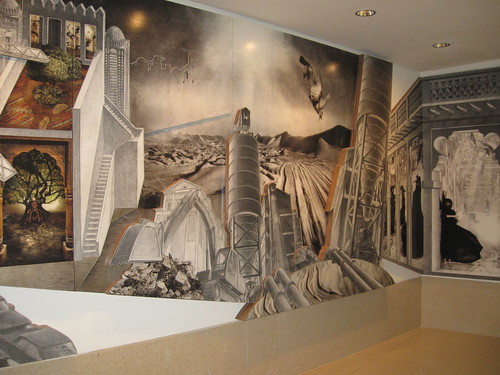
A current example of a deviant behavior occurred within VCUQ premise on November 2011.  The source of this deviant act is an artist from Mexico.  The artist painted a deviant mural painting. Her purpose of the mural painting is to portray cultural transition and women’s empowerment.  She had a good idea but the way in which she portrayed her idea was wrong and deviant.  It was both formally and informally deviant. She painted an explicit painting in public that is socially unacceptable. Such painting has never been drawn in Qatar in public as it conflicts with the Qatari law, social norms and rules as well as our Islamic religion.
 
Qatari citizens or locals have responded to such a deviant act by various methods; they spread the word via messages, they reported to local newspapers’ Al Sharq’, reported to the Dean of VCU as well as higher authorities.
 
Finally, we don’t truly know her true intensions of her painting. By seeking other people’s opinions through informal conversations, many believe that she has done this mural painting in a Muslim country in order to get her name out there and to be included in the list of the controversial artists and gain popularity. Others believe that she was just ignorant. And others believe that it’s a mere misunderstanding; the artist comes from a country where such paintings are acceptable. Deviance could be intentional or unintentional. There are many simple ways to avoid deviance if one wishes; the basic rule is just to be familiar with the host/home’s country’s laws as well as the culture.


Examples of acceptable murals in Qatar:


Example of a mural in Columbus representing women empowerment:


This video shows an Egyptian girl posing naked on facebook and twitter to imply freedom of expression during elections. It caused chaos in Egypt because of the conservative people in the country against liberals. The girl describes it as being "screams against a society of violence, racism, sexism, sexual harassment and hypocrisy."

Friday, February 4, 2011

The Museum of Islamic Art

Just recently, Qatar started to focus more on the aspects of culture and its portrayals. The Museum of Islamic Art is one of the places that offer stories about historical cultures and virtuosity through pieces exhibited. In general, the pieces of art presented in museums differ depending on the time they’ve been created, and they also refer to various religions, civilizations and geographical places. The democratization of museums has changed their function dramatically over the past decades. Anciently, people of high class or the elite were the ones allowed inside the museums, whereas the poor were not allowed to visit museums due to their social status. This misconception has changed, because overtime people began to realize that museums are not about classifications, but free art for everyone to enjoy.


The creation of the Museum of Islamic Art has combined the intelligence of the creativity of the western geometric construction and the originality of the Islamic architect. The museum is distinguished due to its main theme, which is the civilization of the Islamic art. The creator of the museum, I. M. Pei, who is one of the well-known architects in the field, traveled to many countries to study the Islamic civilization in six months. The museum is located on an artificial island based on Pei’s decision in order to avoid having the museum overshadowed by the development of the sea area.


The interior design of the museum is modern compared to its historical concept. The pieces of art are generally paintings, sculptures, vases, carpets, and more. Noticeably, many objects commonly had mesmerizing writing on them, which is known as ‘Calligraphy’. Calligraphy shapes some of the fundamental elements of the Islamic art, where its practice resulted in the creation of different scripts and methods of decorating surfaces or paintings. Furthermore, Arabs are well known for their scientific traditions that they inherited from the ancient Greece, Persia, India and other countries. The presence of science was reflected on many instruments that were engraved with numbers and scientific symbols.


The Museum of Islamic Art was one of Qatar’s first steps towards introducing different and historical cultures. The country is still working on developing its concept of a cultural city through well-established projects such as the cultural village along with new museums.