Tuesday, October 4, 2011

Doors, Doors, Doors!


We usually never pay attention to the way a door is decorated. When focusing on family and staff members in NU-Q (Northwestern University in Qatar), we can get a closer picture of their identity simply by observing their doors. This may sound funny, but we can get a wide range of information about that person just by looking at their office door and its surroundings. Such information includes their role, their achieved status, and their ascribed status.


What do those doors symbolize? After going around looking at the faculty and staff offices of NU-Q, we can see some sort of an emerging social structure. Since the faculty offices are dispersed around the CMU-Q Carnegie Mellon University arc, there is a difference between the first half and the second half of the arc.


One of the halves seems to be livelier than the other, having images of cartoons and posters on doors. Both halves represent professionalism, with articles posted on their doors. It is evident that quotes appear on more than one office. Some professors choose to have their office hours printed on a sheet of paper outside their doors.


As for name tags, each office has one placed on the right hand side of the door. Name tags symbolize achieved status, occupation, and different titles. The cartoons on doors symbolize humor, or can also highlight the professor’s hobby. One of the cartoons is cut out of a newspaper and it is about academia and academic jokes. This indicates his role, which is an academic, and other academics will get this humor. It is a status indicator.


When looking at the other side of the arc, we can see an interesting contrast between both sides. Most of the faculties on this side are journalism professors. One has an evil-eye door hanger. This highlights which culture they are coming from, believing in the evil-eye myth. Student works and photos are also evident, and along with that there are old flyers that have not been removed. In addition, some professors have book covers, ones that they have published, printed and stuck on the doors, also highlighting their social status.


An interesting observation is the use of a Northwestern print doormat. This is only apparent in the offices of both deans, showing that they hold a higher position in the professional hierarchy than the other faculty and staff members, highlighting their status.


Most of the office doors are open with the lights on. This tells a lot, that they are usually present in office and ready for anyone. When doors are closed with the lights on, the professors are usually busy doing something, or they can have their doors closed to avoid noise.


A number of professors have very little information on their doors, if any. They are careful as to what information they expose. In organizations such as Qatar Foundation, they do not give a list of what you can or cannot put on the door. Therefore, they have a free choice.


The student services section is much more vibrant and has a lot going on. Most offices have whiteboards on their doors, as well as paper clocks to indicate what time they will be back in office. Those are there so that students can find them at all times. One difference is a lot of the student affairs staff do not have office hours, which is why they have whiteboards and clocks. Those whiteboards show status and role of the staff member. The academics adviser has the busiest office, being very colorful. To me, I think that her office is the liveliest. She also has this coexist sign that symbolizes diversity and tolerance.


Therefore, we can say that even an office door can give off a lot of information about the person, representing their role and status in society.

Unleashing the Qatari Culture in the Residence Halls

On September, 27th, 2011, one of the female residence halls in Education City in Qatar hosted an event to educate the International students about the Qatari Culture.The CDA’s and the residence hall director arrived before the event to set up all the items which represent the material culture of Qatar. These items included the traditional sofas, Arabic music, local pastries, regional dresses and henna cones.


A total of 16 students made it to the event. Most of the students came from Middle Eastern and Asian countries. However major western influence reflected the way these students dressed and talked. The fact is that Education City, which consist of six American universities, sways the subculture of the students to behave in a more western-oriented manner. They all communicated in English since not everyone from the attendants could speak the Arabic language.


Throughout this social gathering, I noticed many aspects of the non-material culture of the country. For instance, folkways like greeting everyone in the event by kissing on both cheeks were firmly applied. Also, the attendants showed open-mindedness and respect towards each other, which is a value embraced within the Qatari Culture. There were norms like maintaining the cleanliness of the place by disposing all tissues, paper plates, plastic cups after using them. Everyone made sure that they kept the pillows of the traditional sofas in the correct order after sitting on the sofas. The music was played at a modest volume. These examples illustrate how keen the Qataris are about living in a hygienic and organized place.


Back to the material culture, the students indulged in the two large dishes of the freshly baked chicken, meat, spinach and vegetable pastries known as fatayer. The portions were huge and this explains the concept of hospitality and generosity when it comes to dining in the Arabic culture. The students had fun trying out the Women’s traditional dress which corresponds to the beliefs of Islam in the culture as the dress was very conservative. Also throughout the event, the students were excited to get their hands decorated with the complex henna designs as henna in the Qatari culture symbolizes beauty.


Adding to all the energy of the occasion, one of the students turned 19 on the very same day. Matea Malikanovic a freshman at Georgetown University celebrated her birthday among the many students in the event. No one knew that her birthday was on that day so there weren’t any preparation to celebrate the occasion to its full potential. However they did sing her the popular birthday song and exchanged birthday wishes, which showed an example of cultural diffusion. Originally from Bosnia, Malikanovic shares a glimpse of her past, “I was born during the war,” she states. However, the situation has improved immensely since then. Still, she decided to study in Qatar to gain a better understanding of the culture and religions of the Middle East.


Birthday girl


A role is the behavior, obligations, and rights expected of a social status. The role of an Education City student involves committing to your schedule, submitting your assignments on time, participating in class and of course passing exams. Despite the busy academic schedule of most the students at the event, they were all looking forward to relaxing and enjoying their time. In fact, 9 students had exams the next day. Elizabeth Boctor, a Weill Cornell student said “I have no idea what I’m doing here but I know I’m happy.” Similarly, Sarah Omar, from Georgetown University expressed her excitement on attending the event, “We are enjoying free food and seeing people we normally wouldn’t see because of our busy schedules.” This casual get-together permitted the students to step out of their rigorous role and engage in leisure and social activities.

While the event only lasted for two hours, it gave students the chance to renew their motivation for studying and refresh their energy. It also helped inform them about the various aspects of the Qatari culture.

Syriana Indiana

Growing up you meet people from different natures, cultures and ethnicities, people who make you wonder, “What if I grew up with a different background?” Shannon Farhoud is someone I met who definitely strikes many questions. When you first meet Shannon and ask her where she’s from, she can’t provide a one word answer. After it takes her some time to formulate her sentence she usually says, “My dad is Syrian, my mom is Indian Portuguese, and I was born in Canada and grew up in Kuwait.”

Shannon’s parents grew up in very mixed cultures. Her father, who left Syria at the age of 18, to Germany and Austria, eventually moved to Kuwait for work and spoke three different languages, English, Arabic and German. Her mother grew up in India and studied in a British school and later studied in a college in London and finally moved to Kuwait. She spoke English, Hindi and Konkani. Shannon was brought up in a diverse household. This is an obvious form of socialization, which is the process by which people learn the ways of the society in which they live in. As a result of her education, which was mostly in an American school, Shannon can only speak English and Arabic.

Typically, one would identify a Syrian as very pale in complexion, colored eyes with a thick Syrian accent. Shannon has nothing of those attributes. However, Shannon’s natural features indicate that she is more likely to be Indian than Syrian.


Sociologists would definitely look at the religion aspect and see how it affected Shannon’s socialization as she grew up and matured into who she is today. As a baby, Shannon was baptized and lived with a Muslim father and a Christian mother. Growing up, she took Islamic classes in school, but also attended both religious houses. She was taught about both religions and celebrated both. As a child, Shannon was given the choice as to which religion she wanted to affiliate with when she got older. Now, Shannon sees so many similarities between both religions that she doesn’t identify herself as either Muslim or Christian, but practices both religions.

Ten years after Shannon was born her father passed away, which left her living and growing up with the primary agent in Shannon’s nurturing, her mother. Some other primary groups and most important agents that definitely influenced Shannon’s emotions, attitude and behaviors are friends and her school.

Born in 1989, Shannon will be 22 tomorrow and is now a journalism student in Northwestern University in Qatar, who travels the world and is constantly learning about new cultures, religions and backgrounds. Shannon, who could be considered a melting pot of ideas, has a constant shift in culture. We’re living in an increasingly global society; affecting agents are different than the past. Another important agent that plays a big part in Shannon’s life is media. Growing up she watched TV shows in Arabic and English and now, Shannon and her mom share quality time watching Turkish TV shows that are dubbed in Arabic. One of the main reasons why Turkish shows are aired on Arabic TV is because the Turkish and Arabic cultures are very similar and related. From that, one can see how Shannon and her mom not only take in the language, which plays a huge role, but have constant exposure to the Middle Eastern culture.

Socializing in the Wild

According to sociology, socialization is the process by which people develop a sense of self and or social identity, learn about the social groups to which they belong and do not belong. The two main factors that revolve around socialization are nature and nurture, nature referring to ones biological inheritance and nurture referring to ones social environment.

The text talks about the lives of two infant girls, Anna and Isabelle- who were kept in isolation during the first six years of life. Anna was kept in complete isolation and Isabelle was secluded with her deaf- mute mother. Anna died four years after she was found, where as Isabelle survived because of the bond she had with her deaf-mute mother.

This importance of bonding is not just seen in human beings, but is also common among animals as well. This was clearly evident in Harry Harlow’s clinical experiment “Pit of despair” conducted on rhesus macaque monkeys at the University of Wisconsin–Madison in the 1970s. His experiment was conducted on newly born monkeys who were raised in isolation chambers for up to one year. Most of Harlow’s experiment was based on maternal love, in other words the ‘nature of love’. However, being raised in isolation, these monkeys were unable to show appropriate affection to their offspring, they did not know the appropriate ways of interacting socially. They ignored their offspring and some even killed their baby by crushing their head on the floor. His experiment also looks into the forms of affection these monkeys tend to look for in different circumstances, showing how socializing is not only an important factor for human, but works the same way even in the wild.

Sunday, October 2, 2011

Two extremes of music subcultures


In sociology, culture is defined as the way of life of a people. Subcultures are the groups that possess specific traits that set them apart from the main culture. In the music pop culture there are several subcultures to consider. It seems as though each subculture has its own beliefs and norms that they choose to follow.


Whether it’s the way they dress or apply their make-up, they all belong to a subculture that they call their own. The Goth subculture borrowed some of the attributes of the angry punk era, which was stereotyped as people wearing dark clothing, black eyeliner, and white make-up to match the dark quality of the gothic music.


There are several bands that were especially influential on shaping this particular subculture, such as The Cure, The Damned and The Cult. To this day, gothic music remains to be a thriving subculture in many countries around the world. People who belong to this subculture have their own spiritual beliefs, interest in dark poetry and their own sense of style. The Goth music scene is particularly evident in Western Europe, especially in Germany, which holds large festivals that attract tens of thousands of people belonging to the gothic subculture worldwide.


Baby bats” is a term given to those teenagers that are new to the Goth scene. Corporate Goths are those who are older and considered to be more devoted to the Goth subculture and they are more likely to resist giving up their dark lifestyle.


Moving on to another completely different subculture, the hip-hop subculture, there are still certain symbols that are evident in this subculture just as there were symbols associated with the Goth subculture.


Although hip-hop was originally created by the African American youth, its influence has become worldwide due to cultural diffusion. Hip-hop and rap are currently one of the fastest growing music genres in the states.


People belonging to this subculture have a shared language amongst each other, street slang, and dress in a particular way, typically baggy jeans and oversized shirts. Members of this subculture are sometimes parts of gangs, and they associate that with their music by including it in the lyrics or by throwing the gangs hand gestures when they perform. Gang members can also be identified by particular colors that are dominant in their clothing, the way they were their caps and by the hand symbols they do.

Saturday, October 1, 2011

A Bangladeshi Engagement Party: Observing Culture and the Process of Socialization


Qatar Foundation is a perfect representation of the multicultural society that exists here in Doha. According to the QF website, the QF community is made-up of 90 different nationalities. Being exposed to so many different people allows you to interact with, and learn about these cultures that can be found in one oasis. Whether you are a student, staff or faculty member in Education City, your chances of experiencing a taste of culture from all around the world prove to be unique and worthwhile. Here’s an example…


A few weeks ago, I was invited to Rezwan and Samira’s engagement party, friends of mine who were both students in Education City. Rezwan and Samira are both Bangladeshi. They share the same culture, languages, and understanding of the material and non-material culture that they grew up to become accustomed to. Culture has a social context. And my friends to be married, have both undergone a process of socialization in which they have learned and acquired a certain way of life, and a sense of self in the society they live in, in Doha as well as in the social environment of their homeland in Bangladesh. The process through which the Bengali way of life or identity that both Rezwan and Samira have learned, accepted, and taken as his or her own is called internalization. According to the book by Ferrante, through this process of internalization, the norms, values, beliefs and languages are passed on to them by their socializers.


The Bangladeshi people all belong to a group in which they share a distinct identity, interact with each other, and feel a sense of nationality, pride, belonging, and membership. There are different types of groups that act as agents of socialization. And the people who are probably the most influential in terms of passing on the Bangladeshi cultural identity to Rezwan and Samira are family members, especially parents, and elders – people who belong to the primary group, a social group in which members have strong emotional ties.


A Bengali wedding ceremony or any other party prior to a wedding such as an engagement celebration differs greatly from one that my family would host. It was a very interesting and enjoyable experience sitting there amongst his family, and friends (who were not entirely Bengali) watching what went on in this beautiful gathering. A wealth of sociological terms and concepts can be applied to all the elements I observed in the three-hour period I spent at the party. Everywhere I turned, I wanted to shout out one of the theories from class. But I saved it all for the blog, and stuck to “congratulations”.


As soon as I stepped into the party hall upstairs in the Indian restaurant called "Aalishaan", I was surrounded by symbols, material culture and non-material culture. The material culture consists of all the natural or man-made objects with attached meanings, for example the food, the traditional clothing, the festive decorations and gifts. The non-material culture includes the Bengali language, the values (the respect for the elderly, and the behavior towards them), beliefs (pertaining to the Muslim faith) and gestures (greetings, and ways of interaction among the guests and hosts, and celebration activities).


According to Ferrante, socialization involves both nature and nurture. Rezwan and Samira’s genetic make-up, “physical appearance” or biological inheritance, are related to nature. They “look” Bangladeshi, and similarly their Bengali friends, and family, look Bengali too. On the other hand, the social environment I witnessed including their primary group of relatives, close friends and family, and the interactions between them, are all considered the nurture part of socialization, through which Rezwan and Samira live their lives, have social experiences and human interactions. Although their appearances might suggest they are Bangladeshi, there is a reason why some of their relatives for example, do not speak English. Their relatives have not acquired the same education, experiences, and social contact as Samira and Rezwan did. Hence, nature and nurture are both critical to analyzing the process of socialization and either one cannot be ignored.


The ceremony started off with a Qur’an recitation, when all guests remained seated and quiet, followed by a short speech. A significant symbol was used to signify to people that they are expected to be still and quite for the recitation of the Holy Qur’an. That symbol, also used frequently prior to proceeding with a significant act or movement, is the phrase of two words in Arabic “bismullah” meaning, “in the name of God”. As soon as the speaker said those words, everyone sat down, and stopped their conversations, waiting attentively, knowing what to expect afterwards. Another example when this symbol was spoken is before the slicing of the cake.


The cake segment, was one of the one most intriguing and amusing of all the events in the party to me. In Bangladeshi culture, feeding sweets to the bride by all elders, relatives and those involved, is a key part of the ceremony. The glowing bride Samira, had to watch the big mouthfuls being fed to her, piece by piece…and I could see how the poor thing tried so hard to nibble off smaller manageable bits. Everyone wanted to take part in the feeding process, even the bride’s younger brother. Cake was flying at her at a constant speed. Luckily her husband-to-be finally took over, and he and Samira both started feeding their closest relatives in return.


This may be seen as a symbolic gesture between people of group in which the act of feeding cake to each other conveys a meaning of love, blessing, gratitude, respect, good will, and value from one person to another. Other examples of symbols and gestures include the gestures for expression between the mother-in laws to their son and daughter-in-law and the gesture in which Rezwan and Samira’s mothers placed their hands on the bride and grooms heads and hands as to bless them, also saying at times, short versus from the Qur’aan.


Another important part of non-material culture, that is also symbolic in nature, includes presenting the gifts to both the bride and groom from the mother-in-laws. Rezwan’s mother presents Samira with a gold bracelet and ring placing them on her arm and finger. And Samira’s mother presents Rezwan with a new watch, and also places it on his arm. This exchange of gifts is considered part of the engagement process, where both sides present gifts as meaningful tributes. The act of giving the gifts is the non-material culture, and the gifts themselves, can be considered tangible material culture.

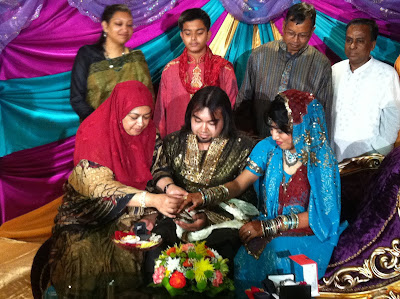


Other tangible material culture includes all the different aspects of the bride and groom’s wardrobe: clothing, accessories, veils, bracelets, necklace, rings, jewellery, and henna.


The food that was served, was Indian cuisine not Bengali. And although there are a lot of similarities between the two in terms of spices and key foods, serving Indian food at a Bengali ceremony could be considered a form of cultural diffusion, in which other cultural items are borrowed from a source outside the Bengali culture.


Finally, all of these shared experiences, gestures, symbols, that are recalled, reproduced, and repeated in this ritual (engagement ceremony) or event are passed on from generation to the next in order to be sustained and preserved. Socialization is impossible without memory. Therefore, the only way through which this preservation and passing on of experiences is possible is through collective memory. Without collective memory, Rezwan and Samira’s families wouldn’t have passed on experiences that shaped the “Bangladeshi” engagement party I attended, groups with particular identities would seize to exist and I wouldn’t have been able to remember any of the things I just wrote about in this blog post!