Showing posts with label Villagio. Show all posts

Saturday, March 30, 2013

Shopping Habits: Women and Men

People’s taste varies from a person to another. It depends on what is your gender. Men usually do not care what to wear as along as it is emphasizing their muscles. On the hand, women likes to wear what can represent them as a sexy cute attractive female that men will keep an eye on. It is a fact that men care about how a woman look compared to her personality. In some books that I read, 80% of men’s attraction to women is based on their looks and 20% is based on their personalities. In contrast, women 80% care about the personality and 20% about the looks. In general, women like to go shopping to look good and keep on track on the fashion revolution that is occurring. Women are usually accompanied with their men or their girlfriends. In the Qatari Society, women here go to shop alone, leaving men at work or home.

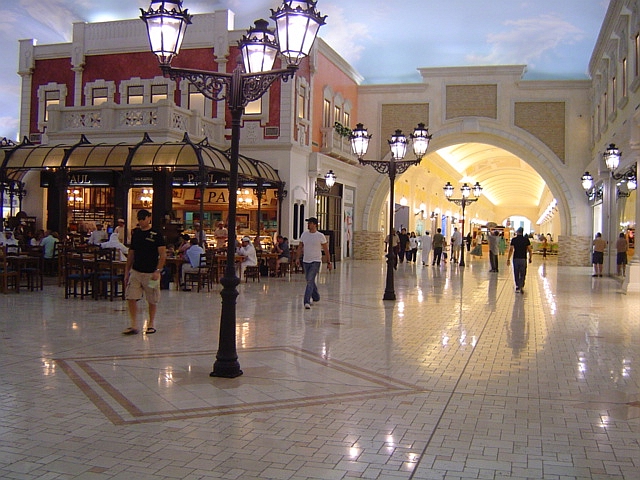
I went to Villagio Mall yesterday to observe the sociological pattern of how people go shopping and with whom. I found a lot of interesting facts that I have not known before. Qatari women in Qatar go shopping alone, or with kids and girlfriends. Qatari men do not interact with the shopping process and buying clothes. It is the mother’s mission to buy clothes for herself or the kids. However, non-Qatari people from different nationalities go shopping with anyone they find available. Asians, other Arabs, White, Black and people from different ethnicities go with their wives. Social class has nothing to do with people who go shopping. It is all about the mentality. Qatari men buy their own clothes without the help of women. They have their own tailor.

In Sociology, this discrimination, if I may call it, varies from a society to another. I just wanted to experiment the concept of gender socialization. I found out the norms here. It is interesting that only non-Qatari men interact with women to buy clothes and different stuff for the house. What was not clear to me is that even it was a Friday night, not a lot of children were there. This is made it a bit harder for me to observe another pattern which is the shopping for kids. Who does it? And with who? Overall, I found what I want, and it was interesting to learn these things about the Qatari society.


Saturday, February 16, 2013

Lagoona Mall: Move up?!


Every time I see the Lagoona Mall slogan “Move Up”, I know they are talking about social class; the photo itself has a photo of a regular girl who is transformed into a model. The Land Mark Mall started out by targeting the upper classes to shop by creating this European environment in the building. Soon, when Villagio came with its Italian Design, it stole these customers because of the variety of shops, and the more expensive shops in a section called “The VIP section”. Lagoona’s number one attraction “Sugar and Spice” is a great example of Conspicuous consumption, where people in the upper class can show their social status through sitting in a coffee shop.


In Doha, malls are not only a destination to shop, but to eat, hangout, or even watch a movie. Malls owners want customers to spend as much time as possible to dry their money out of their pockets on products, and services. In fact, the rent varies on how much time people spend in a section of the mall. For example, the coffee shop next to the cinema has probably high rent rate because the place there is always crowded. Paul, in Villagio, has a good location everyone sees it as they are going to the cinema, or Carrefoure.

Malls actually speak about your personality in Qatar. You are most probably going to see the same faces every time you go to a mall. “City Centre” aims at the variety, they want as many as possible from all social classes. So does “Villagio”, but they also want more of the upper classes, as you can see by their VIP Section.

For the past couple of years, West Bay (excluding City Centre) has become a very common attraction to the upper classes because they want to drink a cup of coffee that costs 200 riyals ($53), or because they want to have a dinner for two that costs 1000 riyals ($260). I’m not exaggerating the prices, but try and go to the Pearl and have a meal there. Even though the meals are not worth it, but the upper classes love them because it shows that they are from a high social status in the society, and their highbrow activities.


Today in Qatar, the highbrow (upper social class) activities are mainly in West Bay, including Katara, the Pearl, Lagoona Mall, or at any hotel in West Bay. Sheeshas (Hookahs) are considered lowbrow culture in Qatar, but the managers were smart enough to open up a couple of expensive restaurants that offer Sheeshas to the elite, and the upper classes who want to enjoy a smoke in West Bay. Look at Sukar Pasha, a very expensive Sheesha lounge in Karara. Wouldn't you consider this as a conspicuous leisure activity?


Now, I can easily judge you about your social class, from the place you smoke in.


The reproduction of social classes


Abduljaleel, 25 years old

I was sitting at the back of my car and my driver was taking me to college when I told him to go pick up my new spectacles from villagio. And so I gave him the receipt and tried to simplify my language with half Arabic and half English to make him understand what I’m trying to say. But I was surprised when he replied with a fine English with a good accent! I was even more surprised when he told me that he completed two years of his college life and couldn’t afford the rest so he dropped off.

Social classes reproduce itself
Abduljaleel’s Father was a Driver and worked so hard for his son not to be a driver and to educate him. But social classes tend to reproduce itself, and social mobility is almost impossible for working class people. It’s as they call it the American dream that social mobility can be achieved by hard work and personal effort. However, social mobility can’t be easily reached, and the idea of that all men are created equal with equal chances is just a dream! Since his father was a driver his future can be expected the day he was born. We can’t predict that he will be a driver as his dad but sociologist will agree that his social status remains as his dad’s, because social classes reproduce itself.

And so he dropped off his American dream!
After two years of college he wasn’t able to afford the rest so he dropped off and became a driver as his father. Social class is not about how hard someone works but rather it is inherited. And because Abduljaleel was born in a lowbrow culture and almost everyone around him was poor and from the same social class mobilization remained just a dream!


Why Social classes reproduce itself?
It is the way that the bourgeoisies (high-class) have set up the society to benefit themselves is preventing the low class people to mobilize upward. The most obvious example is the low wages of the working class people. With low wages none of the working class people is able to afford education or better life. Because if all proletariat (low-class) were able to educate their children and mobilize upward there will be no one left to do the hard work. So bourgeoisies set up the society in a way that they will remain the high-class people.

Friday, April 6, 2012

Shopping and the Gendered Pursuit of Happiness


Once we used to build civilisations. Now we build shopping malls.
-- Author Bill Bryson


Priorities might have shifted in the 21st Century but as a species, we are yet to uncouple ourselves from traditional gendered roles that continue to heavily influence our choices and decisions. This blog aims to exemplify this sociological phenomenon through a quintessential activity of the modern man: shopping.


Gender is undoubtedly the most powerful determinant of how a person views the world and everything in it. And shopping is yet another everyday activity that remains heavily gender influenced.

WOMAN

Rarely does one come across a woman whose eyes don’t light up at the very mention of the word “shopping.”


She is more-than-happy to "meander endlessly through sprawling clothing and accessory collections or detour through the shoe department. She likes to glide up glass escalators past a grand piano, or spray a perfume sample on themselves on their way to, maybe, making a purchase" (Wharton research, retrieved from http://knowledge.wharton.upenn.edu/). She will revel her senses of sight and touch, running her fingers though chiffon silks or tirelessly browsing a mall from end-to-end: pausing, touching, feeling, even for things she knows she will never buy.


MAN

Enter the man-- the counterpart from Mars-- for whom shopping is a whole different ballgame. Plainly speaking, it is a mission of sorts.

Of sacrifices I recall
One stands out clear to me
Like when my wife asks me to come
On one of her shopping sprees


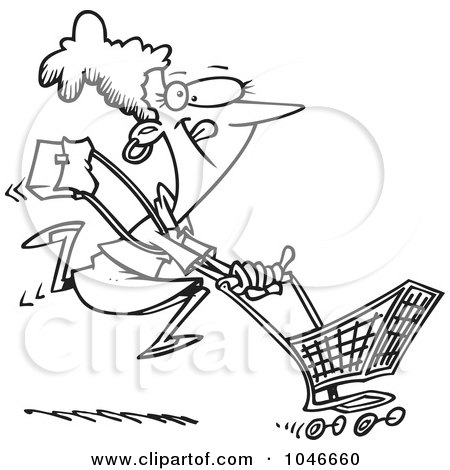
When a man walks in a mall, he knows precisely what he is to buy. The very targeted item makes it into the trolley, after which, without looking left or right, the man “flees the store as quickly as possible.” He knows, for instance, that he needs milk and bread, buys just that, and leaves nonchalantly without a second glance.


A man knows what he wants to get
And buys it on the spot
But a woman must deliberate
Whether she should buy it or not.


A study about supermarket shopping behavior assessed the time taken, basket size and expenditure of male shoppers. Not surprisingly, findings indicated that “men bought fewer items and thus took less time to complete the shopping task." However, unlike what the cartoon suggests, the male’s expenditure was found to be higher per minute because "men seldom comparison-shop" (Gender difference and Store Characteristics Study, 2007).

The study interestingly concluded that most men could easily be categorized in either of the three stereotypical models of male shopping behavior:

Grab and Go:


Whine and Wait:


Fear of the Feminine:


I tag along from store to store
And hope she soon will find
An item that at last she likes
So she’ll make up her mind.

(The poet, obviously, falls in the ‘Whine and Wait’ category!)


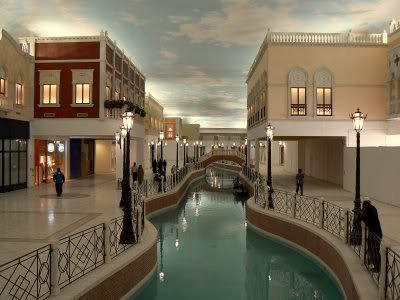
This contrast can be assessed in the way in which the different genders value a shopping experience, say at Doha’s Villagio mall. Sprawled lavishly across hundreds of kilometers of retail space, the bustling mega-shopping center is designed to “transport every buyer to an Italian village by the sea.”


Characterised by “flashy designs, bright lights and abundant variety,” Villagio has inspired consumer appeal by summating the entire planet under one roof (David Grazian, Mix it Up, p177).


For women, it is the sight of these very malls that “turns our fantasy life on.” A wholesome shopping experience, in this case, is sparked by “the multisensory, and emotive aspects of their experience with products” (Hedonic Consumption, retrieved from www.jstor.org/stable/1251707). Further, shopping is considered a mode of inter-personal communication. For example, following is one woman’s description of employees in a favorite store, as part of a research interview:
"The sales associates are always great. They always show me different styles. They will show me something new that's come in."

Meanwhile, a man in the same age bracket (18-35) mused that, "I haven't had much interaction with most sales people. I don't really need them -- as long as they're at the checkout."


Thus, in stark contrast to women, men tend to respond typically to “more utilitarian aspects of the experience -- such as the availability of parking, whether the item they came for is in stock, and the length of the checkout line” (Men Buy, Women Shop, retrieved from http://knowledge.wharton.upenn.edu/)


This trend is amazingly analogous to a contemplation in author John Gray’s book, Men are from Mars, Women are from Venus. Men, believes the author, "are more interested in `objects' and `things' rather then people and feelings," while women “value love, communication, beauty, and relationships.”


Or, it could be that even in a modern hybrid society, we have inadvertently retained a strong bond with our ancestral homo-sapien-ness.

Author of Why we Buy and CEO of an NY consulting firm,Paco Underhill, reasons it thus:

It used to be that men were hunters. If they went into a store they had to kill something and drag it out the door to feel successful. On the other hand, the female of the species was programmed to be a gatherer. She actually got some pleasure from the act of looking and got some reward for being the family purchasing agent. (Living on Earth: Sociology of Shopping, retrieved from http://www.loe.org).


This thought-provoking notion can well justify the following not-too-unheard-of rant:

An old girlfriend once asked me to accompany her window-shopping. Bemused, I did so, unable to believe we wouldn't make at least a few purchases. Instead, we spent the whole day traipsing across town, walking into and around shops, and literally peering into windows for the pure pleasure of browsing the latest fashions.

We bought absolutely nothing, and indeed she was broke at the time and had never intended to. As a male, I considered it the strangest afternoon I had ever spent - going to shops with the express intention of buying nothing.

She, however, was absolutely radiant, having spent an extremely enjoyable afternoon revelling in the shopping experience, unencumbered by the irrelevant annoyance of actually purchasing something.


Underhill justifies such incidences in a woman’s in-built ability to genuinely enjoy a shopping experience. Even if she winds up buying nothing, the time she would have spent looking around the store would have been anything but a mechanical chore.

“As I move through a store," Underhill said in a 2006 interview, "and I’m looking at goods my mind is taking whatever it is and dividing it into the lifestyle that I have versus the lifestyle that I might want to have. This is part of the reason why particularly two women can go to a shopping mall, spend an entire day, buy nothing and have a fabulous time.”

The poet, meanwhile, continues to grumble about his indecisive wife:

I feel I would rather walk the dog
Than plod through stores and shops
With him, at least I have a leash
To cut down on his stops.


(Poem: Of Shops and Dogs, retrieved from http://www.things-to-say.com/humor-clean/shopping.htm)

Saturday, February 18, 2012

How Villagio Cinema pays its bills


Recently, I heard a very interesting fact about Villagio Cinema. Villagio Cinema when it first opened had very reasonable prices, talking more specifically when it came to the food & beverages provided to the public, for example a plate of Nachos cost 15 Riyals.
After couple of months that the cinema was running, everything went up. What do you think the reason was? Trying to make more profit or maybe trying to cover the cost? Well I was told, that the real reason was that the electricity-water bill was too high up, that the cinema had to try to cover it's cost, and also make profit.
Therefore everything went up, from food and drinks. The plate of nachos went up from being 15 QR to 35QR overnight. Now, actually doing the reading, and discussion in class, Qatar is slowly using the factor of going to the cinema as not only cover cost, but also money making. According to our class reading, commercializing or maybe making film market in Qatar is happening slowly. The film empire that is all over the world, is coming to Qatar, and it's there to cover the costs of business in Qatar. Maybe there isn't as much product placement in Qatar, but in the cinema, there is so many different ways to cover costs and make money.
I googled and found that Villagio Cinema has a website, and even the website has advertisements in it. Yet again a way that Villagio Cinema making money, from people wanting to just watch a film. I attached a screen shot from the website showing the advertisements.