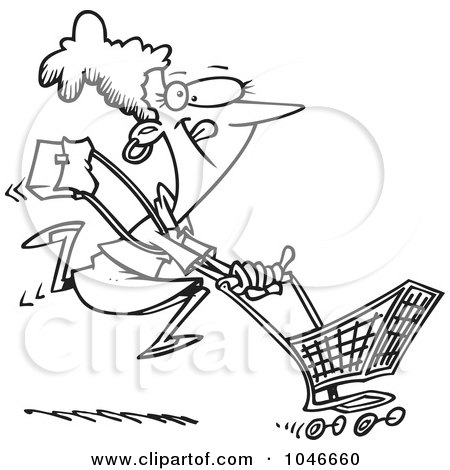
Once we used to build civilisations. Now we build shopping malls.
-- Author
Bill Bryson
Priorities might have shifted in the 21st Century but as a species, we are yet to uncouple ourselves from traditional gendered roles that continue to heavily influence our choices and decisions. This blog aims to exemplify this sociological phenomenon through a quintessential activity of the modern man: shopping.

Gender is undoubtedly the most powerful determinant of how a person views the world and everything in it. And shopping is yet another everyday activity that remains heavily gender influenced.
WOMANRarely does one come across a woman whose eyes don’t light up at the very mention of the word “shopping.”

She is more-than-happy to "meander endlessly through sprawling clothing and accessory collections or detour through the shoe department. She likes to glide up glass escalators past a grand piano, or spray a perfume sample on themselves on their way to, maybe, making a purchase" (Wharton research, retrieved from http://knowledge.wharton.upenn.edu/). She will revel her senses of sight and touch, running her fingers though chiffon silks or tirelessly browsing a mall from end-to-end: pausing, touching, feeling, even for things she knows she will never buy.
 MAN
MAN
Enter the man-- the counterpart from Mars-- for whom shopping is a whole different ballgame. Plainly speaking, it is a mission of sorts.
Of sacrifices I recall
One stands out clear to me
Like when my wife asks me to come
On one of her shopping spreesWhen a man walks in a mall, he knows
precisely what he is to buy. The very targeted item makes it into the trolley, after which, without looking left or right, the man “flees the store as quickly as possible.” He knows, for instance, that he needs milk and bread, buys just that, and leaves nonchalantly without a second glance.

A man knows what he wants to get
And buys it on the spot
But a woman must deliberate
Whether she should buy it or not.
A
study about supermarket shopping behavior assessed the time taken, basket size and expenditure of male shoppers. Not surprisingly, findings indicated that “men bought fewer items and thus took less time to complete the shopping task." However, unlike what the cartoon suggests, the male’s expenditure was found to be higher per minute because "men seldom comparison-shop" (Gender difference and Store Characteristics Study, 2007).
The study interestingly concluded that most men could easily be categorized in either of the three stereotypical models of male shopping behavior:
Grab and Go:

Whine and Wait:

Fear of the Feminine:

I tag along from store to store
And hope she soon will find
An item that at last she likes
So she’ll make up her mind.(The poet, obviously, falls in the ‘Whine and Wait’ category!)

This contrast can be assessed in the way in which the different genders value a shopping experience, say at Doha’s
Villagio mall. Sprawled lavishly across hundreds of kilometers of retail space, the bustling mega-shopping center is designed to “transport every buyer to an Italian village by the sea.”

Characterised by “flashy designs, bright lights and abundant variety,” Villagio has inspired consumer appeal by summating the entire planet under one roof (David Grazian, Mix it Up, p177).

For women, it is the sight of these very malls that “turns our fantasy life on.” A wholesome shopping experience, in this case, is sparked by “the multisensory, and emotive aspects of their experience with products” (Hedonic Consumption, retrieved from www.jstor.org/stable/1251707). Further, shopping is considered a mode of inter-personal communication. For example, following is one woman’s description of employees in a favorite store, as part of a research interview:
"The sales associates are always great. They always show me different styles. They will show me something new that's come in."
Meanwhile, a man in the same age bracket (18-35) mused that, "I haven't had much interaction with most sales people. I don't really need them -- as long as they're at the checkout."

Thus, in stark contrast to women, men tend to respond typically to “more utilitarian aspects of the experience -- such as the availability of parking, whether the item they came for is in stock, and the length of the checkout line” (Men Buy, Women Shop, retrieved from http://knowledge.wharton.upenn.edu/)

This trend is amazingly analogous to a contemplation in author
John Gray’s book,
Men are from Mars, Women are from Venus. Men, believes the author, "are more interested in `objects' and `things' rather then people and feelings," while women “value love, communication, beauty, and relationships.”

Or, it could be that even in a modern hybrid society, we have inadvertently retained a strong bond with our ancestral homo-sapien-ness.
Author of
Why we Buy and CEO of an NY consulting firm,
Paco Underhill, reasons it thus:
It used to be that men were hunters. If they went into a store they had to kill something and drag it out the door to feel successful. On the other hand, the female of the species was programmed to be a gatherer. She actually got some pleasure from the act of looking and got some reward for being the family purchasing agent. (Living on Earth: Sociology of Shopping, retrieved from http://www.loe.org).

This thought-provoking notion can well justify the following not-too-unheard-of rant:
An old girlfriend once asked me to accompany her window-shopping. Bemused, I did so, unable to believe we wouldn't make at least a few purchases. Instead, we spent the whole day traipsing across town, walking into and around shops, and literally peering into windows for the pure pleasure of browsing the latest fashions.
We bought absolutely nothing, and indeed she was broke at the time and had never intended to. As a male, I considered it the strangest afternoon I had ever spent - going to shops with the express intention of buying nothing.
She, however, was absolutely radiant, having spent an extremely enjoyable afternoon revelling in the shopping experience, unencumbered by the irrelevant annoyance of actually purchasing something.Underhill justifies such incidences in a woman’s in-built ability to genuinely enjoy a shopping experience. Even if she winds up buying nothing, the time she would have spent looking around the store would have been anything but a mechanical chore.
“As I move through a store," Underhill said in a 2006
interview, "and I’m looking at goods my mind is taking whatever it is and dividing it into the lifestyle that I have versus the lifestyle that I might want to have. This is part of the reason why particularly two women can go to a shopping mall, spend an entire day, buy nothing and have a fabulous time.”
The poet, meanwhile, continues to grumble about his indecisive wife:
I feel I would rather walk the dog
Than plod through stores and shops
With him, at least I have a leash
To cut down on his stops.(Poem: Of Shops and Dogs, retrieved from http://www.things-to-say.com/humor-clean/shopping.htm)

 Women who get married don’t just sit at home but they also choose to work. The Cinematic Sociology book describes the second shift as the jobs that working wives do to run the household after they finish the workday. We see married Qatari women who work while they still have a husband and a house to take care of. The book described Hochschild’s study where she identified three types of couples. The first types is traditional couples where both the husband and the wife work outside home but the wife is required to come home to do her duties as a mother, which involves cooking, cleaning, laundry, and so on. The husband is only expected to do the traditional male tasks such as fixing something in the house or the car. Usually, married couples in Doha would fall under this category. The man comes home from work, and he expects his food to be prepared, as his wife makes sure that this is something that is taken care of. The second type is called transitional, and it’s when the husband helps his wife with the household stuff. The third type is egalitarian and usually the husband and the wife share the house work together by diving the work with each other, but the woman is expected to do the majority of the work because she’s more organized and more likely to have things done. As they say, behind every great man there is a great woman. Women are the foundation of the house and they have to help and support their husbands in order to maintain a healthy, successful marriage.
The video below shows how Arab women including Qatari women are breaking barriers in the State of Doha.
Women who get married don’t just sit at home but they also choose to work. The Cinematic Sociology book describes the second shift as the jobs that working wives do to run the household after they finish the workday. We see married Qatari women who work while they still have a husband and a house to take care of. The book described Hochschild’s study where she identified three types of couples. The first types is traditional couples where both the husband and the wife work outside home but the wife is required to come home to do her duties as a mother, which involves cooking, cleaning, laundry, and so on. The husband is only expected to do the traditional male tasks such as fixing something in the house or the car. Usually, married couples in Doha would fall under this category. The man comes home from work, and he expects his food to be prepared, as his wife makes sure that this is something that is taken care of. The second type is called transitional, and it’s when the husband helps his wife with the household stuff. The third type is egalitarian and usually the husband and the wife share the house work together by diving the work with each other, but the woman is expected to do the majority of the work because she’s more organized and more likely to have things done. As they say, behind every great man there is a great woman. Women are the foundation of the house and they have to help and support their husbands in order to maintain a healthy, successful marriage.
The video below shows how Arab women including Qatari women are breaking barriers in the State of Doha.