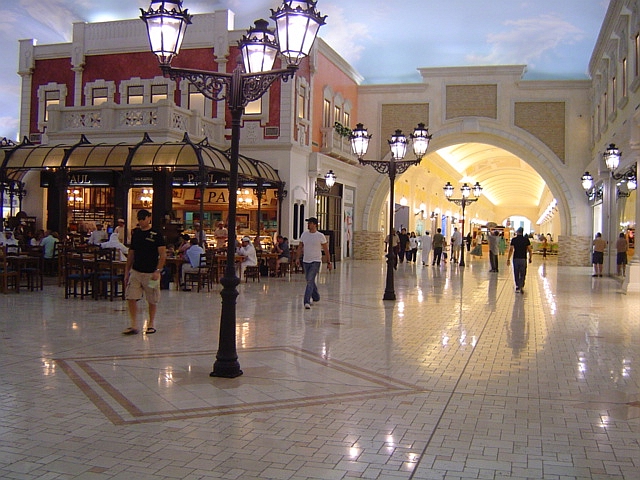
For this active blog, I went on a short trip to the cultural village we all know as Katara. Perhaps the most intriguing question one could ask regarding Katara is the following: Why is Katara considered one of the most popular places to hang out in Doha? This is the question I was bent on answering during my visit.
I drove over to what is probably the most well-known karak shop in Doha, Karak and Chapatti, which is approximately at the center of Katara. It is approximately at the Karak shop where you can pay 15 QR to have value parking, which people use if they cannot find any available parks or perhaps as a public display of wealth. As I was waiting for my order of sweet Chapattis and Karak, which costs around QR 7, over double the typical market price. I looked around me at the groups of people in their cars, some of whom were waiting for their orders just as I was, and others who were enjoying their freshly made Chapattis. What caught my attention immediately was that a large proportion of the total cars around had special plate numbers, and everyone knows that plate numbers are a big thing right now in Doha. A 4-digit plate number could easily sell for QR 100,000(equivalent to USD 36,500). I parked my car and went deeper inside the cultural village. Some of the restaurants that are available include Sukkar Basha, a fancy Lebanese restaurant, Saffron, an exquisite Indian restaurant, and El Wzaar, my all-time favorite seafood restaurant. All restaurants mentioned previously, including the ones that weren’t, are known to be luxurious dine-ins that offer top-notch service and mouth-watering cuisine.


At one end of Katara are the Shawarma and Kenaafa serving restaurants. Although I have never tried the Shawarma they have to offer, I did buy some a couple of times. One shawarma sandwich costs QR 15, which is about triple the price it is offered for in typical shawarma restaurants. Personally, I am not against buying a relatively expensive sandwich, but I do not think that it would taste significantly better than any other shawarma in the market.
To conclude, my observations during my visit to the cultural village known as Katara signal that the majority of what is displayed in Katara, which ranges from people in fancy cars with fancy plate numbers, to luxurious restaurants and priced-up snacks, is conspicuous consumption at its extremes. According to Wikipedia, conspicuous consumption is known as the “spending of money for and the acquiring of luxury goods and services to display economic power.” I am not saying that this behavior is necessarily a bad thing, I am merely acknowledging its natural existence in us as human beings who place emphasis on powerful appearance, and who take delight in enjoying the luxurious commodities life has to offer.
I drove over to what is probably the most well-known karak shop in Doha, Karak and Chapatti, which is approximately at the center of Katara. It is approximately at the Karak shop where you can pay 15 QR to have value parking, which people use if they cannot find any available parks or perhaps as a public display of wealth. As I was waiting for my order of sweet Chapattis and Karak, which costs around QR 7, over double the typical market price. I looked around me at the groups of people in their cars, some of whom were waiting for their orders just as I was, and others who were enjoying their freshly made Chapattis. What caught my attention immediately was that a large proportion of the total cars around had special plate numbers, and everyone knows that plate numbers are a big thing right now in Doha. A 4-digit plate number could easily sell for QR 100,000(equivalent to USD 36,500). I parked my car and went deeper inside the cultural village. Some of the restaurants that are available include Sukkar Basha, a fancy Lebanese restaurant, Saffron, an exquisite Indian restaurant, and El Wzaar, my all-time favorite seafood restaurant. All restaurants mentioned previously, including the ones that weren’t, are known to be luxurious dine-ins that offer top-notch service and mouth-watering cuisine.


At one end of Katara are the Shawarma and Kenaafa serving restaurants. Although I have never tried the Shawarma they have to offer, I did buy some a couple of times. One shawarma sandwich costs QR 15, which is about triple the price it is offered for in typical shawarma restaurants. Personally, I am not against buying a relatively expensive sandwich, but I do not think that it would taste significantly better than any other shawarma in the market.
To conclude, my observations during my visit to the cultural village known as Katara signal that the majority of what is displayed in Katara, which ranges from people in fancy cars with fancy plate numbers, to luxurious restaurants and priced-up snacks, is conspicuous consumption at its extremes. According to Wikipedia, conspicuous consumption is known as the “spending of money for and the acquiring of luxury goods and services to display economic power.” I am not saying that this behavior is necessarily a bad thing, I am merely acknowledging its natural existence in us as human beings who place emphasis on powerful appearance, and who take delight in enjoying the luxurious commodities life has to offer.