Showing posts with label beauty. Show all posts

Sunday, January 27, 2013

Why are women obsessed with becoming thin?


The power of media boosted with the help of technological developments and has been able to shape the society and public opinion. For the past few years, media has been successful in setting their standards of beauty that the public has to unwillingly conform to. The perfect image portrayed of women in magazines, through the use of image manipulation, contributes to the societal and mental image of a beautiful woman. The problem lies in the fact that such images are usually fabrications and set unrealistic expectations.
A stereotype of skinny bodies, flawless faces, pearly teeth, fair skin tones and many more is being reflected on society. What people perceive and compare to their own appearance is strongly related to what the media advocates. Unfortunately, many people will go to extremes in order to be considered ‘normal’ or simply fit in. The media has multiple means by which they are influencing what the society should imitate. Products that are promoted come with a subliminal message that we ought to buy them in order to fulfill our insecurities and feel better about ourselves. They are alienated by society which usually ignites all those problems.


The media has been using subliminal messages to prompt weight loss and advertise products that almost never work. Viewers will still purchase them just so they can meet the beauty standards, which the media has established. Countless people have died as a result of extreme dieting, starving themselves in order to shed the extra pounds. There also have been many incidents of models dying due to anorexia and bulimia, risking their lives just so they can meet the requirements of modeling agencies. This issue is not only associated with models, many girls feel like having an eating disorder is completely normal and required to be able to have the perfect size. Having an eating disorder is being portrayed as normal thanks to celebrities and the way the media interprets it. Likewise it is mirrored on society as we notice many girls becoming victims of bullying because of their appearance.


The obsession with losing weight has also taken its toll on men; they too tend to have low self-esteem and self-image. Whether it was diet pills or extreme diets and workouts, men also have a stereotype that media created.


Media’s influence over public opinion should be used to endorse healthy lifestyles as well as have no specifics when it comes to beauty. Many modeling agencies started up with no special requirements when it came to weight and height. Beauty shouldn’t be limited to a certain type and the society should embrace imperfections and boost positive self-esteem with the help of the media.
   

The question is, Who benefits from creating a certain image for women and beauty that seems to unrealistic?

Because we live in such a capitalist world, where thousands of new products are introduced to the market on a daily basis, advertisements and movies tend to force these things upon society. Movies ares supposed to reflect the society however, they are shaping what everyone should dress, eat, listen to, watch, look, and live like. Those ideologies are transmitted through media outlets in an indirect way, and to our brains they reside and dwell.

I would like to end this entry with a quote from one of the one and only and the eternal goddess, Marilyn Monroe. She also believed that imperfections are beauty.

Monday, April 2, 2012

My Fair Hair

I remember the first time I straightened my hair.
I was at a dinner party with my parents, but as per usual, all the kids were shooed away to the bedrooms. I was probably 11 years old at the time. The 16-year-old whose parents were hosting the party had just straightened her own hair, and the straightener was sitting on the dresser. My poufy mound of curls was an inviting opportunity. After about one hour of stroking my curly locks into pin-straight submission, the operation was complete.

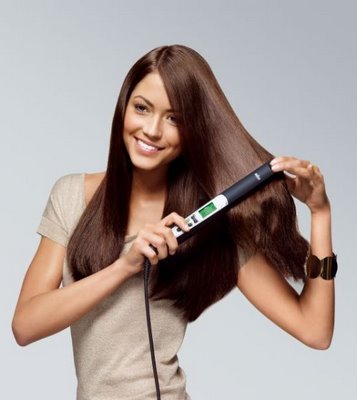
She seems way too happy while straightening her own hair...

I loved the temporary new look. I had long hair back then, so when those curls were extended, my hair reached half way down my back. For an 11-year-old who attended a public elementary school in an upper-middle class suburb, straight hair was a coveted trait in my eyes.
My dad, however, was not keen on the idea. His reaction was priceless. “God created you with curly hair,” he preached. “If he wanted you to have straight hair, you would’ve had straight hair,” he continued, disapprovingly.
Now keep in mind, this was my dad’s philosophy for just about everything from colored nail polish, to eye shadow, to non-neutral shades of lipstick.

An army of lipstick, oh la la.

My mother and my aunts eventually overruled his decrees, and by seventh grade, I got a hair straightener for Christmas.
I think I had developed into a really low-maintenance tone to my morning routine by this point. On occasion, I would pull out the straightener, but I ruled the ponytail for a good two years.
High school provided a whole new set of reasons to straighten my hair. I couldn’t get through the assigned readings of Huckleberry Finn without falling asleep; I really appreciated the book after I was done reading it, but during the long passages on the river, I would read and straighten my hair simultaneously (and fail the quiz the next day… but anyhow).
The straightener, along with my own copy of Huck Finn, was sold in our garage sale before we moved to Qatar.


It’s funny because quite a few people would say how much they wanted my curly hair (my mother included) but I don’t think they understood how much of a hassle I found my own hair to be. There is a scene in Princess Diaries where the hairdresser is trying to brush Mia’s hair, and the brush breaks. That actually happened to me once at a salon in Lebanon (with a comb instead); it wasn’t pretty.

Mia underwent a transformation, but even after it caused her much grief, she kept her new look. hmmmmmmmm...

New country. New school. New haircut. I spent most of last year, and all of this year, with a relatively shorter haircut than what I was accustomed to in the states. It was probably the first time I fully embraced my bouncy locks. I got away from the barrage of US advertisements, TV shows, magazines, and movies that depicted one standard of beauty. I also grew up, and developed my own style, one where my hair wasn’t a source of cultural conflict, but rather a source of opportunity for individuality.
Some combination of boredom and experimentation led me to pick up my sister’s straightener on Saturday afternoon and burn my own hair for a one-time-only look. Aside from my parents and sister, no one in Qatar had ever seen me with perfectly straight hair.
Along with the oooohs and aaaaahs and “it looks really nice” responses, all of which were greatly appreciated, I also got a fair deal of interesting comments. Below is a list of some of the more interesting reactions, in no particular order.
-“You did something to your hair…”
-“Twirl. Work it. Can you whip your hair back and forth?” I did indeed.


-“It’s really different. Nice. But different.”
-“Who is that writing on the whiteboard?” I turn around. “Wow, I didn’t recognize you.”
-“Wow… now you look just like everyone else.”
Something about this comment struck a nerve. I definitely don’t look like the usual me, but how much do I look like everyone else? I may be “back to normal” today, but how far did I stray from the status quo?
And this connection is where all of this ties into sociology. In our discussion on the 10 characteristics of all girly films, a drastic transformation is required. Do I necessarily need to drastically change a fundamental element of my appearance in order to achieve some sort of catharsis? I like my curly hair. I like my straight hair. Movies may place a huge emphasis on drastic physical changes, but in the real world, such matters, at least for me, don’t turn the world upside down. I wouldn’t have it any other way.

Movies teach us that appearance matters… all the time. From the moment a character wakes up, until the moment she goes to sleep. We are supposed to watch movies to see all the pretty people with their four-part ensemble of perfect hair, perfect make-up, perfect clothing, and perfect bodies. We shouldn’t pay to see people who look… well… normal.


Because of the poster above, I still measure my curls by how closely they resemble Meg Ryan's...

If you think of the hair-care industry alone, we go above and beyond the basic necessity of shampoo. We tack on conditioner, gel, mousse, hairspray, chemical burns, hair dye, straighteners, curlers, hair-dryers, and hair-moisturizers.

Half of these belong in some chemistry lab... not on my head

Why? We want the “look” we see glorified on all screens, magazine covers, movie screens, TV shows, our next door neighbor… We are constantly in a race to keep up with whoever Ms. Jones may be.

Surreal

I am fully aware that I knowingly partook in feminine beauty traditions that are repeated in much of the western world on a daily basis. I definitely cannot say that I enjoyed the 40 minutes it took me to straighten every strand of hair. I singed my ear in the process. I did, however, like the temporary results. But that is all they are… temporary. I will probably straighten my hair again, and this, in and of itself, is the reason I can’t fully claim that my sister’s hair straightener is a tool of torture inflicted upon the masses by corporate America’s consumption machine to uphold unreasonable standards of beauty?

Tools of Torture...

I chose to take part in the cycle, and I could just as easily reject it. But, I don’t.

Charlie McDonnel, youtube video creator, used the following words in one of his songs. They are often misattributed to Dr. Seuss but they originated with financier and businessman Bernard Baruch. “Those who matter don’t mind, and those who mind don’t matter.”

Baruch may have been talking about assigned seats at a dinner party, but to me, his words are an anthem for anyone who is worried about hair, weight, image, and overall female sanity.

Friday, October 28, 2011

Society’s Dissatisfaction with Aberrant Beauty!

Every individual is judged by his or her aberrance from the norm of beauty; that’s when sociological imagination appears to explain the nonconforming behavior. Humans act by their nature, and we all are actors who play our role in life. The question of to whom we offer respect is controlled by the social status. Individual achievement that we create and personal choice to present who we are, are the way to define our self, such as graduating, having a respectful job and achieving a dream. We define each other by how we look and by what we do. Everything we do adds to our status in society. Difference must appear so we can define each other. We are born with blue or brown eyes, rich or poor, and with given names. God gives us His blessing by creating us as a human being so the life circle continues.


According to the author, poet, and playwright, Rabindranath Tagore, “Beauty is truth's smile when she beholds her own face in a perfect mirror.” How do we define beauty? In my country perfect skin, wide eyes, tan color skin, and curvy body are defining the main ideal of Arabic beauty. Beauty obsession becomes a large issue that societies suffer from. There are strong pressures on people to be perfect because they want to present who they are in a fake way and accept being treated by the way they look. But yet there is a bright side of this beauty.

Make up, beauty salons, latest trends, jewelry, latest handbags, latest shoes and latest hair cuts are the main material culture, which is a favorite and hot topic these days. When I talk about these topics with my friends, we get excited and a lot of debates start. Qatari culture is really concerned about the appearance. Girls are wearing the latest model of abaya and boys are wearing the bright new Thoub. Male beauty in Qatari culture is taking on greater emphasis, although not as strongly as women’s beauty, but quite fair. Qatari man likes to wear new watches, new sunglasses, new cufflinks, and new soles. Also, they often go to the barber to shave their beard or get a hair cut.


People’s choices of custom and clothing are depending on society to present their cultural tradition and values. Qatar is a nation with high culture, in which there is luxury and splendor because of high income that came from the gas and modernity. With the rising economy Qatar’s modernization included the clothing for both men and women. The cultural values are still in the society. Furthermore, people kept on developing without forgetting their religion and tradition. For example, Qatari women still cover their bodies and they translate the old customs into a new design of body and hair covering. Wearing the abaya is not for religious matters because there are Muslim women who are covering their bodies without the abaya in other countries. However, Qatar society expects Qatari women to wear the abaya in order to be loyal to the country’s tradition.

What happens when thinking of beauty goes too far?
On weddings
At wedding parties Qatari women exaggerate their make up and wear the latest designed dress. Lack of confidence and fear of not getting accepted in the society led the women to spend a fortune on the wedding supplies, such as the latest wedding dress, famous make up artist and hair dresser, which causes a series of problems for men and increases the number of unmarried women because women demand a high dowry to arrange their imagined wedding and men can’t afford it.


“An estimated report presented by Abdul Aziz al-Ansari, the director of the Marriage Bureau located in Doha, stated that nearly 50% of the Qatari women are unmarried…. The biggest hurdle in arranging a partner is due to the high dowry demands by the bride's family” (Himadree, par.2, 4). Women obsess over beauty, exaggerate, and have a strong feeling to be perfect that has led them to never experience the beautiful touchable moments that they will get to when they marry. In role conflict women can take a role by their actions, being mature and balancing their beauty needs. Is it worth it to spend this amount of money? This depends on the goal that they want to achieve.


Religious point of view
In Islam wasting money is forbidden, yet some people do that, and guilt may cause an ongoing series of problems. The ideal society is built on the human relations and their organized interests. Also, it is characterized by its ideas, values and morals, law and systems, which establish boundaries and stop these problems from happening.


Work cited
Himadree, C. “ Spinsterhood Among Qatar Women On The Rise. “The Muslim Woman. 19 July 2006. Web. 23 Oct. 2011.

Sunday, October 9, 2011

McGorgeous

When I think of a beauty salon, the last thing that would come to my mind is McDonald's; however these organizations are actually very similar. Their similarities are not focused on what they offer, but rather how they offer services and products. I've been to beauty salons many times and I never made a connection between them and McDonald's until I learned about McDonaldization. The McDonaldization of society theorizes "the process by which the principles of the fast-food restaurant are coming to dominate more and more sectors of American society as the rest of the world" (Ritzer 1993, p.1). This process of socialization incorporates four fundamental dimensions- efficiency, quantification and calculation, predictability and control. All of these four dimensions have been applied to beauty salons in Qatar. I wanted to find out more about this process and how it has influenced so many organizations, so this weekend I went to a salon to really observe how things got done!


Efficiency: The other day I was at a McDonald's drive-thru and I noticed a board on the wall that said the time taken to place an order and until you receive it is a guaranteed 90 seconds. When people use a drive-thru, they're obviously hungry and want to satisfy themselves in the quickest way possible. Likewise, beauty salons have several employees that tend to customers depending on what they want. For instance, some work on hair, makeup, manicure, pedicures, etc. so that the task can be done as efficiently as possible and to avoid any waiting time. Like consumers in McDonald's that move from hungry to full, customers in a beauty salon transition from feeling ugly to feeling pretty.

Quantification and calculation: Similar to how the prices at McDonalds are standardized in every branch, the prices for each different service in the salon are also set. When you first walk in the salon there is a poster with all the different services customers can choose from and their corresponding prices, just like a McDonald's menu. The prices in all the salons may not all be exactly the same, but they are in the same range. Also some salons offer express services, for example, some promise to perform a mani/pedi in 10 minutes. Customers can also make appointments beforehand so they can come in during a time that is convenient for them without having to wait. Many salons also provide services at home that allow customers to enjoy offers from the comfort of their own house.


Predictability: If you order a big Mac in a mall and then go to a gas station and order the same thing, you will expect and receive the same quality of what you purchased. This is the same for beauty salons. For instance, when I go in for my mani/pedi I expect my fingers and toes to look exactly how I predict them to be. This predictability can be seen in other services and other salons in Qatar and outside. Predictability can also refer to discipline, routine and order and one clear example of this is uniforms. Both McDonald's and beauty salon employees wear uniforms to show exactly here they belong within the organization. For instance, the cashier at the salon would wear a different colored apron than the other employees and the manager of the salon doesn't wear a uniform, just like a McDonald's manager who wears regular clothes.


Control: The food at McDonald's is assembled in a controlled and regulated manner. Each employee has a job that they do in a sequenced chronological order that will help ease the flow of production and delivery of the product. Equally, beauty salons employee numerous people for certain services. For example, if I'm going in to do my hair, my hair would be washed by someone and another person would move over and start working on it. Also what I noticed, beauty salons tend to get busier during the Eid holidays and to control the crowd, customers would be issued numbers and wait for their turn. This keeps things in order and maintains regulated production of the service. Ritzer also discusses the heavy involvement of machinery in Mcdonaldization. For example, in beauty salons everything uses machines, there's even a dryer for your fingers and toes after you apply nail polish. Each step in a beauty process involves a machine and nobody questions what the employees are doing, they only care about the end product. Similar to how the food in McDonald's is assembled to reach a certain quality, the same is done in the form of services for customers in a beauty salon.

McDonald's is recognizable in almost every part of the world with its golden arches which distinguish it. Beauty salons in Qatar are no exception, they are scattered almost everywhere due to their popularity and they have standardized everything from prices, target audience and symbolism. For instance the majority of beauty salons are for females only and they all have the silhouette of a woman to distinguish them. In these two different organization we see how McDonaldization is evident and all four dimensions are applied in beauty salons. We see how this fast food chain has changed, revolutionized and influenced how organizations perform and deliver services and products to customers.