Showing posts with label Nadine Labaki. Show all posts

Sunday, March 18, 2012

Where do we go now

After watching Nadine Labaki’s first film, Caramel, I was excited to watch her new film, Where Do We Go Now. In this film, Nadine plays the role of the main character, Amal. Once again Nadine successfully brings up a sensitive issue that is happening in Lebanon and in a few Arab countries, religious war. The film features a group of women trying to keep their unprivileged village and its people safe from getting killed in the war. In the sequence of events, we see the conflict between people from different religious backgrounds, and as Nadine herself says, “it shows how men can be friends in one day and become enemies the next.” Just because their religious group is having a fight in another village.


Gender role was clear in the film, as we can see how women sacrificed everything to help their husbands and kids to coexist with the other habitants under the religious pressures that everyone went under from time to time.

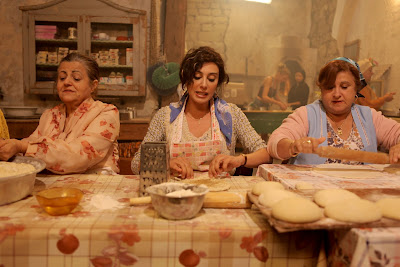
As known and as it is always the case in almost all movies, women are stereotyped to cook. We see that in one of the scenes were all women are gathered in the kitchen preparing pies. We also see that one of the women prepares gel, and her son takes it to the city to sell it, they cook to live. In all the scenes women were shown doing activities that don’t require physical labour, yet necessitate to have moral and spiritual power. We see that when “” hid the death of her youngest son from everyone around her just so she doesn’t become the subject of religious conflict among different legions citizens. Femininity in the film was clearly stated through the physical appearance of women where the only clothing they put on were skirts and dresses. Through the behavior where they keep coming up with tricks in order to keep men out of the religious war happening in other villages, by burning the newspapers and breaking the television.


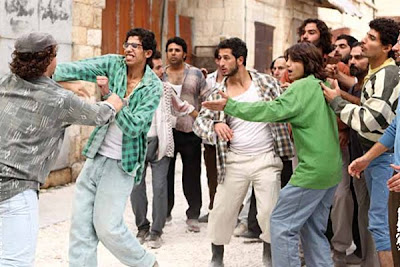
On the other hand men were associated with power in different scenes in the movie. For instance, men did all the work that required physical power such as moving the furniture, carrying sheep on their backs and carrying coffins on their shoulders. Men also have certain jobs to do, for instance, we see Rabee, painting the walls of Amal’s cafeteria. In some scenes men were chilling in the cafeteria drinking tea, smoking and playing cards, which represents men’s behavior during their past time. Men were impatient and easy to lost their temper. Moreover men show power on each other in fights. Showing physical power, having certain behavior and being emotionless sometimes represented masculinity.


Gender socialization was presented in the film in scenes that show the two teenagers, Nassim and Rokas, taking long travels on their bikes to sell products that are made by the village’s women in the city and brining grocery to their family and leaving the house in the early morning to be on time for the opening of the souk. They socialize to behave in a specific way that forces them to grow beyond their young age.


The way each character looked, behaved and expressed their feelings meant to give women femininity, and men masculinity.

Saturday, March 17, 2012

Show me what you wear I'll tell you who you are

Caramel is a 2007 award-winning Lebanese film. The director, Nadine Labaki is also the main actress in the film. According to IMDb, a popular online database of information affiliated with visual media, that Caramel won five awards including the Argentinean Film Critics Association Awards and was nominated for five others.


The film features the daily lives of five different Lebanese women. Layal, Nesrine and Rima work together in a beauty saloon. Jamal, a woman in her forties is a regular customer of the saloon. Throughout the movie, we see her trying to make herself look younger and convincing herself and everyone around her that she could still be a part of the advertisements’ world. The fifth character is Rose, an aged woman who never got married because of her devotion to take care of her mentally disabled sister, Lili. Rose finally gets to find the love of her life and yet she chooses her sister over her happiness once again.


Throughout the film, we see the direct confrontation between tradition and modernization in different scenes. This is manifested in the opening scene where Layal was making (home-made) Sukar (sugar), a traditional means, which is used for waxing. Then, right after that scene, we see that the saloon has a lot of modern equipment.


The choice of music in the film also emphasizes the clash between tradition and modernization. We see Layal driving her car ¬– a symbol of modernization – while listening to traditional, old Lebanese songs. The wedding song Layal and Jamal were singing to Nesrine in the saloon as a way to celebrate her upcoming wedding. In addition, the music that was played during Nesrine’s wedding was consisting of Mawwals – songs that are typically played in traditional Lebanese weddings. The music in all these scenes bring out the role tradition and culture plays in these characters’ daily lives.


The interior design and the décor in the different houses displayed in the film also demonstrate the clash between tradition and modernization. These houses played an important role in giving the audiences specific ideas about the characters. The architecture of Bassam’s house, Nesrine’s husband, was very traditional with the penthouse and the well. On the other hand, Salah’s (Layal’s married boyfriend) house, we see the aquarium and the modern furniture. One can immediately notice that modernization is the emblem of a highbrow culture in Lebanon. How your house looks like or what car you drive are expressive of which class you belong to, the elite, educated class or the traditional middle-class.


Fashion is also a part of this picture of tradition versus modernization. We see the younger characters more associated with modern clothing. Rose and Lili represented the older generation with their old-fashioned skirts and dresses. On the other hand, we see Layal being the most fashionable among the five women. Fashion seem to signify someone’s status in this movie as well – the more modernized clothes; the higher social class. Upper class people are the ones who wear stylish and elegant clothes.


One can see how music, furniture, fashion are used in movies to indicate of the clash between culture and tradition on the one hand and between modernization and westernization on the other hand.