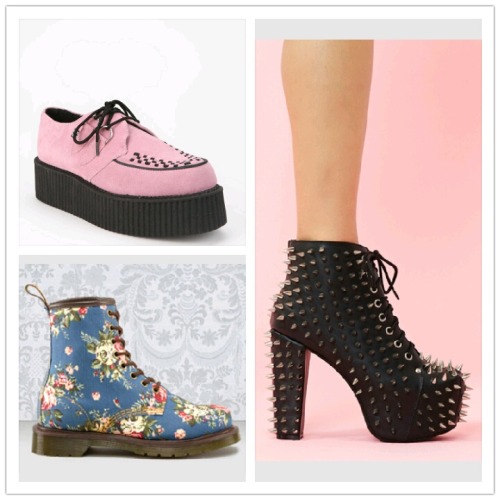
For this blog post, I decided to visit a mall and, using prior knowledge about subcultures in Qatar and building off of what we had discussed in sociology class, see if I could determine if people were part of a subculture from how they were dressing, and to also observe if, and how, mainstream fashion and commercialized commodity play a role in Qatar’s subcultures or the lack of them.
Focusing on Qatari women, it was initially hard to determine if a person was just attempting to express individuality, a shift towards a subculture, or just a slight deviance from the dominant culture. After a lot of slightly creepy staring and observation, I began to determine who might fall where. There were some girls with huge
hipster glasses and dip-dyed hair peeking out from their
sheila, and some with ombre fishtailed braids and galaxy printed leggings in the changing rooms. Others had on
abayas with huge
studs, or studded belts around their abayas, and bags with studs, and bracelets with studs, and shoes with studs and even headbands with studs. To me, these all seemed to be women who were pulled into the commodity form of a subculture, most likely that of the reemerging mainstreamed hipster or
grunge, and not belonging to it at all and probably not knowing the origins of such stylistic choices. However, there was one woman that I saw who stood out (and I apologize that I have no photos of this as the woman was very conservative). One woman who I saw without her abaya, in the changing room of H&M, had on a pair of
creepers, I have never seen them sold here so I doubt they are part of the mainstream culture or fashion in Qatar. She also had a lot of short pink and blue hair and chains, which I had never seen on a Qatari woman before, and, from my knowledge on such things, seemed very punk rock in the way she was talking and carrying herself. When recalling this incident to a friend, she told me “she must have been a boya”.

In such a conservative society, it is hard for many women to express their subcultural interests without being labeled as a boya (a tomboy), or being too weird or different, or bringing shame to the family name. From my time spent observing different people, I noticed that it is very important to look at the dominant culture when discussing or examining youth subcultures. To have a spectacular subculture in Qatar that creates ‘noise’ and interference in the orderly sequence and leads to deviation from the cultural norms would be looked down upon with great distain and would probably be legally impossible. The types of
subcultures that we see out in the open in more liberal countries such as punks, goths, emos, cosplayers, and grunge are all represented externally by a specific style that defines them as being part of that subculture. In Qatar, these representations of subcultures still exist, but are harder to determine as if one is not fully submerged in the style of a subculture and only partaking in minimal attempts to symbolize their choice are they part of the subculture at all? There are few groups of people who consider themselves as punks, emos, goths or grunge, and yet their styles do not reflect that of the general subculture, as in Qatar, to dress in full representation would be socially unacceptable. In Qatar, it seems as though those who wish they belonged to a more stylistically expressive subculture and could publicly display this are out of luck.

The concept of the commodity form comes into play in this context, as most people who wish to represent a subculture in Qatar end up buying into the commercialized and mainstream forms of it and missing the entire concept of being a subculture. Very few people often succeed in remaining original, mostly by creating their own original clothing or adapting the mainstream fashions back to representing their subcultures in a way that is not part of the dominant culture. Dick Hebdige refers to this commodity form in “The Meaning of Style”, The Subcultures Reader, stating, “as soon as the original innovations which signify ‘subculture’ are translated into commodities and made generally available, they become ‘frozen’. Once removed from their private contexts… they become codified, made comprehensible, rendered at once public property and profitable merchandise.”

Another way of examining and defining the stylistic choices of many Qatari women can be to look at it from the ideological form. As mentioned by Hebdige, the ideological form is when the subcultural style becomes more accepted through the labeling and re-defining of deviant behavior by dominant groups such as the media or the police, through various forms of communication technology. In Qatar, the wearing of studs and spikes on almost every visible surface of an
abaya would, in the past, be unheard of and would probably result in many upset mothers, however, now that it is just part of the new mainstream fashion, it seems to be very acceptable. According to Hebdige, “the media, as Stuart Hall has argued, not only record resistance, they ‘situate it within the dominant framework of meanings’ and those young people who choose to inhabit a spectacular youth culture are simultaneously returned, as they are represented on TV and in the newspapers, to the place where common sense would have them fit.” This alludes to the idea that there probably was a group of Qatari girls who did wear spikes in the beginning - for a purpose other than to be cool and fashionable and were probably trying to express their allegiance to a goth or metal subculture.