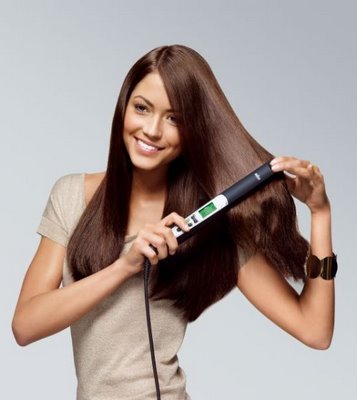
I remember the first time I straightened my hair.
I was at a dinner party with my parents, but as per usual, all the kids were shooed away to the bedrooms. I was probably 11 years old at the time. The 16-year-old whose parents were hosting the party had just straightened her own hair, and the straightener was sitting on the dresser. My poufy mound of curls was an inviting opportunity. After about one hour of stroking my curly locks into pin-straight submission, the operation was complete.
She seems way too happy while straightening her own hair...
I loved the temporary new look. I had long hair back then, so when those curls were extended, my hair reached half way down my back. For an 11-year-old who attended a public elementary school in an
upper-middle class suburb, straight hair was a coveted trait in my eyes.
My dad, however, was not keen on the idea. His reaction was priceless. “God created you with curly hair,” he preached. “If he wanted you to have straight hair, you would’ve had straight hair,” he continued, disapprovingly.
Now keep in mind, this was my dad’s philosophy for just about everything from colored nail polish, to eye shadow, to non-neutral shades of lipstick.
An army of lipstick, oh la la.
My mother and my aunts eventually overruled his decrees, and by seventh grade, I got a hair straightener for Christmas.
I think I had developed into a really low-maintenance tone to my morning routine by this point. On occasion, I would pull out the straightener, but I ruled the ponytail for a good two years.
High school provided a whole new set of reasons to straighten my hair. I couldn’t get through the assigned readings of
Huckleberry Finn without falling asleep; I really appreciated the book after I was
done reading it, but during the long passages on the river, I would read and straighten my hair simultaneously (and fail the quiz the next day… but anyhow).
The straightener, along with my own copy of Huck Finn, was sold in our garage sale before we moved to Qatar.
It’s funny because quite a few people would say how much they wanted my curly hair (my mother included) but I don’t think they understood how much of a hassle I found my own hair to be. There is a scene in
Princess Diaries where the
hairdresser is trying to brush Mia’s hair, and the brush breaks. That actually happened to me once at a salon in Lebanon (with a comb instead); it wasn’t pretty.
Mia underwent a transformation, but even after it caused her much grief, she kept her new look. hmmmmmmmm...
New country. New school. New haircut. I spent most of last year, and all of this year, with a relatively shorter haircut than what I was accustomed to in the states. It was probably the first time I fully embraced my bouncy locks. I got away from the barrage of US advertisements, TV shows, magazines, and movies that depicted one standard of beauty. I also grew up, and developed my own style, one where my hair wasn’t a source of cultural conflict, but rather a source of opportunity for individuality.
Some combination of boredom and experimentation led me to pick up my sister’s straightener on Saturday afternoon and burn my own hair for a one-time-only look. Aside from my parents and sister, no one in Qatar had ever seen me with perfectly straight hair.
Along with the oooohs and aaaaahs and “it looks really nice” responses, all of which were greatly appreciated, I also got a fair deal of interesting comments. Below is a list of some of the more interesting reactions, in no particular order.
-“You did something to your hair…”
-“Twirl. Work it. Can you whip your hair back and forth?” I did indeed.
-“It’s really different. Nice. But different.”
-“Who is that writing on the whiteboard?” I turn around. “Wow, I didn’t recognize you.”
-“Wow… now you look just like everyone else.”
Something about this comment struck a nerve. I definitely don’t look like the usual me, but how much do I look like everyone else? I may be “back to normal” today, but how far did I stray from the status quo?
And this connection is where all of this ties into sociology. In our discussion on the 10 characteristics of all girly films, a drastic transformation is required. Do I necessarily need to drastically change a fundamental element of my appearance in order to achieve some sort of catharsis? I like my curly hair. I like my straight hair. Movies may place a huge emphasis on drastic physical changes, but in the real world, such matters, at least for me, don’t turn the world upside down. I wouldn’t have it any other way.
Movies teach us that appearance matters… all the time. From the moment a character wakes up, until the moment she goes to sleep. We are supposed to watch movies to see all the pretty people with their four-part ensemble of perfect hair, perfect make-up, perfect clothing, and perfect bodies. We shouldn’t pay to see people who look… well… normal.
Because of the poster above, I still measure my curls by how closely they resemble Meg Ryan's...
If you think of the hair-care industry alone, we go above and beyond the basic necessity of shampoo. We tack on conditioner, gel, mousse, hairspray, chemical burns, hair dye, straighteners, curlers, hair-dryers, and hair-moisturizers.
Half of these belong in some chemistry lab... not on my head
Why? We want the “look” we see glorified on all screens, magazine covers, movie screens, TV shows, our next door neighbor… We are constantly in a race to keep up with whoever
Ms. Jones may be.
Surreal
I am fully aware that I knowingly partook in feminine beauty traditions that are repeated in much of the western world on a daily basis. I definitely cannot say that I enjoyed the 40 minutes it took me to straighten every strand of hair. I singed my ear in the process. I did, however, like the temporary results. But that is all they are… temporary. I will probably straighten my hair again, and this, in and of itself, is the reason I can’t fully claim that my sister’s hair straightener is a tool of torture inflicted upon the masses by corporate America’s consumption machine to uphold unreasonable standards of beauty?
Tools of Torture...
I chose to take part in the cycle, and I could just as easily reject it. But, I don’t.
Charlie McDonnel, youtube video creator, used the following words in one of
his songs. They are often
misattributed to Dr. Seuss but they originated with financier and businessman
Bernard Baruch. “Those who matter don’t mind, and those who mind don’t matter.”
Baruch may have been talking about assigned seats at a dinner party, but to me, his words are an anthem for anyone who is worried about hair, weight, image, and overall female sanity.